
We read your photo as:
Enter the above transactions in various ledger accounts and prepare a trial balance.
Accounting
ScanSolve AI Answer
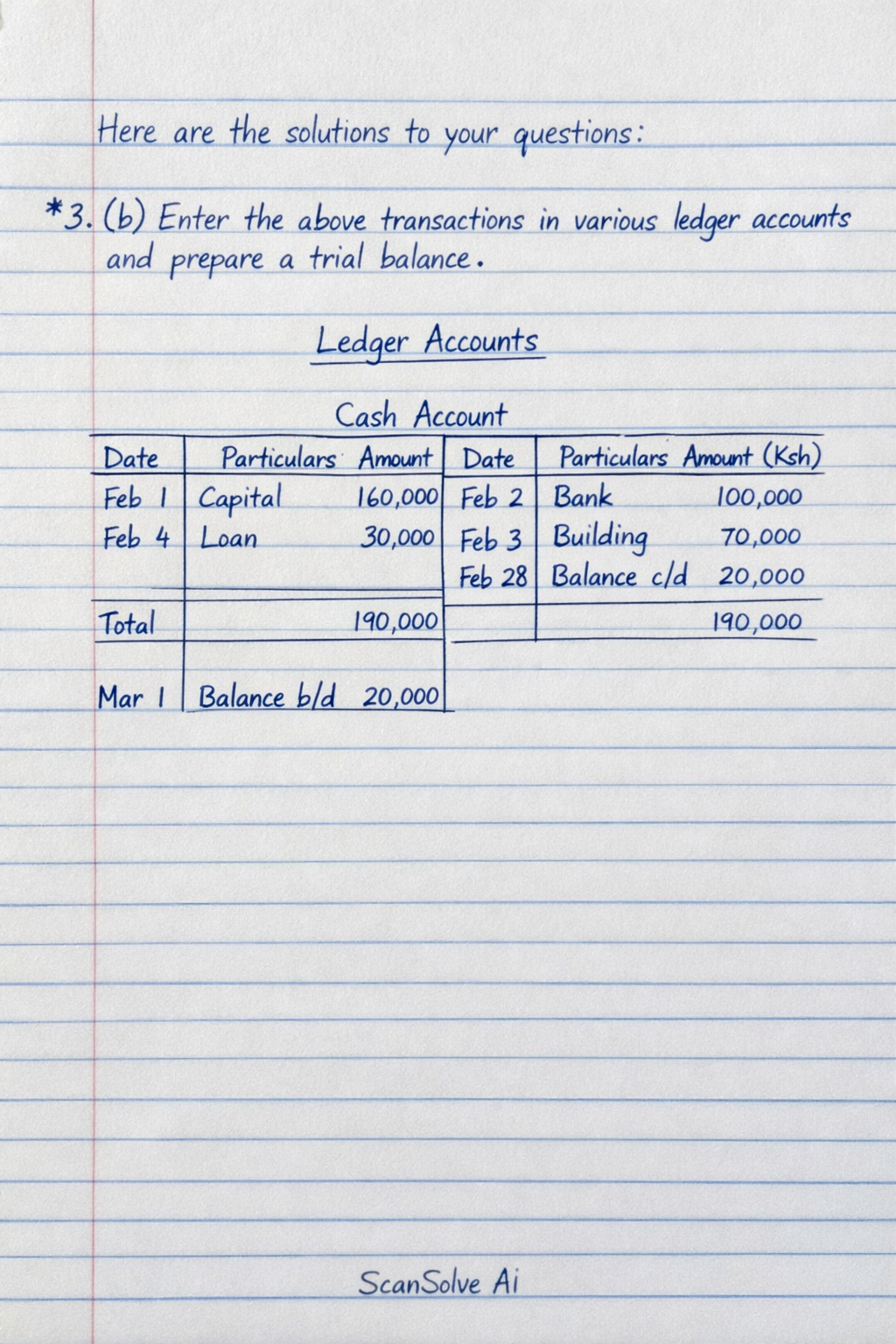
Here are the solutions to your questions:
3. (b) Enter the above transactions in various ledger accounts and prepare a trial balance.
Ledger Accounts
Cash Account
Bank Account
Capital Account
Building Account
Loan Account
Purchases Account
Debtors Account (Accounts Receivable)
Sales Account
Trial Balance as at February 28, 2022
4. (a) Explain five current trends in product promotion.
- Digital Marketing: This involves using online channels such as social media, search engines, email, and websites to promote products and reach target audiences.
- Influencer Marketing: Businesses collaborate with individuals who have a significant following and credibility in a specific niche to endorse or promote their products.
- Content Marketing: This trend focuses on creating and distributing valuable, relevant, and consistent content (like blogs, videos, or infographics) to attract and retain a clearly defined audience.
- Personalization: Promotional messages and offers are tailored to individual customers based on their data, preferences, and past behavior, making promotions more relevant.
- Experiential Marketing: This involves creating immersive and interactive brand experiences, such as pop-up shops, events, or virtual reality experiences, to engage customers directly.
4. (b) Explain five features of money as a medium of exchange.
- Acceptability: Money must be generally accepted by everyone in an economy as a means of payment for goods and services.
- Divisibility: Money should be easily divisible into smaller units without losing its value, allowing for transactions of varying amounts.
- Portability: Money should be easy to carry and transport, making it convenient for people to use in daily transactions.
- Durability: Money must be able to withstand wear and tear from frequent handling and last for a reasonable period without deteriorating.
- Scarcity: Money must be limited in supply to maintain its value and prevent inflation, ensuring it remains a reliable store of value.
Was this helpful?
Still stuck on this one?
Ask a follow-up, and the answer starts from this question.
Got a different question?Ask your own question
More Accounting Questions
QFrom the given transactions, prepare the journal entries, necessary ledger accounts, and the trial…QPrepare the trial balance by using those ledger accountsQPrepare the trial balance for the transaction aboveQPrepare a cash book, sales day book, purchases day book, bills payable and receivable books from the…QYou are required to prepare ledger account to record the above transaction
Handwritten Step-by-Step Solution
Get this as a handwritten image on WhatsApp — like a tutor wrote it for you.
Try on WhatsApp