
Physics Homework Help
Step-by-step AI solutions. Ask your own question
Physics questions
- If Reflections are to be seen larger under a magnifying glass

- Give points that are related with the motion
- Which row correctly shows forces that are acting at P and Q?

- Volt meter parts and functions e.g resistor etc
- Derived quantities and their units list them
- A force of 300 N is exerted on a surface of 75 m. What is the pressure exerted on the surface?

- What is the current flowing in the circuit?

- How long does it take the earth to revolve around the sun once?

- Answer the following questions. a) What do we call the movement of the earth around the sun? b) What is the name of the…

- State Boyle's law in words. Use the data in the table above to draw a graph of pressure (p) versus the inverse of the…

- Calculate the resultant force of the charge as seen due to the charges A and B.

- What happen when a bar magnet is suspended freely by a thread
- Le plateau d'un tourne-disque a un diamètre d = 30,0cm et tourne à 33, 3tours./min. 1. Quelle est la nature du mouvement…

- What happened when a bar magnet is suspended freely by a thread
- What is resolution of a vector
- A jar with mass of 10kg is measured in 1500g. Fluid. What is the density?

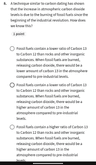
- A technique similar to carbon dating has shown that the increase in atmospheric carbon dioxide levels is due to the…
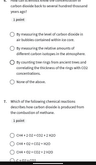
- How can scientists know the concentration of carbon dioxide back to several hundred thousand years ago?
About Physics
Physics explains how the universe works, from the motion of everyday objects to the behavior of subatomic particles. High school and college physics courses build a toolkit of principles — Newton's laws, conservation of energy, electromagnetism — that let you predict and explain physical phenomena. Success in physics requires both conceptual understanding and comfort with the math that models reality.
Popular topics in Physics
Kinematics
Displacement, velocity, acceleration, free-fall, and projectile motion in one and two dimensions.
Newton's Laws
Force diagrams, net force, friction, tension, normal force, and applying F = ma to real scenarios.
Energy & Work
Kinetic and potential energy, the work-energy theorem, conservation of energy, and power.
Momentum & Collisions
Linear momentum, impulse, elastic and inelastic collisions, and conservation of momentum.
Circular Motion & Gravitation
Centripetal acceleration, orbital mechanics, Kepler's laws, and universal gravitation.
Electricity & Circuits
Coulomb's law, electric fields, Ohm's law, series and parallel circuits, and Kirchhoff's rules.
Waves & Optics
Wave properties, superposition, interference, diffraction, reflection, refraction, and lens equations.
Thermodynamics
Heat transfer, specific heat, the laws of thermodynamics, entropy, and ideal gas behavior.
Magnetism
Magnetic fields, force on moving charges, electromagnetic induction, and Faraday's law.
Modern Physics
Photoelectric effect, wave-particle duality, atomic spectra, and nuclear decay.
How ScanSolve helps with Physics
ScanSolve reads your physics problem, identifies the relevant principles, and produces a structured solution that mirrors how a tutor would explain it. Each solution starts by listing the known quantities and what you need to find, then selects the appropriate equations and solves step by step.
For mechanics problems, the solver draws implicit free-body diagrams in its reasoning, resolves forces into components, and applies Newton's second law or energy conservation as appropriate. For circuits, it traces current paths, applies Kirchhoff's laws, and simplifies resistor networks methodically.
Because physics problems often combine multiple concepts, ScanSolve explains why each principle applies in context. This helps you build the problem-solving framework you need to tackle unfamiliar questions on exams.
Study tips for Physics
- 01
Always draw a diagram before writing equations. Sketching the situation, labeling forces, and choosing a coordinate system prevents sign errors and clarifies the problem.
- 02
Memorize the core equations, but focus more on understanding when each one applies. Knowing F = ma is useless if you cannot identify all the forces acting on an object.
- 03
Check units at every step. Dimensional analysis catches algebra mistakes early and confirms your final answer makes physical sense.
- 04
Study solved examples actively: cover the solution, attempt the problem, then compare your approach. This is far more effective than passively reading through worked examples.
Frequently asked Physics questions
What is Newton’s second law?
Newton’s second law states F = ma — force equals mass times acceleration. It’s the foundation of classical mechanics.
How do I calculate kinetic energy?
Kinetic energy is KE = ½mv², where m is mass in kg and v is velocity in m/s.
What is Ohm’s law?
Ohm’s law states V = IR — voltage equals current times resistance. It applies to most simple circuits.
How can ScanSolve help with Physics homework?
ScanSolve's AI solves physics problems step by step. Snap a photo of your homework or type your question to get instant, detailed solutions with clear explanations.
Is Physics homework help free on ScanSolve?
Yes, ScanSolve offers free physics homework help with step-by-step solutions. Upgrade to Pro at $89.99/year (about $7.50/month) or $9.99/week for unlimited answers and our most capable AI model.
Physics study guides
All articles- Newton's Laws of Motion Explained: First, Second & Third LawUnderstand Newton's three laws of motion with real-world examples. Learn about inertia, F=ma, and action-reaction pairs. Essential physics guide for students.
- Ohm's Law Explained: Formula, Examples & CalculatorUnderstand Ohm's Law (V=IR) with clear explanations, worked examples, series and parallel circuits, and practice problems. The complete guide for physics students.
- How to Balance Chemical Equations: Step-by-Step MethodMaster balancing chemical equations with this step-by-step guide. Learn the trial and error method, tips for complex equations, and practice problems for chemistry students.
- The Periodic Table Explained: Groups, Periods, Trends & Electron ConfigurationUnderstand the periodic table including groups, periods, periodic trends, and electron configuration. A complete chemistry guide to elements and their properties.
More in Science
Explore more subjects
Have a Physics question?
Get a step-by-step solution in seconds. Or send a photo of your physics homework on WhatsApp — no app download needed.