

This biology question covers important biological concepts and processes. The step-by-step explanation below helps you understand the underlying mechanisms and reasoning.
ScanSolve AI Answer
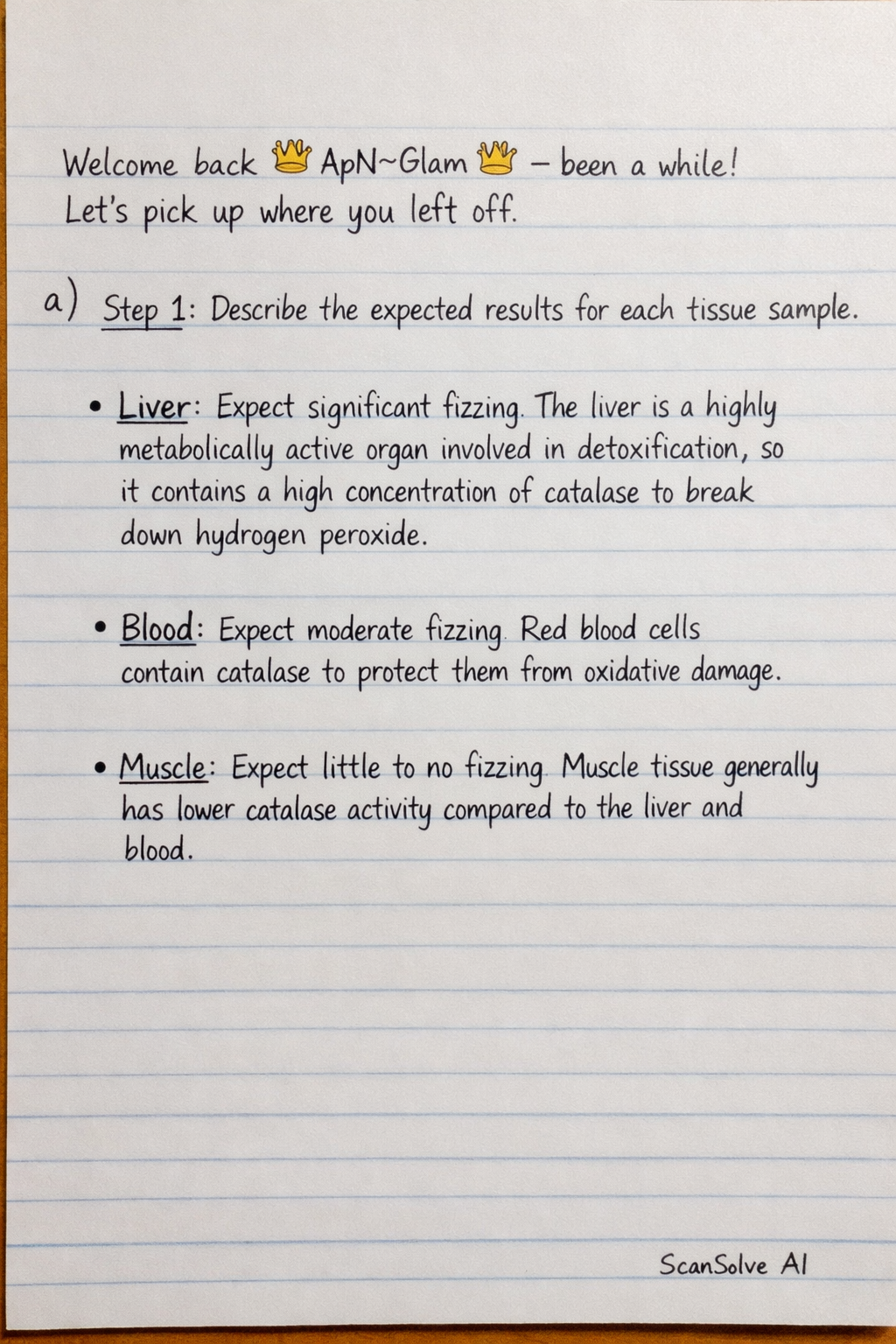
Welcome back 👑ApN~Glam👑 — been a while! Let's pick up where you left off. a) Step 1: Describe the expected results for each tissue sample. • Liver: Expect significant fizzing. The liver is a highly metabolically active organ involved in detoxification, so it contains a high concentration of catalase to break down hydrogen peroxide. • Blood: Expect moderate fizzing. Red blood cells contain catalase to protect them from oxidative damage. • Muscle: Expect little to no fizzing. Muscle tissue generally has lower catalase activity compared to the liver and blood. b) Step 1: Devise a control experiment. To confirm that the reaction is due to enzyme action, a control experiment should involve denaturing the enzyme. Enzymes are proteins and are sensitive to heat. • Take a sample of liver tissue (known to have high catalase activity). • Boil the liver tissue for several minutes. This will denature the catalase enzyme, altering its active site and rendering it inactive. • Macerate the boiled liver tissue with a few drops of distilled water in a separate mortar. • Transfer some of the macerated, boiled material to a test tube. • Add a few drops of hydrogen peroxide to this test tube. • Observe and record the results. Step 2: State the expected result of the control experiment. • Expected result: There should be little to no fizzing in the test tube containing the boiled liver tissue. This lack of reaction confirms that the fizzing observed in the experimental setup (with unboiled tissue) was indeed due to the active catalase enzyme. c) Step 1: Comment on the methods used. • Maceration: This process breaks down cell walls and membranes, releasing the intracellular enzymes (like catalase) into the solution, increasing their accessibility to the substrate (hydrogen peroxide). • Distilled water: Used to ensure that no other chemicals or ions interfere with the enzyme activity or the reaction. • Hydrogen peroxide: This is the substrate for the catalase enzyme. Its breakdown into oxygen and water is what is being observed. • Observation of fizzing: This is a direct visual indicator of oxygen gas production, which signifies the activity of the catalase enzyme. • Using different tissues: This allows for a comparative study of catalase concentration and activity across various organs, highlighting their physiological roles. Step 2: Comment on the significance of the results obtained. • Varying fizzing levels: The differences in fizzing rates among the tissues indicate that catalase is not uniformly distributed throughout the body; its concentration varies depending on the metabolic needs and functions of the specific tissue. • High activity in liver: The liver's high catalase activity is significant because it is a primary organ for detoxification. Catalase helps protect liver cells from damage by breaking down toxic hydrogen peroxide, a byproduct of metabolism. • Control experiment significance: The absence of fizzing in the boiled control sample is crucial. It confirms that the observed breakdown of hydrogen peroxide and subsequent fizzing is specifically due to the enzymatic action of catalase, rather than a non-enzymatic chemical reaction or the presence of the tissue itself. This validates the experimental findings. Drop the next question 📸