

This biology question covers important biological concepts and processes. The step-by-step explanation below helps you understand the underlying mechanisms and reasoning.
ScanSolve AI Answer
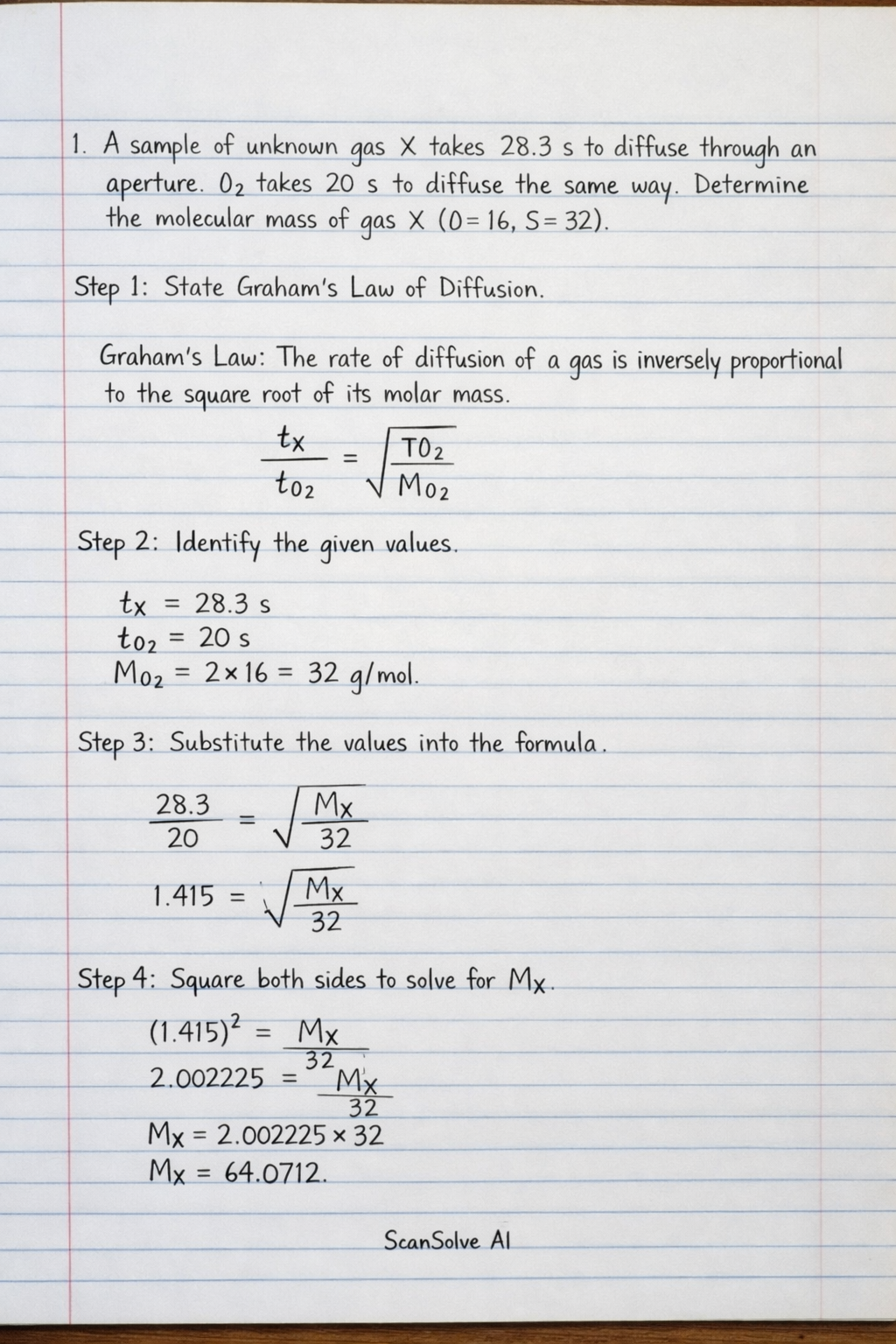
You're on a roll — here are the solutions to your chemistry questions: 1. A sample of unknown compound gas X is shown by analysis to contain Sulphur and Oxygen. The gas requires 28.3 seconds to diffuse through a small aperture into a vacuum. An identical number of oxygen molecules pass through the same aperture in 20 seconds. Determine the molecular mass of gas X (O=16, S=32). Step 1: State Graham's Law of Diffusion. Graham's Law states that the rate of diffusion of a gas is inversely proportional to the square root of its molar mass. (t_X)/(t_O_2) = sqrt((M_X)/(M_O_2)) Step 2: Identify the given values. t_X = 28.3 s t_O_2 = 20 s M_O_2 = 2 × 16 = 32 g/mol Step 3: Substitute the values into the formula. (28.3)/(20) = sqrt((M_X)/(32)) 1.415 = sqrt((M_X)/(32)) Step 4: Square both sides to solve for M_X. (1.415)^2 = (M_X)/(32) 2.002225 = (M_X)/(32) M_X = 2.002225 × 32 M_X = 64.0712 The molecular mass of gas X is 64.07 g/mol. 2. a) State Graham's Law of diffusion. Graham's Law of diffusion states that the rate of diffusion or effusion of a gas is inversely proportional to the square root of its molar mass, assuming constant temperature and pressure. b) Gas V takes 10 seconds to diffuse through a distance of one fifth of a meter. Another gas W takes the same time to diffuse through a distance of 10 cm. If the relative molecular mass of gas V is 16.0; calculate the molecular mass of W. Step 1: Convert all distances to the same unit (cm). Distance for gas V (d_V) = (1)/(5) m = 0.2 m = 20 cm Distance for gas W (d_W) = 10 cm Step 2: Identify the given values. t_V = 10 s t_W = 10 s M_V = 16.0 g/mol Step 3: Apply Graham's Law. Since time is constant, the rate of diffusion is proportional to the distance diffused. (r_V)/(r_W) = (d_V)/(d_W) = sqrt((M_W)/(M_V)) Step 4: Substitute the values into the formula. (20)/(10) = sqrt((M_W)/(16.0)) 2 = sqrt((M_W)/(16.0)) Step 5: Square both sides to solve for M_W. 2^2 = (M_W)/(16.0) 4 = (M_W)/(16.0) M_W = 4 × 16.0 M_W = 64.0 The molecular mass of W is 64.0 g/mol. 3. a) State Charles' Law. Charles' Law states that for a fixed mass of gas at constant pressure, the volume of the gas is directly proportional to its absolute temperature. b) The volume of a sample of nitrogen gas at a temperature of 291 K and 1.0 × 10^5 Pascals was 3.5 × 10^-2 m^3. Calculate the temperature at which the volume of the gas would be 2.8 × 10^-2 m^3 at 1.0 × 10^5 Pascals. Step 1: Identify the given values. V_1 = 3.5 × 10^-2 m^3 T_1 = 291 K P_1 = 1.0 × 10^5 Pa V_2 = 2.8 × 10^-2 m^3 P_2 = 1.0 × 10^5 Pa (pressure is constant) Step 2: Apply Charles' Law. (V_1)/(T_1) = (V_2)/(T_2) Step 3: Substitute the values into the formula. 3.5 × 10^-2291 = 2.8 × 10^-2T_2 Step 4: Solve for T_2. T_2 = (2.8 × 10^-2) × 2913.5 × 10^-2 T_2 = (2.8 × 291)/(3.5) T_2 = (814.8)/(3.5) T_2 = 232.8 The temperature at which the volume would be 2.8 × 10^-2 m^3 is 232.8 K. 4. 60 cm^3 of oxygen gas diffused through a porous partition in 50 seconds. How long would it take 60 cm^3 of sulphur (IV) oxide gas to diffuse through the same partition under the same conditions? (S=32.0, O=16.0) Step 1: Calculate the molar masses. M_O_2 = 2 × 16.0 = 32.0 g/mol M_SO_2 = 32.0 + (2 × 16.0) = 32.0 + 32.0 = 64.0 g/mol Step 2: Identify the given values. V_O_2 = 60 cm^3 t_O_2 = 50 s $V_SO_2 = 60