
We read your photo as:
An expansionary monetary policy will increase investment expenditure.
ScanSolve AI Answer
Answer
a, b, c and d
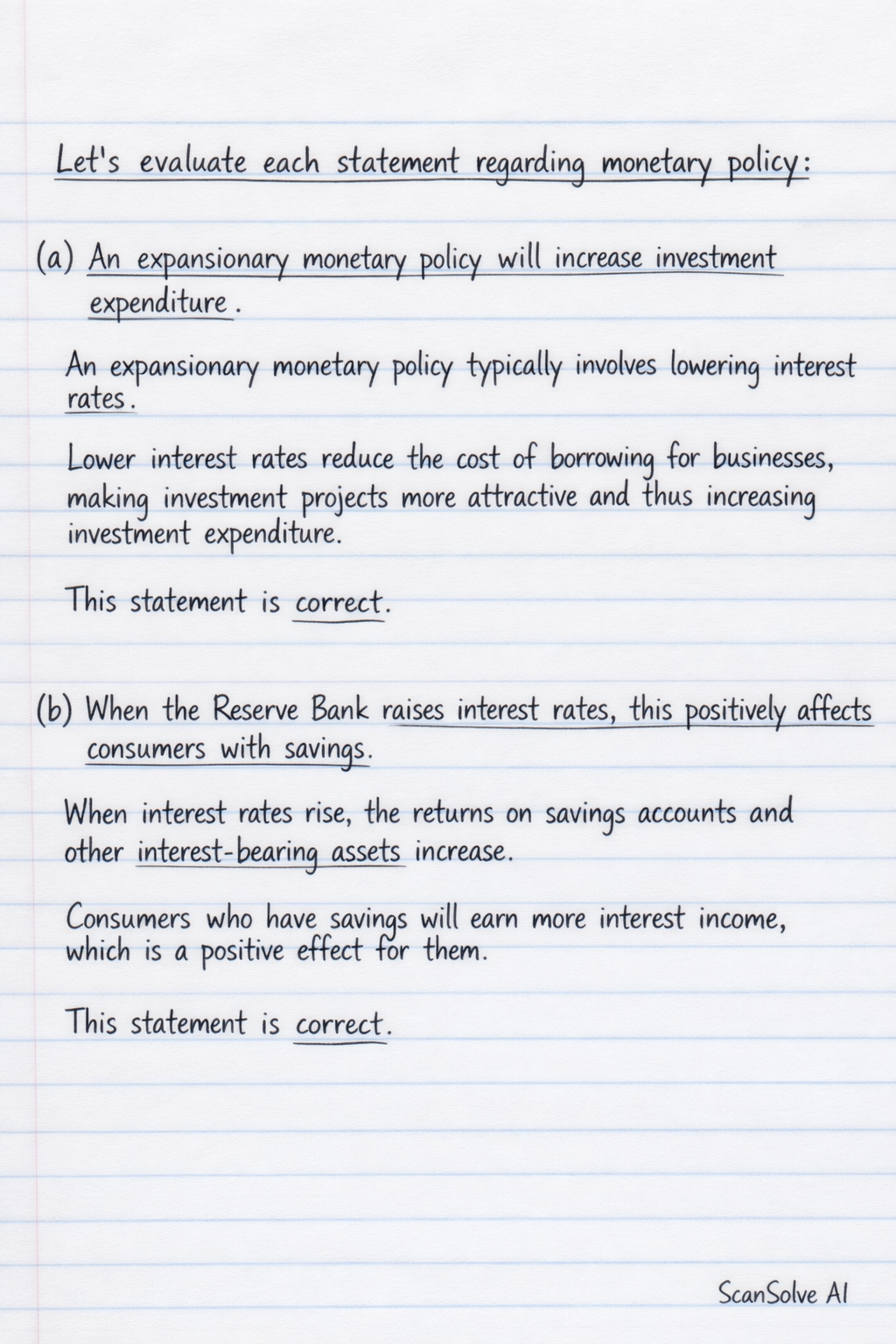
Let's evaluate each statement regarding monetary policy:
-
(a) An expansionary monetary policy will increase investment expenditure. An expansionary monetary policy typically involves lowering interest rates. Lower interest rates reduce the cost of borrowing for businesses, making investment projects more attractive and thus increasing investment expenditure. This statement is correct.
-
(b) When the Reserve Bank raises interest rates, this positively affects consumers with savings. When interest rates rise, the returns on savings accounts and other interest-bearing assets increase. Consumers who have savings will earn more interest income, which is a positive effect for them. This statement is correct.
-
(c) A contractionary monetary policy negatively affects a factory buying machinery and equipment on credit. A contractionary monetary policy involves raising interest rates. Higher interest rates increase the cost of borrowing. If a factory is buying machinery and equipment on credit, it means they are taking out a loan, and higher interest rates will make that loan more expensive, negatively impacting the factory. This statement is correct.
-
(d) Monetary policy also affects consumption expenditure on goods and services in the real sector. Monetary policy influences interest rates, which in turn affect consumer borrowing costs (e.g., for mortgages, car loans) and the incentive to save. Lower interest rates encourage borrowing and spending (consumption), while higher interest rates discourage it. These changes directly impact consumption expenditure in the real sector. This statement is correct.
Since all statements (a), (b), (c), and (d) are correct, the option that includes all of them is the correct answer.
The correct option is c. a, b, c and d.
Try one yourself
A new problem that tests the same skill.
Still stuck on this one?
Ask a follow-up, and the answer starts from this question.
More Business/Management Questions
Handwritten Step-by-Step Solution
Get this as a handwritten image on WhatsApp — like a tutor wrote it for you.
Try on WhatsApp