
We read your photo as:
Determine the chemical formula and molar mass of lead(II) trioxonitrate(V).
ScanSolve AI Answer
Answer
Step-by-step solution
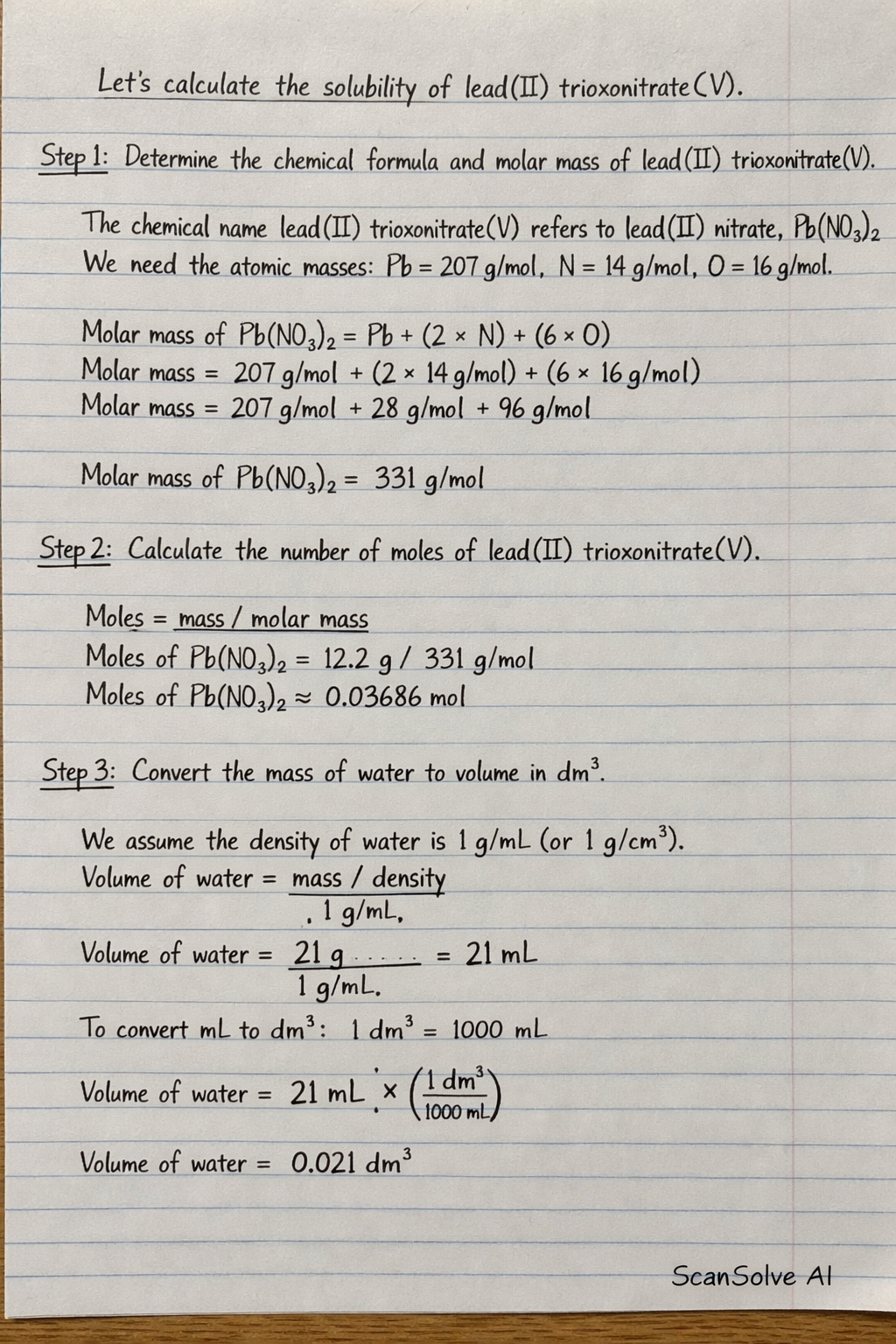
4 stepsLet's calculate the solubility of lead(II) trioxonitrate(V).
Determine the chemical formula and molar mass of lead(II) trioxonitrate(V).
The chemical name lead(II) trioxonitrate(V) refers to lead(II) nitrate, Pb(NO₃)₂.
We need the atomic masses: Pb = 207 g/mol, N = 14 g/mol, O = 16 g/mol.
Molar mass of Pb(NO₃)₂ = Pb + (2 × N) + (6 × O)
Molar mass = 207 g/mol + (2 × 14 g/mol) + (6 × 16 g/mol)
Molar mass = 207 g/mol + 28 g/mol + 96 g/mol
Molar mass of Pb(NO₃)₂ = 331 g/molCalculate the number of moles of lead(II) trioxonitrate(V).
Moles = mass / molar mass
Moles of Pb(NO₃)₂ = 12.2 g / 331 g/mol
Moles of Pb(NO₃)₂ ≈ 0.03686 molConvert the mass of water to volume in dm³.
We assume the density of water is 1 g/mL (or 1 g/cm³).
Volume of water = mass / density
Volume of water = 21 g / (1 g/mL) = 21 mL
To convert mL to dm³: 1 dm³ = 1000 mL
Volume of water = 21 mL × (1 dm³ / 1000 mL)
Volume of water = 0.021 dm³Calculate the solubility in mol dm⁻³.
Solubility = moles of solute / volume of solvent (in dm³)
Solubility = 0.03686 mol / 0.021 dm³
Solubility ≈ 1.755 mol/dm³
Rounding to two significant figures (based on the given mass of 21 g of water):
Try one yourself
A new problem that tests the same skill.
Still stuck on this one?
Ask a follow-up, and the answer starts from this question.
More Chemistry Questions
Handwritten Step-by-Step Solution
Get this as a handwritten image on WhatsApp — like a tutor wrote it for you.
Try on WhatsApp