

This chemistry question involves key chemical concepts and calculations. The detailed solution below walks through each step, from identifying the reaction type to computing the final answer.
ScanSolve AI Answer
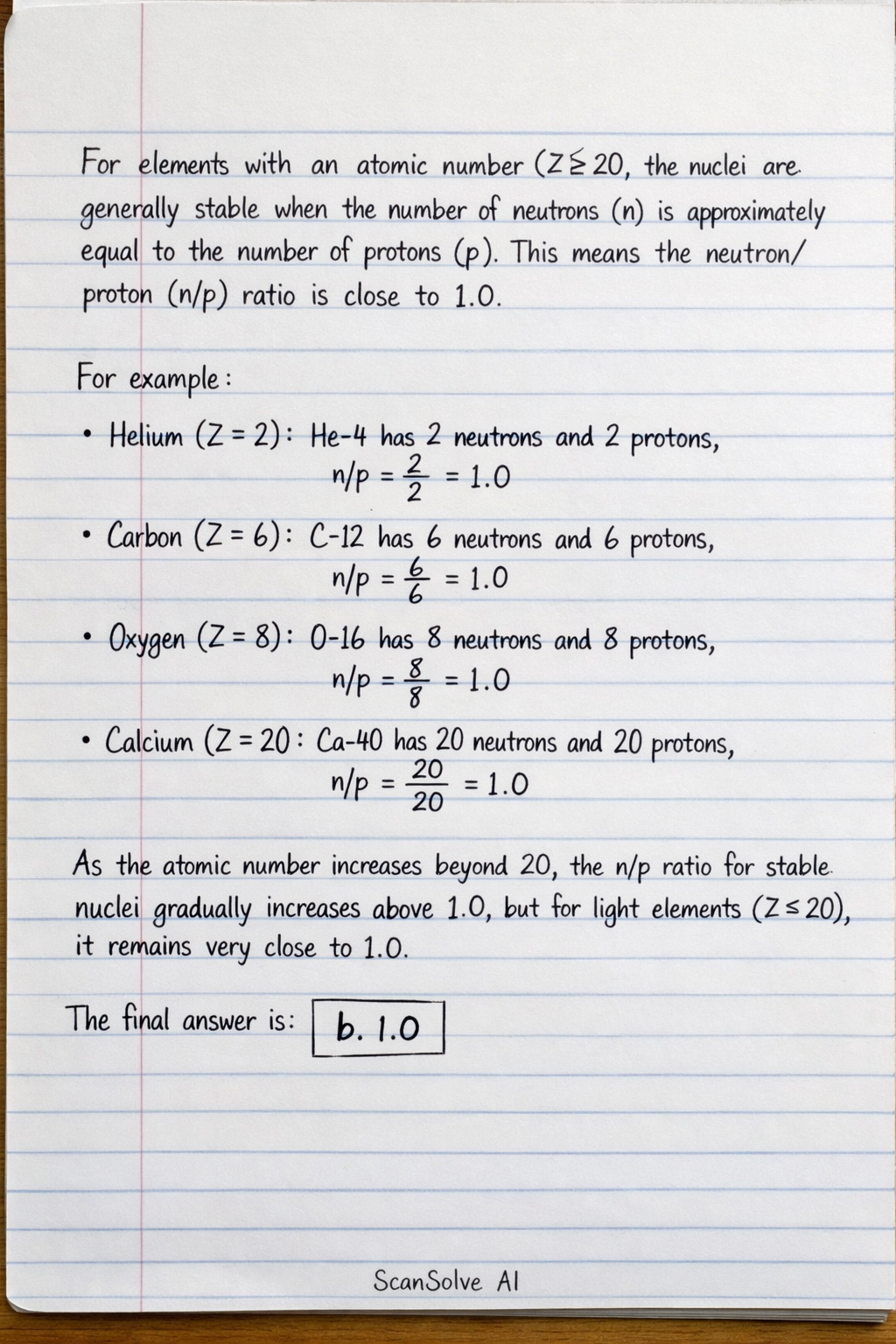
For elements with an atomic number (Z) less than or equal to 20, the nuclei are generally stable when the number of neutrons (n) is approximately equal to the number of protons (p). This means the neutron-to-proton (n/p) ratio is close to 1.0. For example: • Helium (Z=2): He-4 has 2 neutrons and 2 protons, so n/p = 2/2 = 1.0. • Carbon (Z=6): C-12 has 6 neutrons and 6 protons, so n/p = 6/6 = 1.0. • Oxygen (Z=8): O-16 has 8 neutrons and 8 protons, so n/p = 8/8 = 1.0. • Calcium (Z=20): Ca-40 has 20 neutrons and 20 protons, so n/p = 20/20 = 1.0. As the atomic number increases beyond 20, the n/p ratio for stable nuclei gradually increases above 1.0, but for light elements (Z 20), it remains very close to 1.0. The final answer is b. 1.0. Last free one today — make it count tomorrow, or type /upgrade for unlimited.