
We read your photo as:
I) The catalyst used in the catalytic oxidation of ammonia to nitrogen oxide is platinum-rhodium gauze*.
Chemistry
ScanSolve AI Answer
Here are the solutions to the questions:
f)
- i) The catalyst used in the catalytic oxidation of ammonia to nitrogen oxide is platinum-rhodium gauze.
- ii) The balanced chemical equation for the reaction between ammonia and air (oxygen) is:
- iii) One environmental problem likely to be faced in an area where a nitric (V) acid manufacturing plant is located is acid rain or photochemical smog due to the emission of nitrogen oxides.
g) One source of nitrogen in the Haber process is air.
2)
a)
- i) An element that can form an ion with a charge of -2 is R or S. These elements are in Group 16 and gain two electrons to achieve a stable octet.
- ii) Q is an alkali metal (Group 1). The chloride of Q will have a giant ionic lattice structure.
- iii) V is in Period 2, Group 17, and W is in Period 3, Group 17. Both are halogens. Reactivity of halogens decreases down the group. Therefore, V is more reactive than W. This is because V has a smaller atomic radius, so its nucleus has a stronger attraction for an incoming electron, making it easier to gain an electron.
- iv) T is in Period 4, Group 1, and U is in Period 4, Group 2. Both are in the same period. Atomic radius decreases across a period from left to right. Therefore, T has a larger atomic radius than U. This is because U has a greater nuclear charge than T, which pulls the electrons closer to the nucleus, resulting in a smaller atomic radius.
Was this helpful?
Still stuck on this one?
Ask a follow-up, and the answer starts from this question.
Got a different question?Ask your own question
More Chemistry Questions
QI) Name the catalyst used in step II:QWhat is a catalyst? (ii) Name the catalyst applied in Haber process and in Contact process. (b)…QFor the reaction 4NH3(g) + 5O2(g) 4NO(g) + 6H2O(g), explain how a reduction in pressure or the use…QThe chemical industry relies heavily on inorganic compounds as catalysts. (6) Describe with specific…QA) It is called the contact process because the reacting gases, sulphur(IV) oxide and oxygen, come…
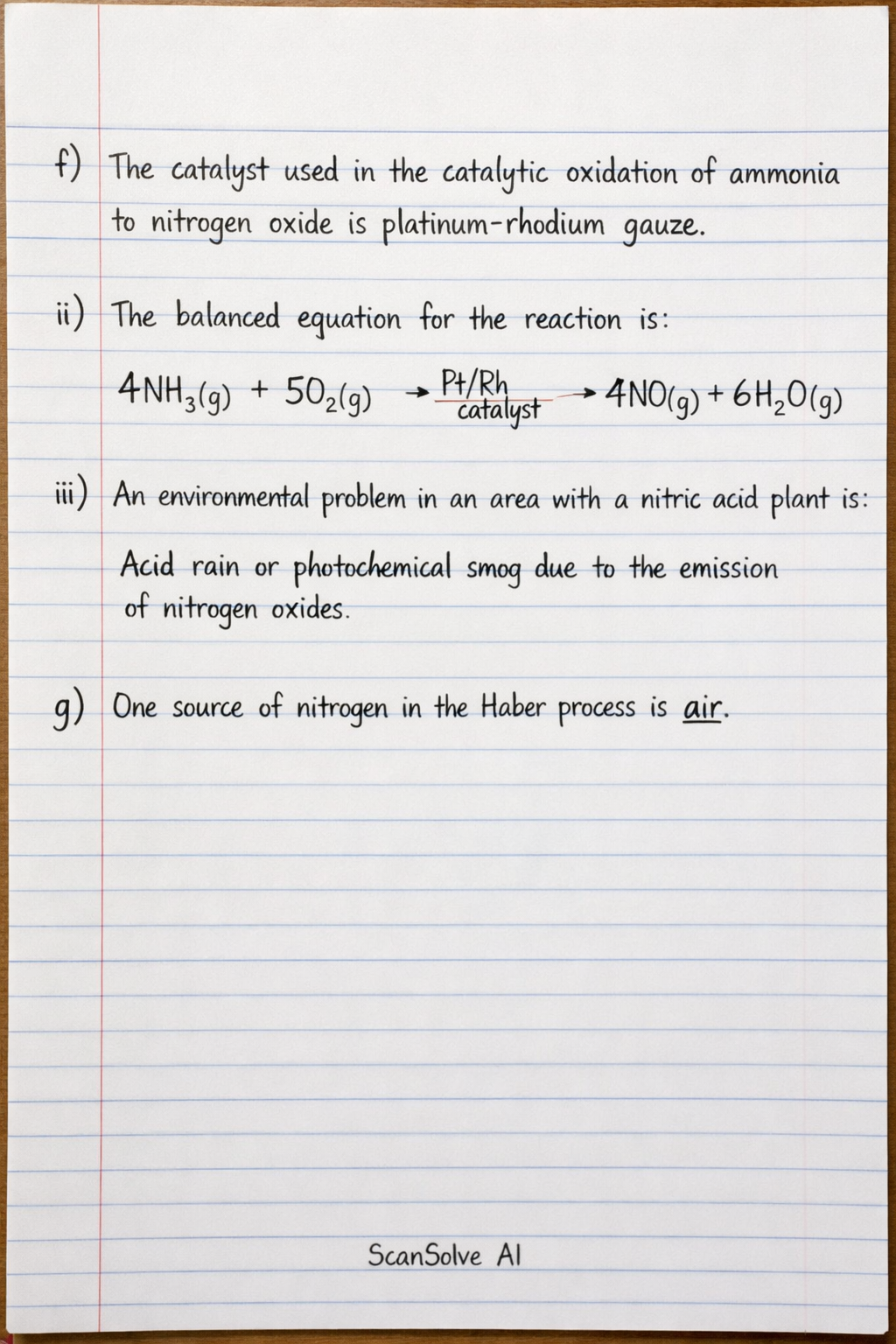
Handwritten Step-by-Step Solution
Get this as a handwritten image on WhatsApp — like a tutor wrote it for you.
Try on WhatsApp