
We read your photo as:
Identify the intermolecular forces for each compound.
Chemistry
ScanSolve AI Answer
Answer
A
Step-by-step solution
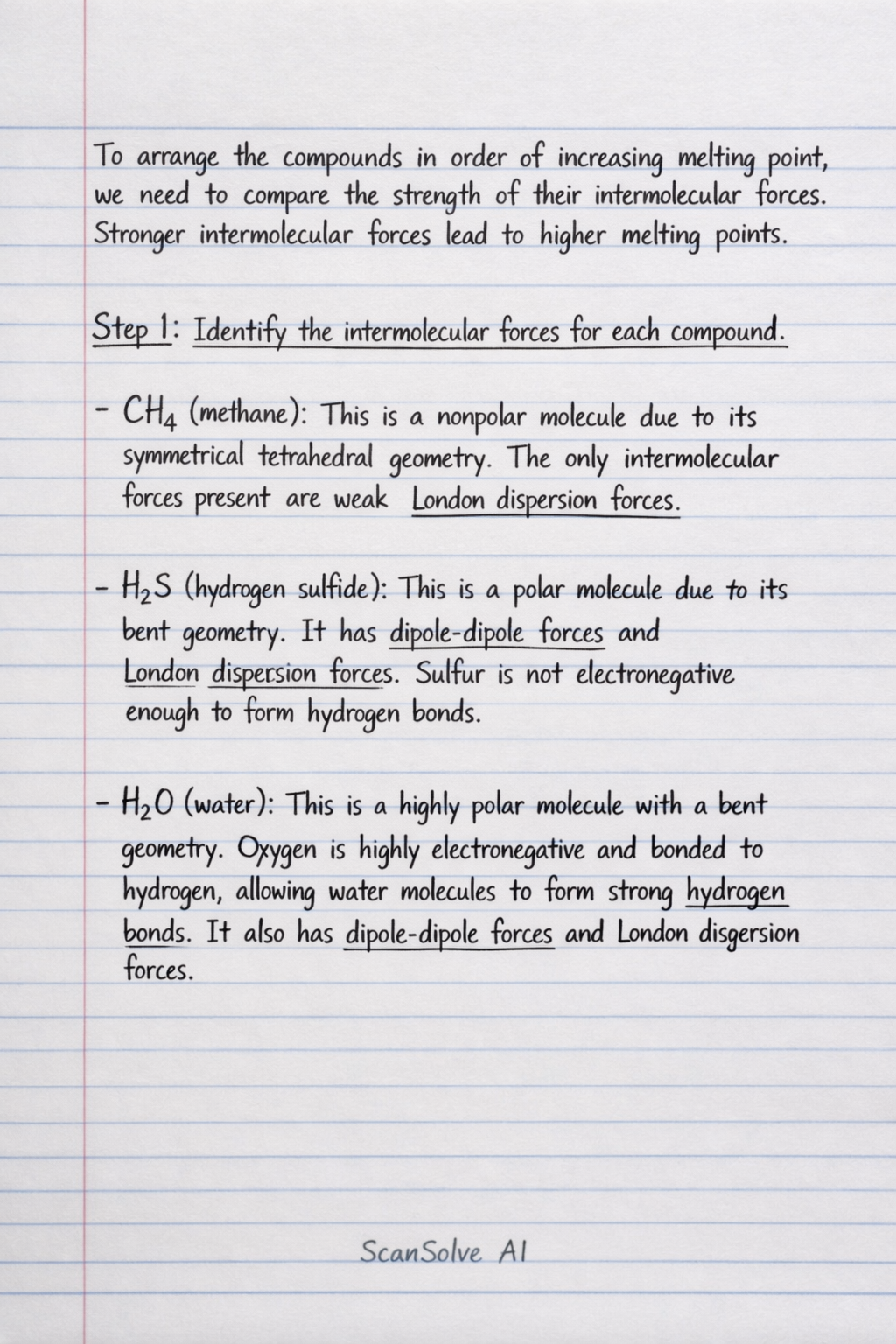
4 stepsTo arrange the compounds in order of increasing melting point, we need to compare the strength of their intermolecular forces. Stronger intermolecular forces lead to higher melting points.
Identify the intermolecular forces for each compound.
- (methane): This is a nonpolar molecule due to its symmetrical tetrahedral geometry. The only intermolecular forces present are weak London dispersion forces.
- (hydrogen sulfide): This is a polar molecule due to its bent geometry. It has dipole-dipole forces and London dispersion forces. Sulfur is not electronegative enough to form hydrogen bonds.
- (water): This is a highly polar molecule with a bent geometry. Oxygen is highly electronegative and bonded to hydrogen, allowing water molecules to form strong hydrogen bonds. It also has dipole-dipole forces and London dispersion forces.
Compare the relative strengths of the intermolecular forces.
- London dispersion forces are the weakest.
- Dipole-dipole forces are stronger than London dispersion forces.
- Hydrogen bonds are the strongest of these three types of intermolecular forces.
Determine the order of increasing melting point based on intermolecular force strength.
The order of increasing intermolecular force strength is:
(London dispersion) < (dipole-dipole + London dispersion) < (hydrogen bonding + dipole-dipole + London dispersion).Therefore, the order of increasing melting point is:
Select the correct option.
This order matches option A.
The correct option is A.
Was this helpful?
Try one yourself
A new problem that tests the same skill.
Still stuck on this one?
Ask a follow-up, and the answer starts from this question.
Got a different question?Ask your own question
More Chemistry Questions
Handwritten Step-by-Step Solution
Get this as a handwritten image on WhatsApp — like a tutor wrote it for you.
Try on WhatsApp