
We read your photo as:
Define an acid and base based on the following theories:
ScanSolve AI Answer
Step-by-step solution
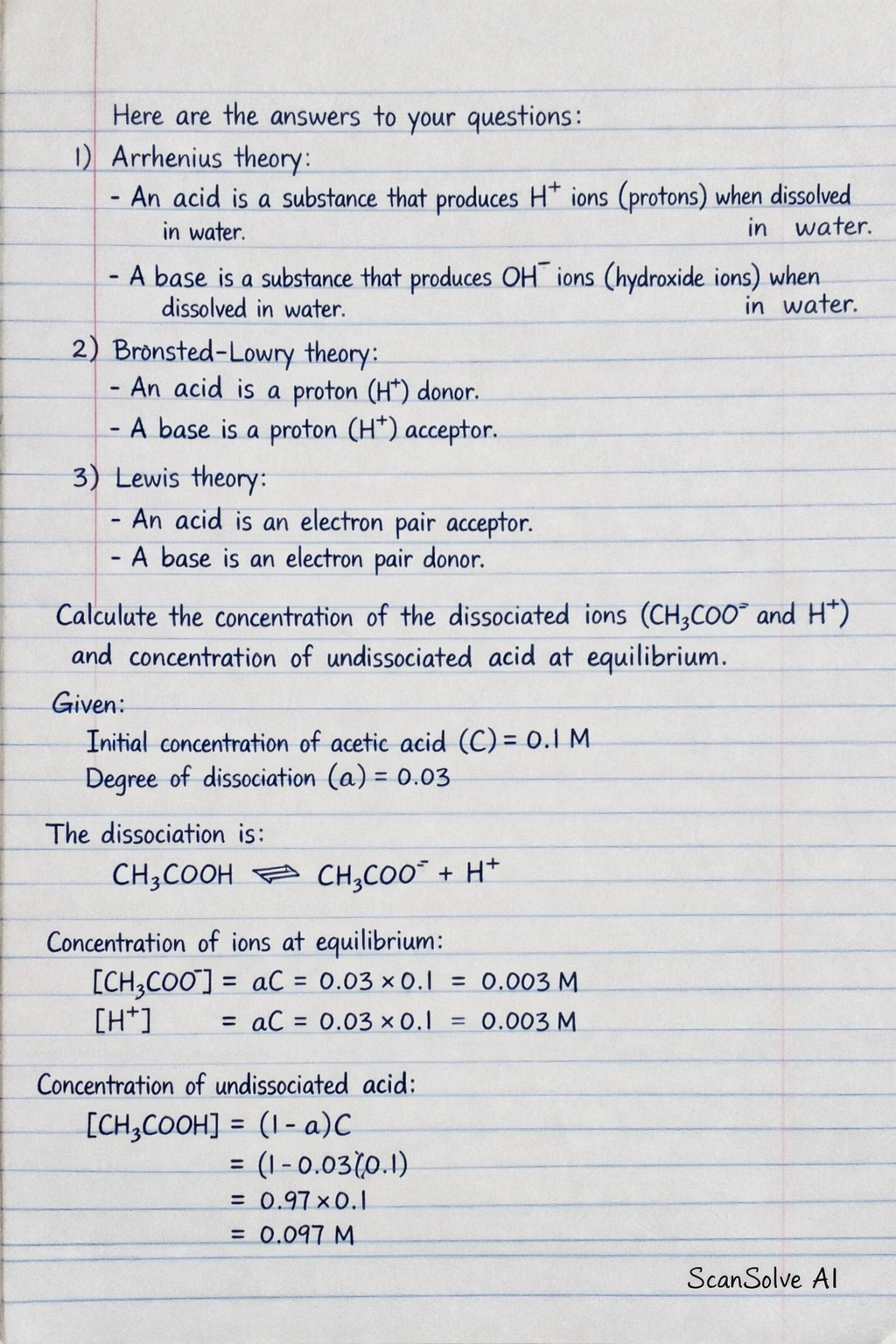
6 stepsHere are the answers to your questions:
-
Define an acid and base based on the following theories:
-
i. Arrhenius theory:
- An acid is a substance that produces ions (protons) when dissolved in water.
- A base is a substance that produces ions (hydroxide ions) when dissolved in water.
-
ii. Brønsted-Lowry theory:
- An acid is a proton () donor.
- A base is a proton () acceptor.
-
iii. Lewis theory:
- An acid is an electron pair acceptor.
- A base is an electron pair donor.
-
-
Calculate the concentration of the dissociated ions ( and ) and concentration of undissociated acid at equilibrium.
Given:
Initial concentration of acetic acid () =
Degree of dissociation () = 0.03The dissociation of acetic acid is:
Calculate the concentration of dissociated ions.
The concentration of dissociated ions is given by $C \times \alpha$. $$ [\text{CH}_3\text{COO}^-] = [\text{H}^+] = C \times \alpha = 0.1 \text{ M} \times 0.03 = 0.003 \text{ M} $$ The concentration of dissociated ions is $\boxed{\text{0.003 M}}$.Calculate the concentration of undissociated acid.
The concentration of undissociated acid at equilibrium is $C(1-\alpha)$. $$ [\text{CH}_3\text{COOH}] = C(1-\alpha) = 0.1 \text{ M} \times (1 - 0.03) = 0.1 \text{ M} \times 0.97 = 0.097 \text{ M} $$ The concentration of undissociated acid is $\boxed{\text{0.097 M}}$.-
Define Ostwald's dilution law. Ostwald's dilution law states that for a weak electrolyte, the degree of dissociation () is inversely proportional to the square root of its concentration () or directly proportional to the square root of its volume (). This means that as a solution of a weak electrolyte is diluted, its degree of dissociation increases. It is mathematically expressed as for a weak acid, where is the acid dissociation constant.
-
Calculate the pH of a solution with a hydroxide ion concentration of M.
Given:
-
Calculate the pOH of the solution.
$$ \text{pOH} = -\log[\text{OH}^-] $$ $$ \text{pOH} = -\log(3.0 \times 10^{-3}) $$ $$ \text{pOH} \approx 2.52 $$Calculate the pH of the solution using the relationship .
$$ \text{pH} = 14 - \text{pOH} $$ $$ \text{pH} = 14 - 2.52 $$ $$ \text{pH} = 11.48 $$ The pH of the solution is $\boxed{\text{11.48}}$.-
Calculate the pH of a buffer solution containing 0.2 M acetic acid () and 0.1 M sodium acetate (). The pKa of acetic acid is 4.74.
Given:
-
Use the Henderson-Hasselbalch equation for buffer solutions.
$$ \text{pH} = \text{pKa} + \log\left(\frac{[\text{Base}]}{[\text{Acid}]}\right) $$Substitute the given values into the equation and calculate the pH.
$$
\text{pH} = 4.74 + \log\left(\frac{0.1 \text{ M}}{0.2 \text{ M}}\right)
$$
$$
\text{pH} = 4.74 + \log(0.5)
$$
$$
\text{pH} = 4.74 + (-0.301)
$$
$$
\text{pH} = 4.439
$$
The pH of the buffer solution is $\boxed{\text{4.44}}$.
Still stuck on this one?
Ask a follow-up, and the answer starts from this question.
More Chemistry Questions
Handwritten Step-by-Step Solution
Get this as a handwritten image on WhatsApp — like a tutor wrote it for you.
Try on WhatsApp