
We read your photo as:
Calculate the pH for 0.001 M HCl.
ScanSolve AI Answer
Answer
Step-by-step solution
5 stepslet's evaluate each statement to determine which are correct.
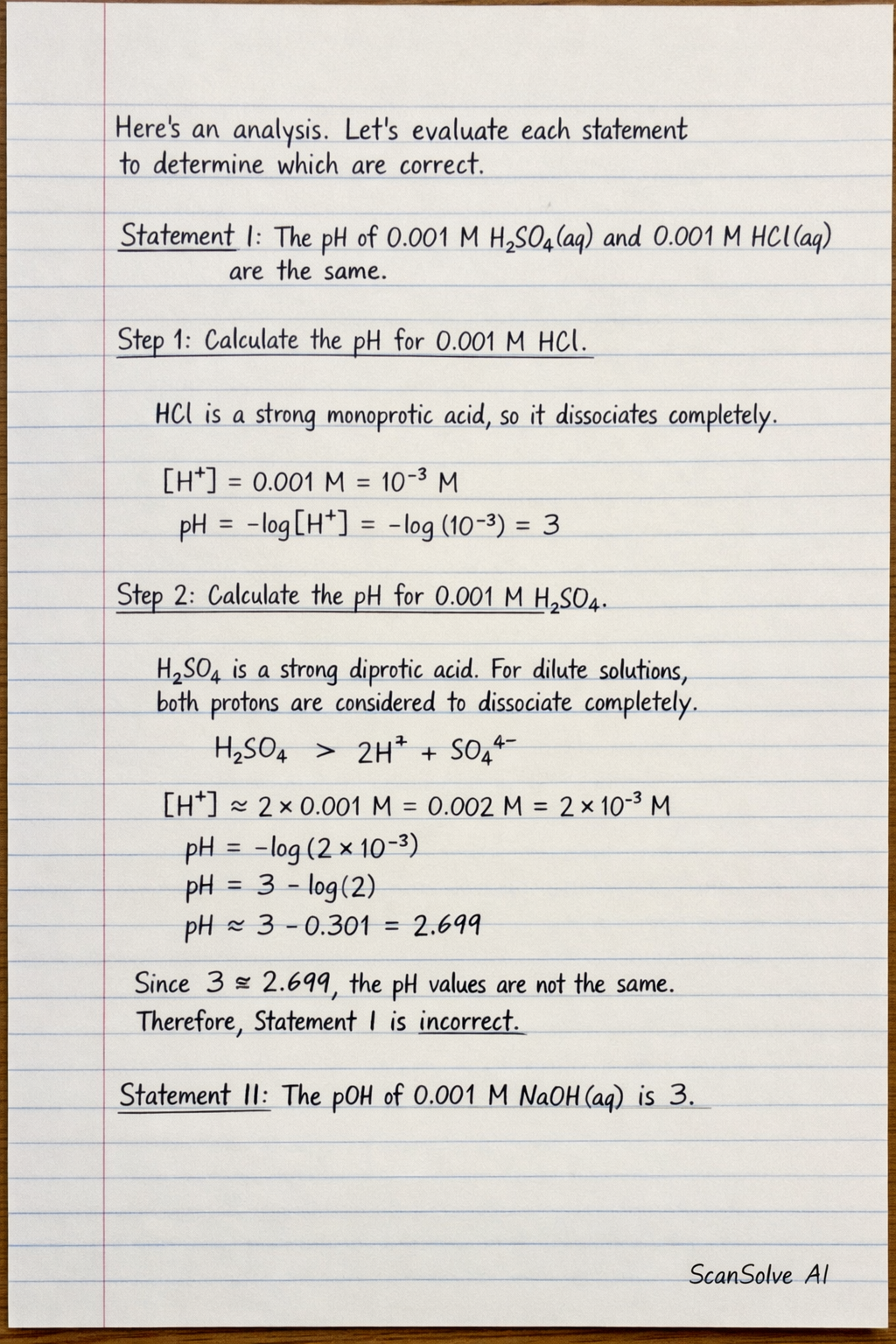
Statement I: The pH of 0.001 M H₂SO₄(aq) and 0.001 M HCl(aq) are the same.
Calculate the pH for 0.001 M HCl.
HCl is a strong monoprotic acid, so it dissociates completely.
Calculate the pH for 0.001 M H₂SO₄.
H₂SO₄ is a strong diprotic acid. For dilute solutions, both protons are considered to dissociate completely.
So, for 0.001 M H₂SO₄, the concentration of is approximately .
Since , the pH values are not the same.
Therefore, Statement I is incorrect.Statement II: The pOH of 0.001 M NaOH(aq) is 3.
Determine the concentration of .
NaOH is a strong base, so it dissociates completely.
For 0.001 M NaOH, .
Calculate the pOH.
Therefore, Statement II is correct.
Statement III: The ionic product of water, Kw, is temperature dependent.
The autoionization of water is an endothermic process:
According to Le Chatelier's principle, an increase in temperature shifts the equilibrium to the right, increasing the concentrations of both and . Since , increases with temperature.
Therefore, Statement III is correct.Statement IV: The pKb of 0.010 M NH₃ solution is greater than 7. (kb of NH₃ = 1.8 x 10⁻⁵)
Calculate the pKb from the given .
The pKb is a constant for a given base and does not depend on its concentration.
Since 4.745 is not greater than 7, the statement is incorrect.
Therefore, Statement IV is incorrect.Conclusion:
Statements II and III are correct.The final answer is .
Try one yourself
A new problem that tests the same skill.
Still stuck on this one?
Ask a follow-up, and the answer starts from this question.
More Chemistry Questions
Handwritten Step-by-Step Solution
Get this as a handwritten image on WhatsApp — like a tutor wrote it for you.
Try on WhatsApp