
We read your photo as:
The image you've sent describes a quantitative analysis experiment (titration), not qualitative analysis. Assuming you're asking for the formulas relevant to the experiment shown in the image, here
ScanSolve AI Answer
This answer stops before the end.
It was cut off when it was first written. Ask ScanSolve this question again for the full working.
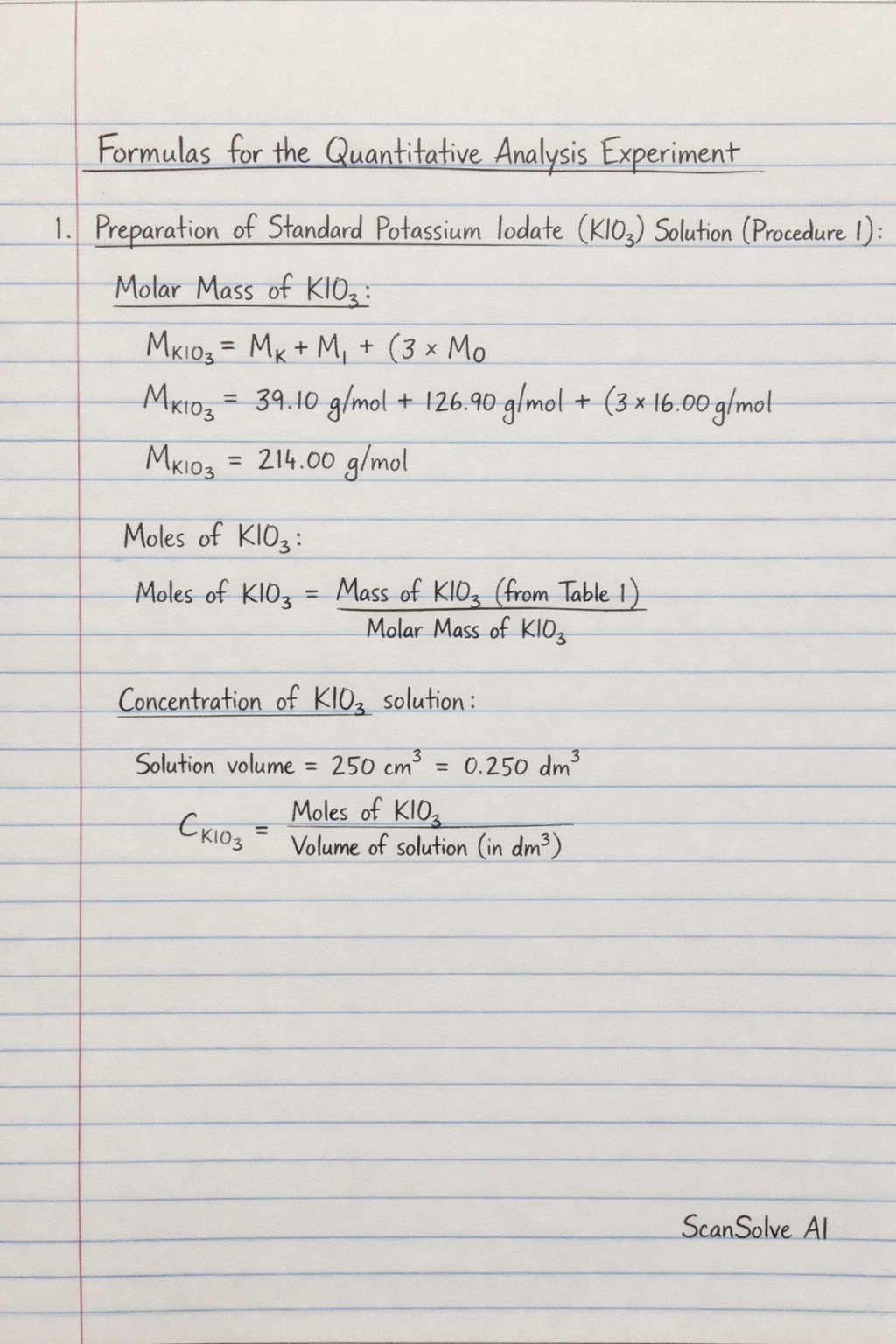
The image you've sent describes a quantitative analysis experiment (titration), not qualitative analysis. Assuming you're asking for the formulas relevant to the experiment shown in the image, here they are:
Formulas for the Quantitative Analysis Experiment
1. Preparation of Standard Potassium Iodate (KIO₃) Solution (Procedure 1):
- Molar Mass of KIO₃: To calculate the molar mass, you'd sum the atomic masses of its constituent elements: Using standard atomic masses:
- Moles of KIO₃:
- Concentration of KIO₃ solution: The solution is made up to 250 cm³.
2. Standardization of Sodium Thiosulphate (Na₂S₂O₃) Solution (Procedure 2):
This involves two sequential redox reactions:
- Reaction 1: Iodate reacts with Iodide in acidic medium to produce Iodine.
- Reaction 2: Iodine is then titrated with Thiosulphate.
- Stoichiometry: From Reaction 1, 1 mole of IO₃⁻ produces 3 moles of I₂. From Reaction 2, 1 mole of I₂ reacts with 2 moles of S₂O₃²⁻. Therefore, 1 mole of IO₃⁻ reacts with moles of S₂O₃²⁻.
- Calculation of Concentration of Na₂S₂O₃: Where is the volume of KIO₃ solution used (25 cm³ = 0.025 dm³) and is the mean titre from Table 2.
3. Determination of Concentration of Copper (II) Sulphate (CuSO₄) Solution (Procedure 3):
This also involves two sequential redox reactions:
- Reaction 1: Copper(II) ions react with Iodide to produce Iodine.
- Reaction 2: Iodine is then titrated with Thiosulphate.
- Stoichiometry: From Reaction 1, 2 moles of Cu²⁺ produce 1 mole of I₂. From Reaction 2, 1 mole of I₂ reacts with 2 moles of S₂O₃²⁻. Therefore, 2 moles of Cu²⁺ react with 2 moles of S₂O₃²⁻, which simplifies to a 1:1 molar ratio.
Still stuck on this one?
Ask a follow-up, and the answer starts from this question.
More Chemistry Questions
Handwritten Step-by-Step Solution
Get this as a handwritten image on WhatsApp — like a tutor wrote it for you.
Try on WhatsApp