
We read your photo as:
The nucleus of a hydrogen atom (specifically, the most common isotope, protium, 1H) has an atomic number of 1 and a mass number of 1. This means it contains one proton and no neutrons. Ele
Chemistry
ScanSolve AI Answer
Answer
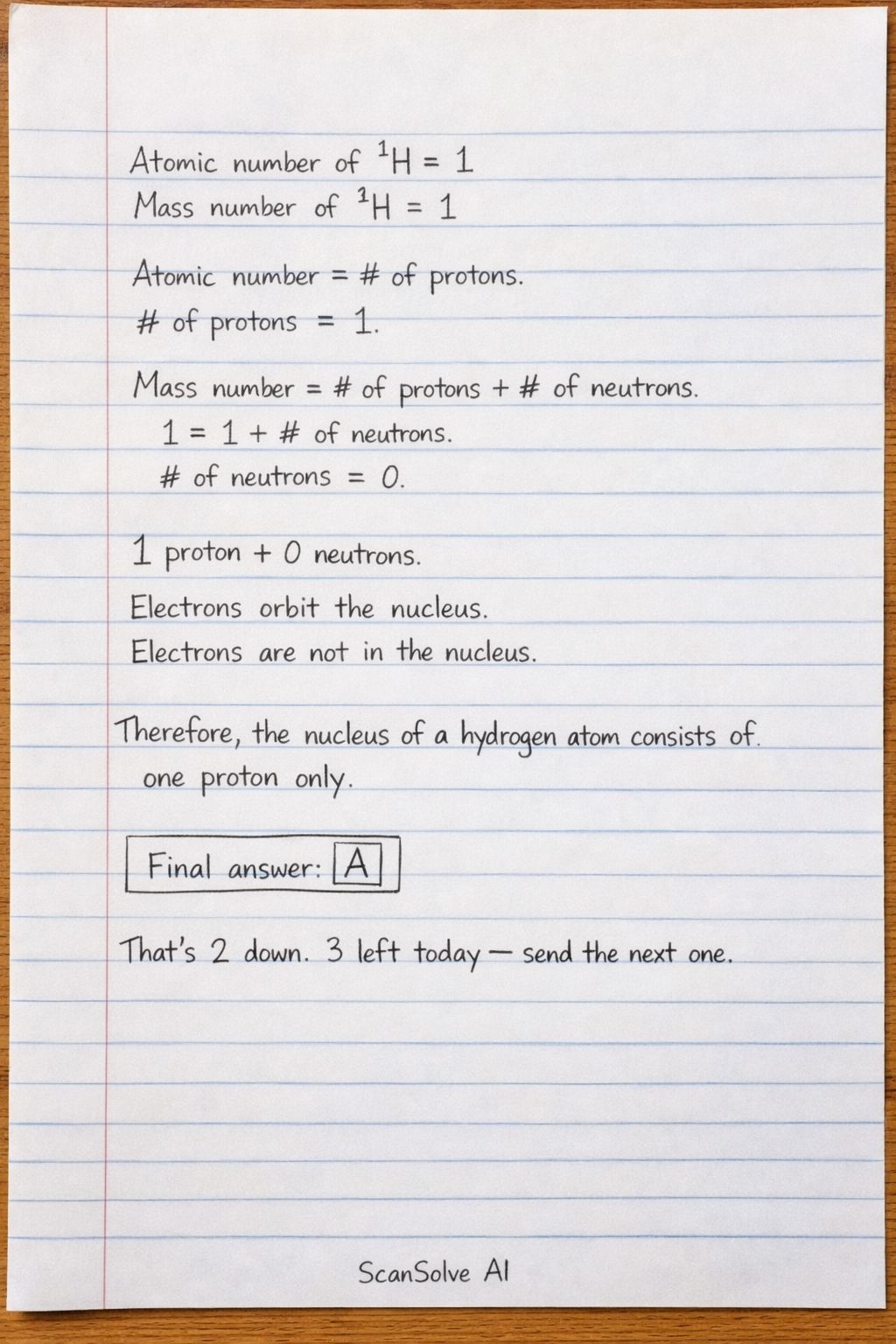
The nucleus of a hydrogen atom (specifically, the most common isotope, protium, ) has an atomic number of 1 and a mass number of 1. This means it contains one proton and no neutrons. Electrons orbit the nucleus and are not part of it.
Therefore, the nucleus of a hydrogen atom consists of one proton only.
The final answer is .
Was this helpful?
Try one yourself
A new problem that tests the same skill.
Still stuck on this one?
Ask a follow-up, and the answer starts from this question.
Got a different question?Ask your own question
More Chemistry Questions
QExplain the atomic structure and calculate the mass number of a hydrogen atom with 1 proton and 0…Q1.5 The..... is a particle inside the nucleus that has no charge. A. Protons B. Electrons C…Q1.1. Proton: C (Positively charged sub-atomic particle)QFor elements with an atomic number (Z) less than or equal to 20, the nuclei are generally stable…QUnderstand the relationships for a hydrogen atom.
Handwritten Step-by-Step Solution
Get this as a handwritten image on WhatsApp — like a tutor wrote it for you.
Try on WhatsApp