
This chemistry question involves key chemical concepts and calculations. The detailed solution below walks through each step, from identifying the reaction type to computing the final answer.
ScanSolve AI Answer
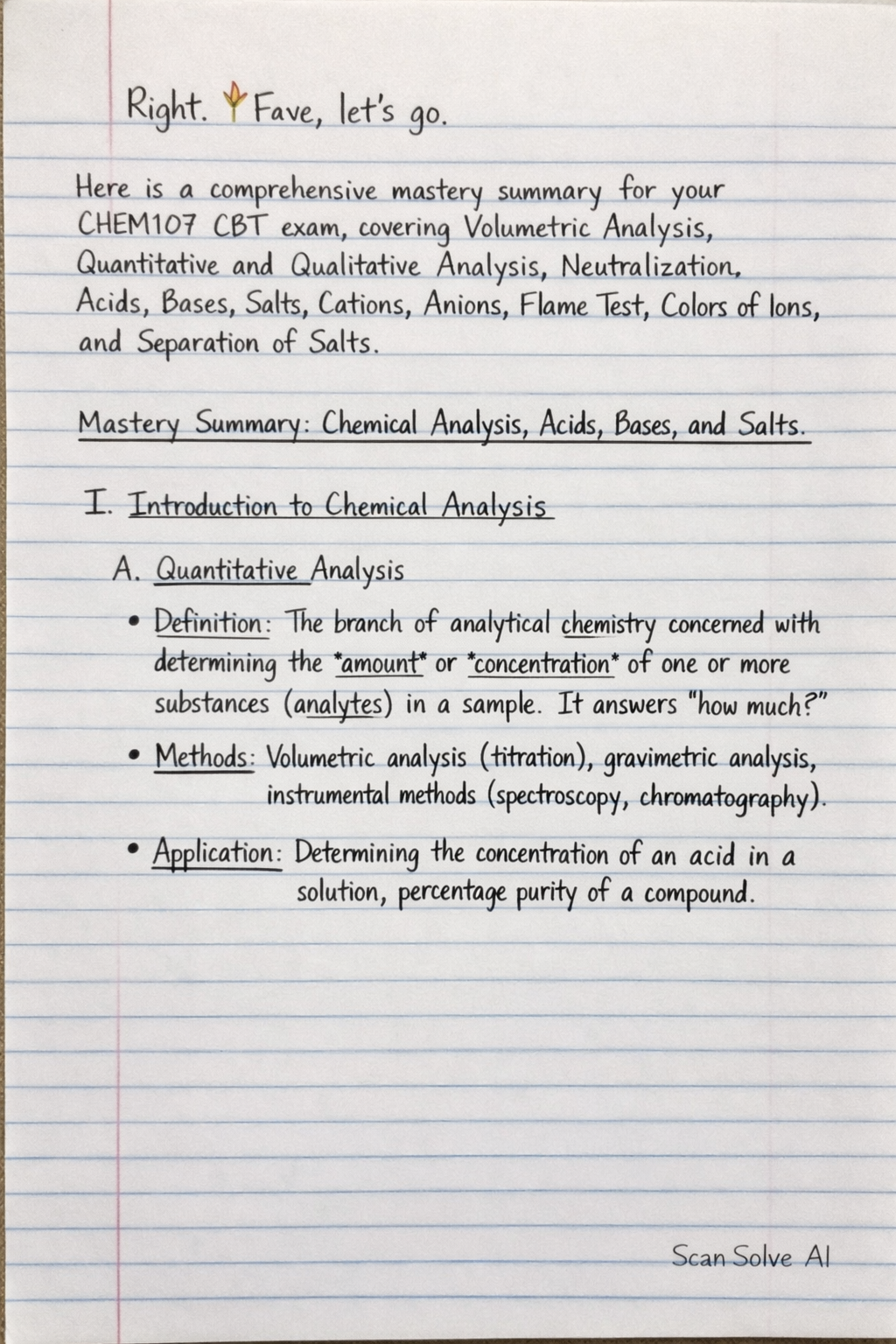
Right ✨Fave, let's go. Here is a comprehensive mastery summary for your CHEM107 CBT exam, covering Volumetric Analysis, Quantitative and Qualitative Analysis, Neutralization, Acids, Bases, Salts, Cations, Anions, Flame Test, Colors of Ions, and Separation of Salts. --- Mastery Summary: Chemical Analysis, Acids, Bases, and Salts I. Introduction to Chemical Analysis A. Quantitative Analysis Definition: The branch of analytical chemistry concerned with determining the amount or concentration* of one or more substances (analytes) in a sample. It answers "how much?". Methods: Volumetric analysis (titration), gravimetric analysis, instrumental methods (spectroscopy, chromatography). Application: Determining the concentration of an acid in a solution, percentage purity of a compound. B. Qualitative Analysis Definition: The branch of analytical chemistry concerned with identifying the presence or absence* of specific substances or elements in a sample. It answers "what is present?". Methods: Flame tests, precipitation reactions, gas evolution tests, specific chemical tests for functional groups. Application: Identifying the metal ions (cations) or non-metal ions (anions) present in an unknown salt. C. Comparison: Quantitative vs. Qualitative Analysis | Feature | Qualitative Analysis | Quantitative Analysis | | :-------------- | :------------------------------------------------- | :-------------------------------------------------- | | Goal | Identify what substances are present. | Determine how much of a substance is present. | | Outcome | Presence/absence of components. | Numerical value (concentration, mass, percentage). | | Methods | Flame tests, precipitation, color changes, gas tests. | Titration, gravimetry, spectroscopy. | | Example | Identifying Fe^3+ in a solution. | Determining the molarity of HCl solution. | | Prerequisite | Often precedes quantitative analysis. | Requires knowledge of what is present. | II. Volumetric Analysis (Titration) A. Key Definitions Volumetric Analysis: A quantitative analytical method based on measuring the volume of a solution of known concentration (titrant) required to react completely with a solution of unknown concentration (analyte). Titration: The process of gradually adding a solution of known concentration (titrant) to a solution of unknown concentration (analyte) until the reaction is complete. Titrant: The solution of known* concentration, typically placed in the burette. Analyte (or Titrand): The solution of unknown* concentration, typically placed in the conical flask. Equivalence Point (Stoichiometric Point): The theoretical point in a titration where the moles of titrant added are chemically equivalent to the moles of analyte present, according to the stoichiometry of the reaction. The reaction is complete. End Point: The point in a titration where a visible physical change (e.g., color change of an indicator) occurs, signaling the completion of the reaction. It should be as close as possible to the equivalence point. Indicator: A substance (usually a weak acid or base) that changes color over a specific pH range, used to visually signal the end point of a titration. Standard Solution: A solution whose concentration is accurately known. Primary Standard: A substance used to prepare a standard solution directly. It must be: High purity (typically 99.9\%). Stable (does not decompose, absorb moisture or CO_2 from air). High molar mass (to minimize weighing errors). Readily soluble in the solvent. Reacts stoichiometrically and rapidly. Examples: Anhydrous sodium carbonate (Na_2CO_3), oxalic acid dihydrate (H_2C_2O_4 · 2H_2O), potassium hydrogen phthalate (KHP). Secondary Standard: A solution whose concentration is determined by titration against a primary standard. Its concentration may change over time. Examples: NaOH, HCl, KMnO_4. These are often hygroscopic, volatile, or react with CO_2. B. Principles of Titration The reaction between titrant and analyte must be: Stoichiometric: A definite, known mole ratio. Rapid: To allow for quick determination of the end point. Complete: To ensure accurate results. Observable: A way to detect the end point (e.g., indicator color change). C. Acid-Base Titration 1. Neutralization Reaction Definition: A chemical reaction between an acid and a base, typically producing a salt and water. General Equation: Acid + Base Salt + Water Ionic Equation (Strong Acid + Strong Base): H^+(aq) + OH^-(aq) H_2O(l) Application: Used to determine the unknown concentration of an acid or a base. 2. Acid-Base Indicators Principle: Indicators are weak organic acids or bases that have different colors in their protonated and deprotonated forms. The color change occurs over a specific pH range, which should ideally bracket the pH at the equivalence point of the titration. Selection: Strong Acid - Strong Base: Equivalence point at pH = 7. Indicators like methyl orange (pH 3.1-4.4, red to yellow) or phenolphthalein (pH 8.2-10.0, colorless to pink) can be used, though phenolphthalein is often preferred for its sharper color change. Strong Acid - Weak Base: Equivalence point at pH < 7 (acidic). Use indicators that change color in the acidic range, e.g., methyl orange. Weak Acid - Strong Base: Equivalence point at pH > 7 (basic). Use indicators that change color in the basic range, e.g., phenolphthalein. Weak Acid - Weak Base: No sharp pH change at the equivalence point, making accurate end point detection difficult. Not typically performed in introductory labs. CBT Trap: Knowing the color changes and pH ranges for common indicators is crucial. Methyl Orange: Red (acidic) Orange (transition) Yellow (basic) Phenolphthalein: Colorless (acidic) Pink (basic) Litmus: Red (acidic) Purple (neutral) Blue (basic) 3. Titration Procedure (Step-by-Step) 1. Preparation: Rinse the burette with the titrant solution (known concentration). Fill it above the zero mark, then drain to ensure no air bubbles and the meniscus is at or below zero. Record initial burette reading. Rinse the pipette with the analyte solution (unknown concentration). Rinse the conical flask with distilled water only (to avoid adding extra moles of analyte). 2. Pipetting: Use the pipette to accurately transfer a precise volume (aliquot) of the analyte solution into the clean conical flask. 3. Indicator Addition: Add 2-3 drops of the appropriate indicator to the conical flask. (Too much indicator can affect the pH and end point). 4. Titration: Slowly add the titrant from the burette to the conical flask, swirling constantly. 5. End Point Detection: Continue adding titrant drop by drop until the indicator changes color permanently (persists for at least 30 seconds). This is the end point. 6. Reading: Record the final burette reading. 7. Repeat: Repeat the titration multiple times (usually 3 concordant readings, within ± 0.1 cm^3 of each other) to ensure accuracy. Calculate the average volume of titrant used (titre). 4. Calculations in Volumetric Analysis Molarity (M): Moles of solute per liter of solution. M = moles of solutevolume of solution (L) Moles (n): n = M × V (where V is in L) n = massmolar mass Concentration (g/L): Concentration (g/L) = M × Molar Mass Dilution Formula: For diluting a stock solution: M_1V_1 = M_2V_2 (where M_1, V_1 are initial molarity and volume; M_2, V_2 are final molarity and volume) Titration Formula (for 1:1 mole ratio): M_A V_A = M_B V_B (where A = acid, B = base) General Titration Formula (for non-1:1 mole ratio): (M_A V_A)/(n_A) = (M_B V_B)/(n_B) (where n_A, n_B are the stoichiometric coefficients from the balanced chemical equation) Step-by-Step Calculation Guide: 1. Write the balanced chemical equation for the reaction. 2. Identify the knowns (concentration of titrant, volume of analyte, average titre volume). 3. Calculate the moles of the substance in the burette (titrant) using n = M × V. 4. Use the mole ratio from the balanced equation to find the moles of the substance in the conical flask (analyte). 5. Calculate the unknown concentration (molarity) of the analyte using M = (n)/(V). 6. Convert molarity to other units (e.g., g/L) if required. Units: Volume in cm^3 or mL must be converted to dm^3 or L for molarity calculations (1 dm^3 = 1 L = 1000 cm^3 = 1000 mL). Molarity is in mol/L or mol/dm^3. 5. Common Mistakes and CBT Traps Reading the Burette: Always read the bottom of the meniscus at eye level. Incorrect reading (parallax error) is a common mistake. Air Bubbles: Not removing air bubbles