

This English question involves literary analysis, grammar, or writing skills. The detailed response below provides a well-structured answer with supporting evidence and clear explanations.
ScanSolve AI Answer
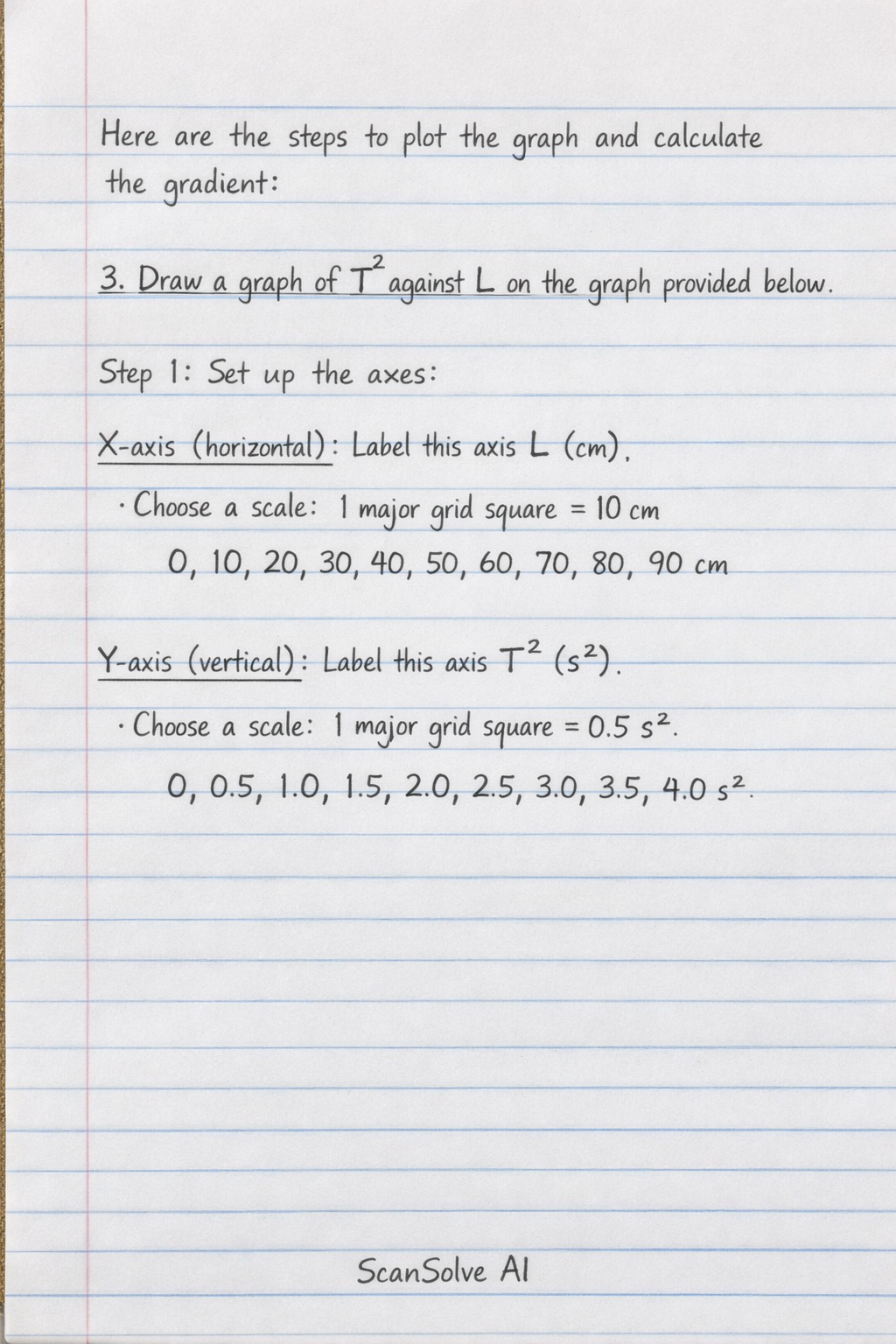
Here are the steps to plot the graph and calculate the gradient: 3. Draw a graph of T^2 against L on the graph provided below. Step 1: Set up the axes. X-axis (horizontal): Label this axis L \, (cm). Choose a scale where 1 major grid square (10 small squares) represents 10 \, cm. Mark the axis at 0, 10, 20, 30, , 90 \, cm. Y-axis (vertical): Label this axis T^2 \, (s^2). Choose a scale where 1 major grid square (10 small squares) represents 0.5 \, s^2. Mark the axis at 0, 0.5, 1.0, 1.5, , 4.0 \, s^2. Step 2: Plot the data points from the table. For each pair of (L, T^2) values, mark a small 'x' or a dot on the graph. (40 \, cm, 1.61 \, s^2): Plot at x=4 major squares, y=3 major squares and 2.2 small squares up. (50 \, cm, 2.02 \, s^2): Plot at x=5 major squares, y=4 major squares and 0.4 small squares up. (60 \, cm, 2.43 \, s^2): Plot at x=6 major squares, y=4 major squares and 8.6 small squares up. (70 \, cm, 2.82 \, s^2): Plot at x=7 major squares, y=5 major squares and 6.4 small squares up. (80 \, cm, 3.24 \, s^2): Plot at x=8 major squares, y=6 major squares and 4.8 small squares up. (90 \, cm, 3.61 \, s^2): Plot at x=9 major squares, y=7 major squares and 2.2 small squares up. Step 3: Draw the best-fit line. Draw a single straight line that passes as close as possible to all the plotted points. This line should also pass through the origin (0,0) as T^2 is directly proportional to L for a simple pendulum. 4. From the graph calculate the gradient. Step 1: Choose two points on the best-fit line. To calculate the gradient accurately, select two points that are far apart on your drawn best-fit line. These points do not necessarily have to be your original data points. For example, let's choose: Point 1: (L_1, T_1^2) = (40 \, cm, 1.61 \, s^2) Point 2: (L_2, T_2^2) = (90 \, cm, 3.61 \, s^2) Step 2: Calculate the gradient using the formula m = ( T^2)/( L). m = (T_2^2 - T_1^2)/(L_2 - L_1) m = 3.61 \, s^2 - 1.61 \, s^290 \, cm - 40 \, cm m = 2.00 \, s^250 \, cm m = 0.04 \, s^2/cm The gradient of the graph is $0.04 \, s^2