Please solve it in English

English

ScanSolve AI Answer

Answers

3 parts
b(i)

2.21×10⁹ Pa\text{2.21} \times 10^9 \text{ Pa}

b(ii)

0.0227\text{0.0227}

b(iii)

9.74×10¹⁰ Pa\text{9.74} \times 10^{10} \text{ Pa}

Step-by-step solution

5 steps

Okay, kengstanley86, let's solve this one in English.

Here are the calculations for part (b) of the question, using the data from Figure 4:

Part b(i)· 3 steps

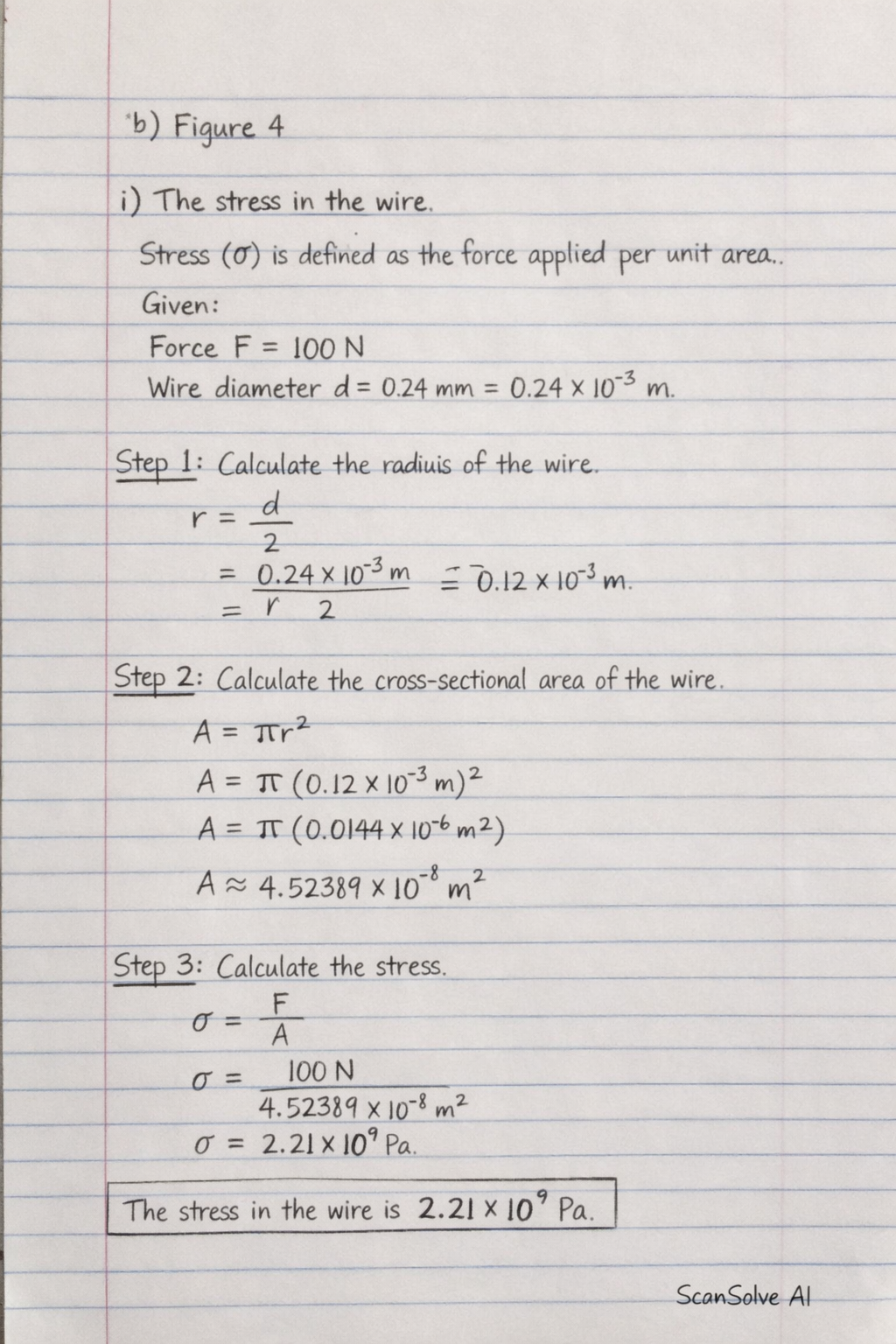
The stress in the wire

Figure 4

Stress (σ\sigma) is defined as the force applied per unit area.
Given:
Force F=100 NF = 100 \text{ N}
Wire diameter d=0.24 mm=0.24×10⁻³ md = 0.24 \text{ mm} = 0.24 \times 10^{-3} \text{ m}

  1. Calculate the radius of the wire.

    r=d2=0.24×10⁻³ m2=0.12×10⁻³ mr = \frac{d}{2} = \frac{0.24 \times 10^{-3} \text{ m}}{2} = 0.12 \times 10^{-3} \text{ m}
  2. Calculate the cross-sectional area of the wire.

    A=πr2A = \pi r^2 A=π(0.12×10⁻³ m)2A = \pi (0.12 \times 10^{-3} \text{ m})^2 A=π(0.0144×10⁻⁶ m2)A = \pi (0.0144 \times 10^{-6} \text{ m}^2) A≈4.52389×10⁻⁸ m2A \approx 4.52389 \times 10^{-8} \text{ m}^2
  3. Calculate the stress.

    σ=FA\sigma = \frac{F}{A} σ=100 N4.52389×10−8 m2\sigma = \frac{100 \text{ N}}{4.52389 \times 10^{-8} \text{ m}^2} σ≈2.21×10⁹ Pa\sigma \approx 2.21 \times 10^9 \text{ Pa}

    The stress in the wire is 2.21×10⁹ Pa\boxed{\text{2.21} \times 10^9 \text{ Pa}}.

Part b(ii)

0.0227\text{0.0227}

The strain in the wire

Strain (ϵ\epsilon) is defined as the extension per unit original length.
Given:
Original length L0=1.76 mL_0 = 1.76 \text{ m} (from Figure 4)
Extension ΔL=0.04 m\Delta L = 0.04 \text{ m} (from Figure 4)

  1. Calculate the strain.

    ϵ=ΔLL0\epsilon = \frac{\Delta L}{L_0} ϵ=0.04 m1.76 m\epsilon = \frac{0.04 \text{ m}}{1.76 \text{ m}} ϵ≈0.0227\epsilon \approx 0.0227

    The strain in the wire is 0.0227\boxed{\text{0.0227}}.

Part b(iii)

9.74×10¹⁰ Pa\text{9.74} \times 10^{10} \text{ Pa}

The Young's modulus of the material

Young's modulus (EE) is defined as the ratio of stress to strain.

  1. Calculate Young's modulus.

    E=σϵE = \frac{\sigma}{\epsilon} E=2.21×10⁹ Pa0.0227E = \frac{2.21 \times 10^9 \text{ Pa}}{0.0227} E≈9.74×10¹⁰ PaE \approx 9.74 \times 10^{10} \text{ Pa}

    The Young's modulus of the material is 9.74×10¹⁰ Pa\boxed{\text{9.74} \times 10^{10} \text{ Pa}}.

Was this helpful?

Try one yourself

A new problem that tests the same skill.

Still stuck on this one?

Ask a follow-up, and the answer starts from this question.
Got a different question?Ask your own question
Handwritten step-by-step solution preview

Handwritten Step-by-Step Solution

Get this as a handwritten image on WhatsApp — like a tutor wrote it for you.

Try on WhatsApp