
We read your photo as:
Question 9: Your friend hates reading poems because they are useless and have no any messages. Prove him wrong by using six points from any two poems.
English
ScanSolve AI Answer
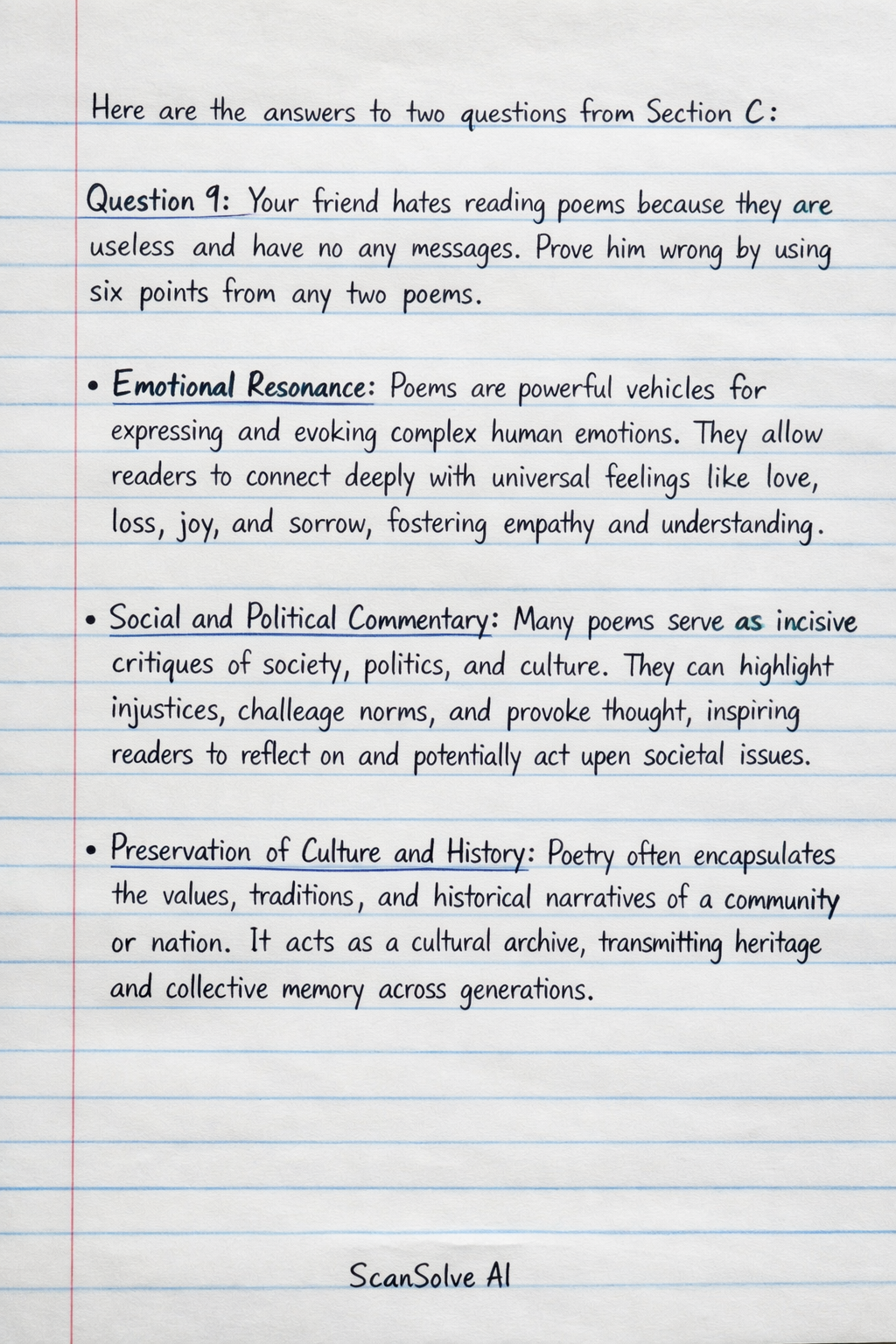
Here are the answers to two questions from Section C:
Question 9: Your friend hates reading poems because they are useless and have no any messages. Prove him wrong by using six points from any two poems.
- Emotional Resonance: Poems are powerful vehicles for expressing and evoking complex human emotions. They allow readers to connect deeply with universal feelings like love, loss, joy, and sorrow, fostering empathy and understanding.
- Social and Political Commentary: Many poems serve as incisive critiques of society, politics, and culture. They can highlight injustices, challenge norms, and provoke thought, inspiring readers to reflect on and potentially act upon societal issues.
- Preservation of Culture and History: Poetry often encapsulates the values, traditions, and historical narratives of a community or nation. It acts as a cultural archive, transmitting heritage and collective memory across generations.
- Philosophical Exploration: Poems frequently delve into profound philosophical questions about existence, morality, the meaning of life, and the human condition. They offer diverse perspectives and encourage introspection, expanding one's understanding of the world.
- Aesthetic Appreciation and Language Mastery: Beyond their thematic content, poems offer beauty through their artistic use of language, rhythm, imagery, and sound devices. They provide intellectual and sensory pleasure, showcasing the expressive potential of words.
- Personal Connection and Insight: Poems can offer profound personal insights, helping individuals articulate their own experiences, find solace in shared human struggles, or gain new perspectives on their own lives.
Question 10: Figures of speech Enhance the playwright to send messages successful to the public". Use two plays you have read under this section to support your answer with six points in total.
- Metaphor and Simile: These figures create vivid comparisons, making abstract ideas tangible and relatable. Playwrights use them to deepen the audience's understanding of characters' emotions, situations, or underlying themes by drawing parallels to familiar concepts.
- Symbolism: Through symbolism, objects, characters, or actions represent larger, often abstract, ideas or concepts. This adds layers of meaning to the play, allowing the playwright to convey complex messages subtly and powerfully without explicit exposition.
- Irony (Verbal, Situational, Dramatic): Irony creates a contrast between expectation and reality, or between what is said and what is meant. It can be used to generate humor, build suspense, or highlight a critical message about human folly or societal issues, engaging the audience's intellect.
- Hyperbole: Exaggeration for emphasis or effect, hyperbole draws heightened attention to a particular point or emotion. It can underscore the intensity of a character's feelings or the absurdity of a situation, making the playwright's message more impactful and memorable.
- Personification: Attributing human qualities or actions to inanimate objects or abstract ideas makes descriptions more engaging and memorable. It can help to convey a play's atmosphere, a character's perception of their surroundings, or a deeper thematic message.
- Allusion: References to historical events, mythological figures, or other literary works enrich the play's context and meaning. Allusions allow playwrights to tap into shared cultural knowledge, adding depth and resonance to their messages for an informed audience.
Was this helpful?
Still stuck on this one?
Ask a follow-up, and the answer starts from this question.
Got a different question?Ask your own question
More English Questions
QA. UNDERSTANDING THE POEM (8) 1. What can words do according to the poem? (2) 2. What does the poet…QA) Step 1: Suggest the meaning of the poem.QGive two theme found in the poemsQRead one of the poems below carefully and answer the questions below it.QExplain two non-verbal cues you would use to make the performance of the poem effective
Browse by topic:Literature
Handwritten Step-by-Step Solution
Get this as a handwritten image on WhatsApp — like a tutor wrote it for you.
Try on WhatsApp