

This English question involves literary analysis, grammar, or writing skills. The detailed response below provides a well-structured answer with supporting evidence and clear explanations.
ScanSolve AI Answer
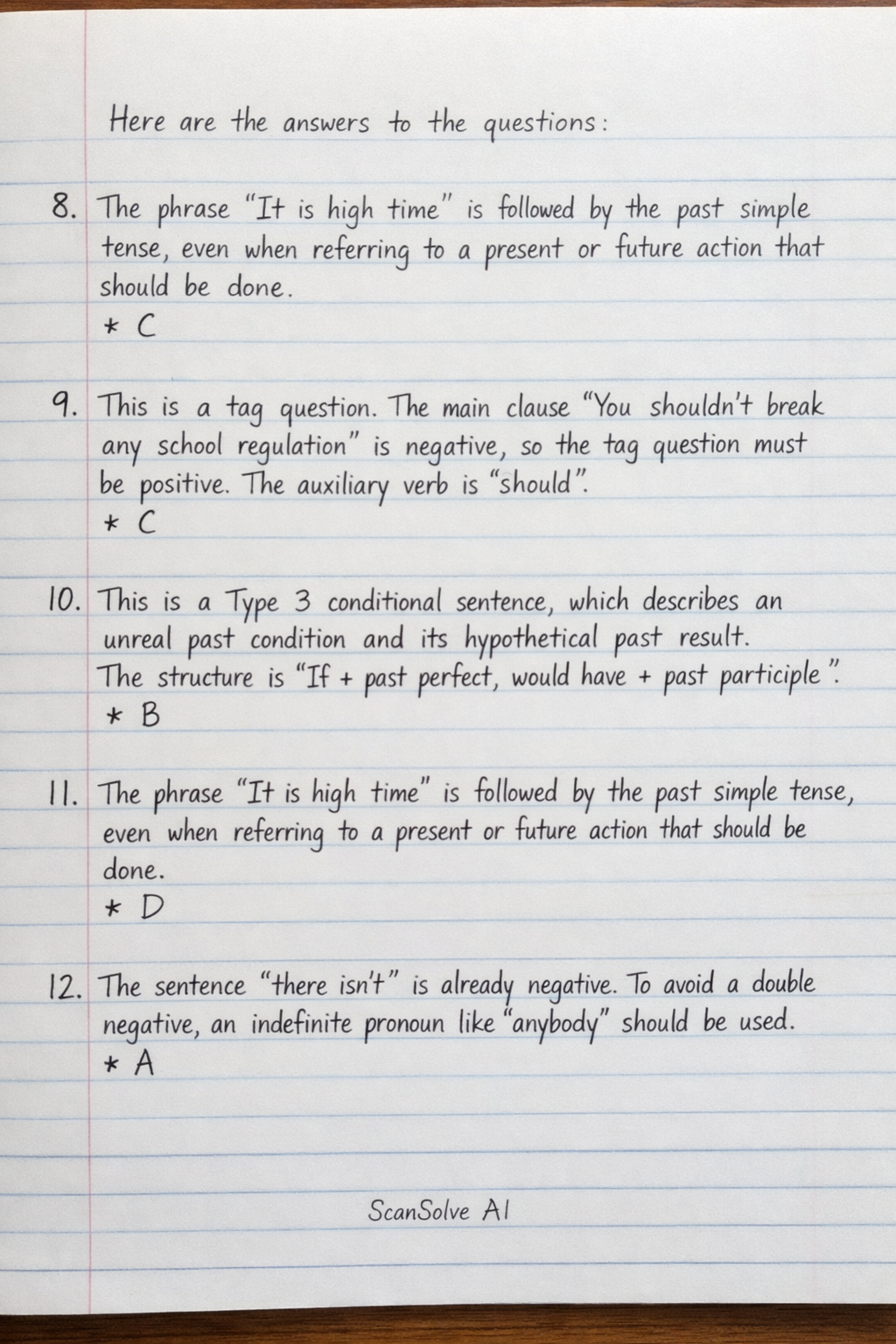
Here are the answers to the questions: 8. The phrase "It is high time" is followed by the past simple tense, even when referring to a present or future action that should be done. C 9. This is a tag question. The main clause "You shouldn't break any school regulation" is negative, so the tag question must be positive. The auxiliary verb is "should". C 10. This is a Type 3 conditional sentence, which describes an unreal past condition and its hypothetical past result. The structure is "If + past perfect, would have + past participle". B 11. The phrase "It is high time" is followed by the past simple tense, even when referring to a present or future action that should be done. D 12. The sentence "there isn't" is already negative. To avoid a double negative, an indefinite pronoun like "anybody" should be used. A 13. This option provides the clearest and most grammatically correct way to express the frequency of going to town. "Twice a term" specifies the frequency within a term, and "during the year" specifies the overall period. C 14. When converting direct speech to reported speech, the present perfect tense ("have gone") shifts to the past perfect tense ("had gone"), and the pronoun "we" changes to "they". B 15. The original sentence is in the past continuous tense ("were sweeping"). The passive form for the past continuous tense is "was/were + being + past participle". D 16. The word "incensed" means extremely angry or enraged. C 17. The word "fatigue" means extreme tiredness or weariness. C 18. The word "gigantic" means extremely large or enormous. A That's 2 down. 3 left today — send the next one.