

This mathematics problem involves applying core mathematical principles and formulas. Below you will find a complete step-by-step solution with detailed explanations for each step, helping you understand not just the answer but the method behind it.
ScanSolve AI Answer
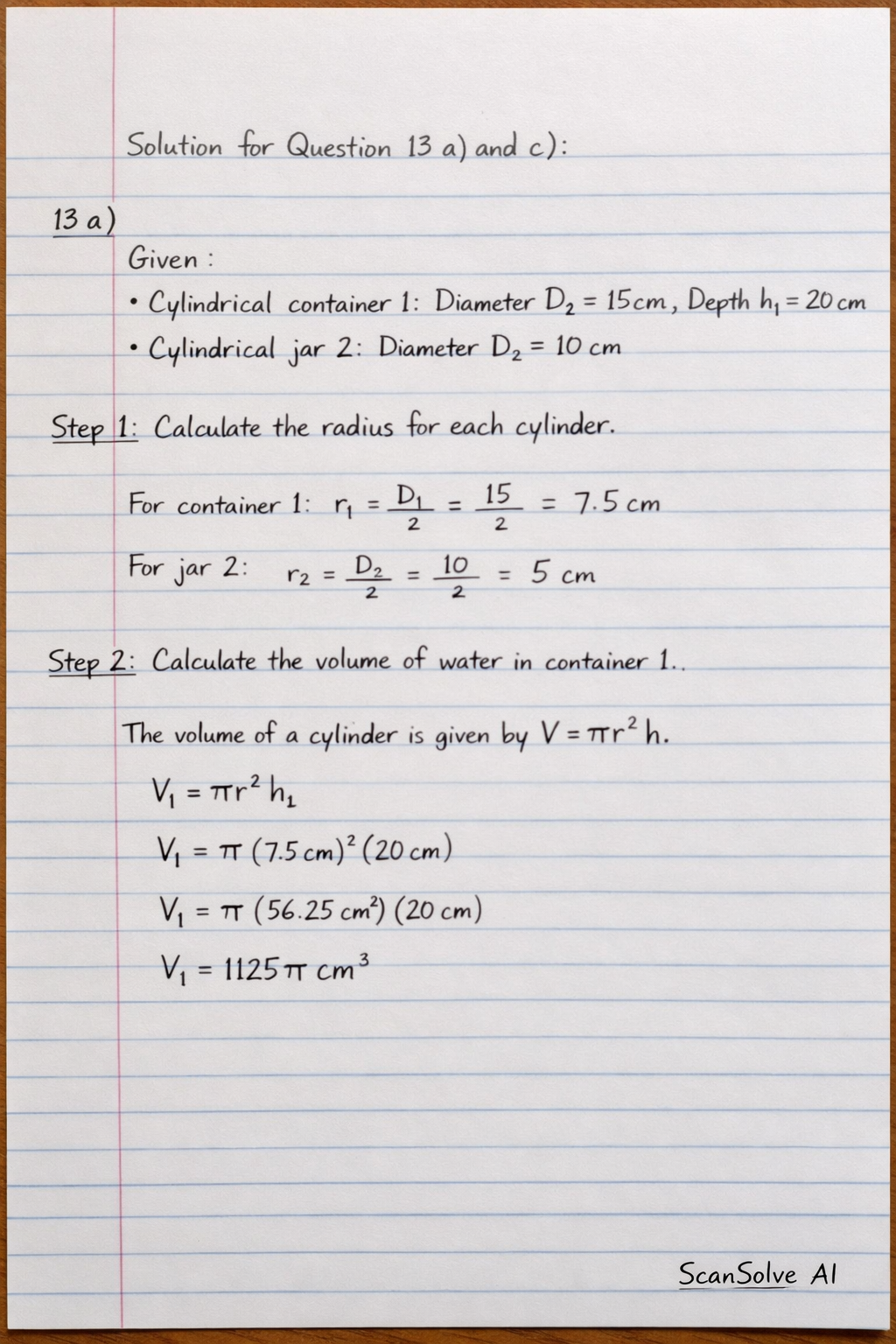
Here's the solution for question 13 a) and c): 13 a) Given: Cylindrical container 1: Diameter D_1 = 15 cm, Depth h_1 = 20 cm Cylindrical jar 2: Diameter D_2 = 10 cm Step 1: Calculate the radius for each cylinder. For container 1: r_1 = (D_1)/(2) = (15)/(2) = 7.5 cm For jar 2: r_2 = (D_2)/(2) = (10)/(2) = 5 cm Step 2: Calculate the volume of water in container 1. The volume of a cylinder is given by V = r^2 h. V_1 = r_1^2 h_1 V_1 = (7.5 cm)^2 (20 cm) V_1 = (56.25 cm^2) (20 cm) V_1 = 1125 cm^3 Step 3: Use the conservation of volume to find the depth in jar 2. When the water is poured into jar 2, its volume remains the same, so V_2 = V_1. Let h_2 be the depth of water in jar 2. V_2 = r_2^2 h_2 1125 cm^3 = (5 cm)^2 h_2 1125 cm^3 = 25 cm^2 h_2 Divide both sides by 25 : h_2 = 1125 cm^325 cm^2 h_2 = (1125)/(25) cm h_2 = 45 cm The depth of the water in the jar is 45 cm. 13 c) Given: Cylindrical tank: Diameter D = 5.0 m, Volume of water V = 110 000 dm^3 Step 1: Convert all measurements to consistent units. Let's convert everything to meters. Radius r = (D)/(2) = 5.0 m2 = 2.5 m Volume V = 110 000 dm^3. Since 1 m = 10 dm, then 1 m^3 = (10 dm)^3 = 1000 dm^3. V = 110 000 dm^31000 dm^3/m^3 = 110 m^3 Step 2: Use the volume formula to find the height of the water. The volume of a cylinder is V = r^2 h. We need to find h. Using = (22)/(7): 110 m^3 = (22)/(7) × (2.5 m)^2 × h 110 m^3 = (22)/(7) × 6.25 m^2 × h h = 110 m^3 × 722 × 6.25 m^2 h = (770)/(137.5) m h = 5.6 m The height of the water in the tank is 5.6 m. That's 2 down. 3 left today — send the next one.