
We read your photo as:
Determine the general term for each arithmetic sequence.
ScanSolve AI Answer
Answer
Step-by-step solution
4 stepsDetermine the general term for each arithmetic sequence.
The formula for the -th term of an arithmetic sequence is , where is the first term and is the common difference.
For the first sequence:
The first term .
The common difference .
The general term is .
To find the number of terms in this sequence, set :So, the first sequence has 101 terms.
For the second sequence:
The first term .
The common difference .
The general term is .
To find the number of terms in this sequence, set :So, the second sequence has 91 terms.
Find the first common term and the common difference of the sequence of common terms.
The common terms must satisfy both general forms:
We are looking for the smallest integer values of and that satisfy this equation.
Let's test values for :
If , (not divisible by 4)
If , (divisible by 4, so )
When , the term in the first sequence is .
When , the term in the second sequence is .
So, the first common term is 19.The common difference of the sequence of common terms is the Least Common Multiple (LCM) of the common differences of the two original sequences.
and .
LCM.
So, the sequence of common terms is an arithmetic sequence with first term and common difference .
The general term for the common sequence is .Determine the upper limit for the common terms.
A common term must be present in both sequences. Therefore, it cannot exceed the last term of either sequence.
The last term of the first sequence is 415.
The last term of the second sequence is 464.
The common terms must be less than or equal to the minimum of these two last terms: .Find the number of common terms.
We need to find the number of terms such that :
Since must be an integer, the largest possible value for is 20.
Therefore, there are 20 common terms in the two sequences.The final answer is .
Try one yourself
A new problem that tests the same skill.
Still stuck on this one?
Ask a follow-up, and the answer starts from this question.
More Mathematics Questions
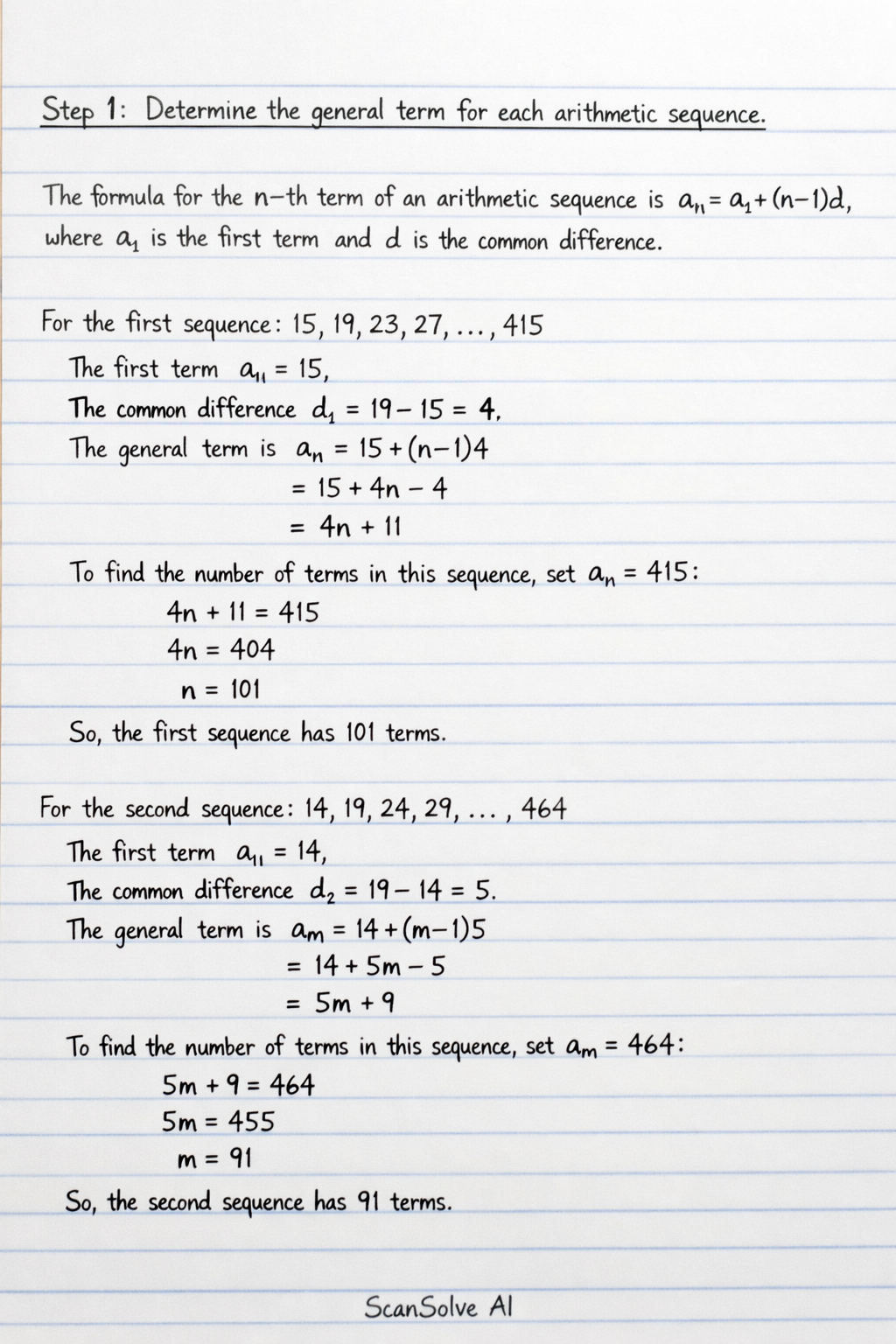
Handwritten Step-by-Step Solution
Get this as a handwritten image on WhatsApp — like a tutor wrote it for you.
Try on WhatsApp