

This mathematics problem involves applying core mathematical principles and formulas. Below you will find a complete step-by-step solution with detailed explanations for each step, helping you understand not just the answer but the method behind it.
ScanSolve AI Answer
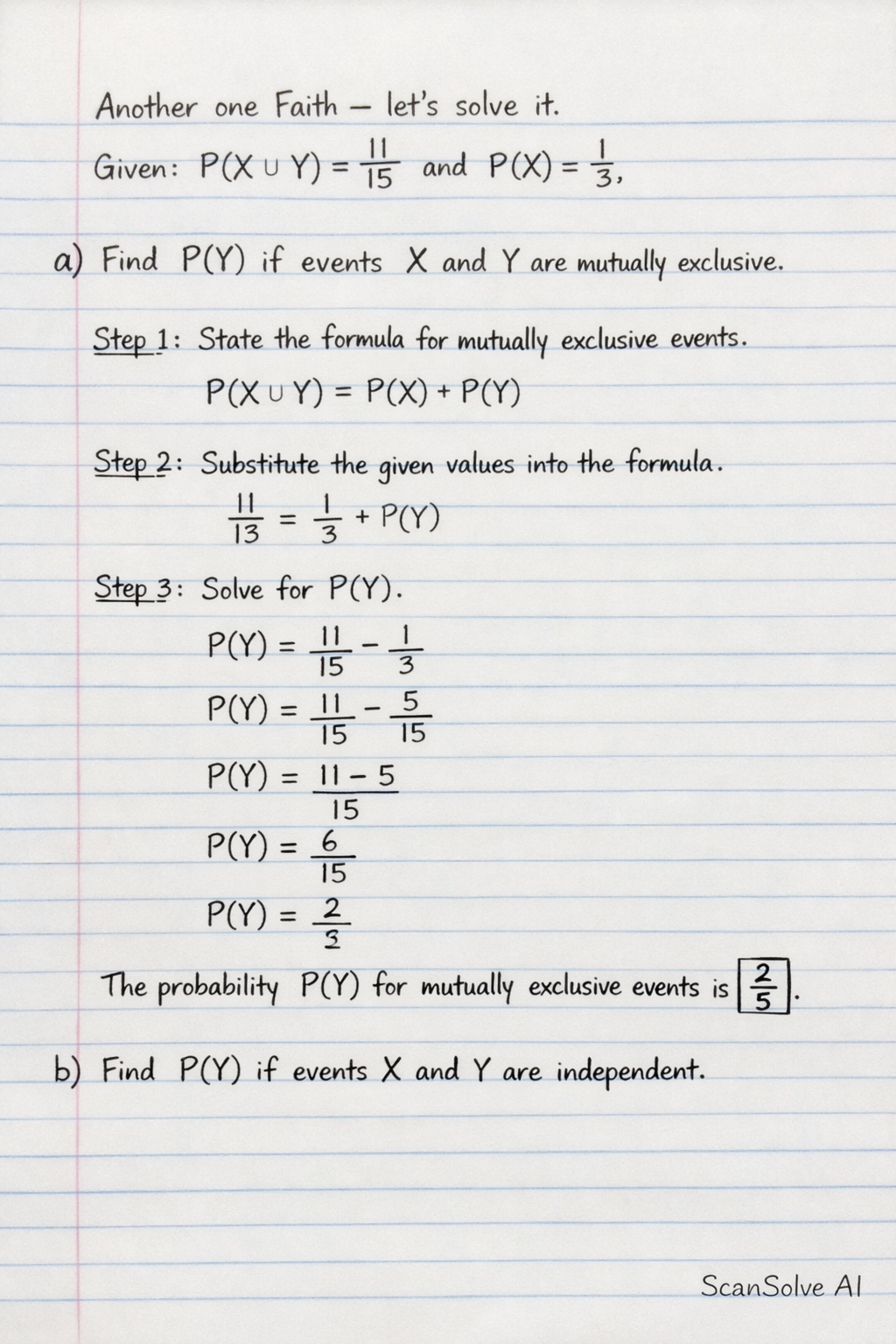
Another one Faith — let's solve it. Given: P(X Y) = (11)/(15) and P(X) = (1)/(3). a) Find P(Y) if events X and Y are mutually exclusive. Step 1: State the formula for mutually exclusive events. For mutually exclusive events, the probability of their union is the sum of their individual probabilities, as P(X Y) = 0. P(X Y) = P(X) + P(Y) Step 2: Substitute the given values into the formula. (11)/(15) = (1)/(3) + P(Y) Step 3: Solve for P(Y). P(Y) = (11)/(15) - (1)/(3) To subtract, find a common denominator, which is 15. P(Y) = (11)/(15) - (1 × 5)/(3 × 5) P(Y) = (11)/(15) - (5)/(15) P(Y) = (11 - 5)/(15) P(Y) = (6)/(15) Simplify the fraction: P(Y) = (2)/(5) The probability P(Y) for mutually exclusive events is (2)/(5). b) Find P(Y) if events X and Y are independent. Step 1: State the formula for independent events. For independent events, the probability of their intersection is the product of their individual probabilities: P(X Y) = P(X) · P(Y). The general addition rule for probabilities is: P(X Y) = P(X) + P(Y) - P(X Y) Step 2: Substitute the independence condition into the general addition rule. P(X Y) = P(X) + P(Y) - P(X)P(Y) Step 3: Substitute the given values into the equation. (11)/(15) = (1)/(3) + P(Y) - ((1)/(3))P(Y) Step 4: Rearrange the equation to solve for P(Y). Combine terms involving P(Y): (11)/(15) - (1)/(3) = P(Y) - (1)/(3)P(Y) (11)/(15) - (5)/(15) = P(Y)(1 - (1)/(3)) (6)/(15) = P(Y)((3)/(3) - (1)/(3)) (2)/(5) = P(Y)((2)/(3)) Step 5: Isolate P(Y). P(Y) = (2)/(5) ÷ (2)/(3) P(Y) = (2)/(5) × (3)/(2) P(Y) = (3)/(5) The probability P(Y) for independent events is (3)/(5). What's next?