Given that when P(x) is divided by (x+2), the remainder is 3, we have P(-2) = 3.

Mathematics
Given that when P(x) is divided by (x+2), the remainder is 3, we have P(-2) = 3.

ScanSolve AI Answer

Answer

43x+13-\frac{4}{3}x + \frac{1}{3}

Hey ThegirlGodishelping🥰💙🫠, good to see you again.

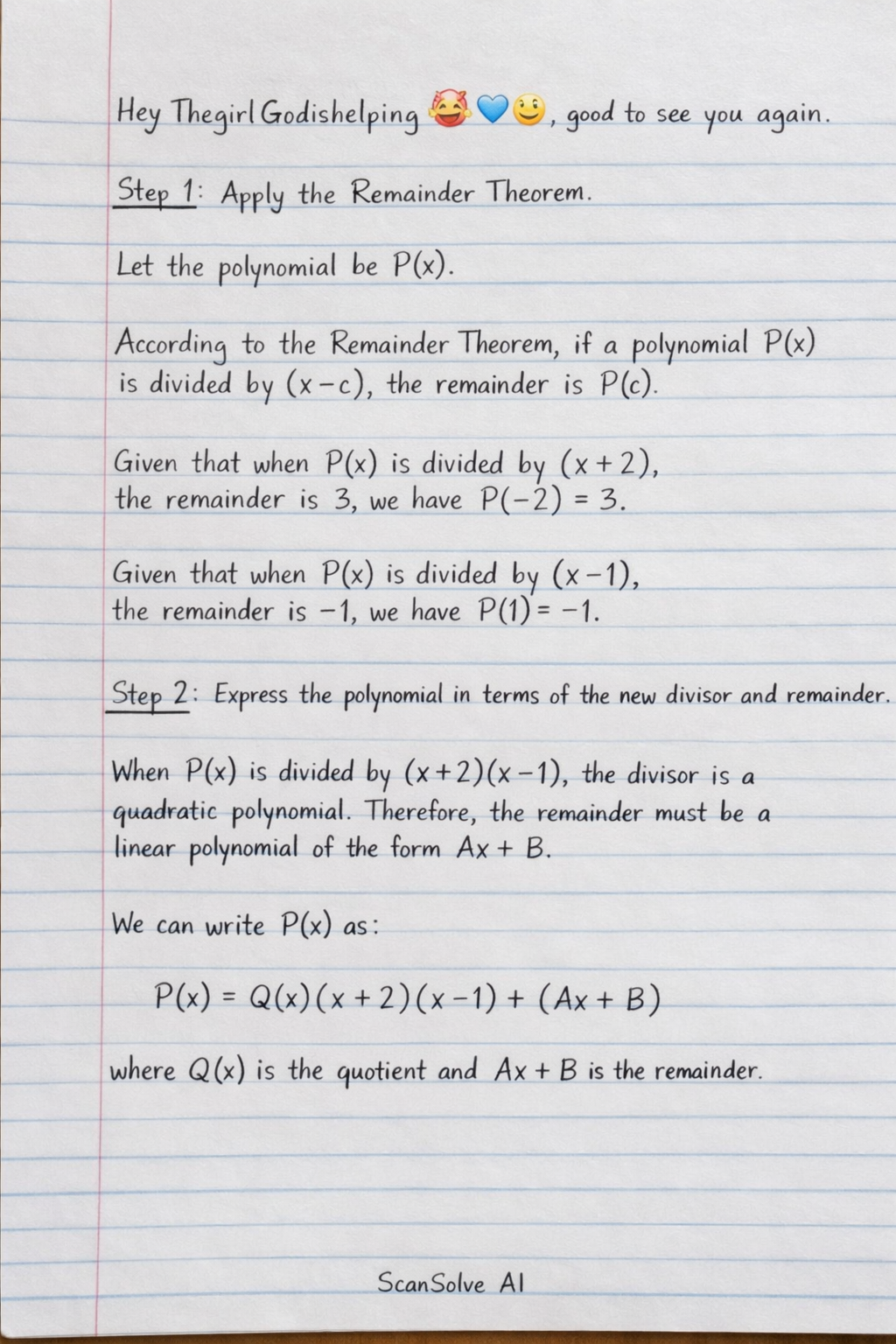
Step 1: Apply the Remainder Theorem. Let the polynomial be P(x)P(x). According to the Remainder Theorem, if a polynomial P(x)P(x) is divided by (xc)(x-c), the remainder is P(c)P(c). Given that when P(x)P(x) is divided by (x+2)(x+2), the remainder is 33, we have P(2)=3P(-2) = 3. Given that when P(x)P(x) is divided by (x1)(x-1), the remainder is 1-1, we have P(1)=1P(1) = -1.

Step 2: Express the polynomial in terms of the new divisor and remainder. When P(x)P(x) is divided by (x+2)(x1)(x+2)(x-1), the divisor is a quadratic polynomial. Therefore, the remainder must be a linear polynomial of the form Ax+BAx + B. We can write P(x)P(x) as: P(x)=Q(x)(x+2)(x1)+(Ax+B)P(x) = Q(x)(x+2)(x-1) + (Ax + B) where Q(x)Q(x) is the quotient and Ax+BAx + B is the remainder.

Step 3: Use the given conditions to form a system of equations. Substitute x=2x = -2 into the equation for P(x)P(x): P(2)=Q(2)(2+2)(21)+(A(2)+B)P(-2) = Q(-2)(-2+2)(-2-1) + (A(-2) + B) 3=Q(2)(0)(3)+(2A+B)3 = Q(-2)(0)(-3) + (-2A + B) 3=2A+B()3 = -2A + B \quad (*) Substitute x=1x = 1 into the equation for P(x)P(x): P(1)=Q(1)(1+2)(11)+(A(1)+B)P(1) = Q(1)(1+2)(1-1) + (A(1) + B) 1=Q(1)(3)(0)+(A+B)-1 = Q(1)(3)(0) + (A + B) 1=A+B()-1 = A + B \quad (**)

Step 4: Solve the system of linear equations for AA and BB. We have the system:

  1. 2A+B=3-2A + B = 3
  2. A+B=1A + B = -1 Subtract equation (2) from equation (1): (2A+B)(A+B)=3(1)(-2A + B) - (A + B) = 3 - (-1) 2AA+BB=3+1-2A - A + B - B = 3 + 1 3A=4-3A = 4 A=43A = -\frac{4}{3} Substitute the value of AA into equation (2): 43+B=1-\frac{4}{3} + B = -1 B=1+43B = -1 + \frac{4}{3} B=33+43B = -\frac{3}{3} + \frac{4}{3} B=13B = \frac{1}{3}

Step 5: State the remainder. The remainder is Ax+BAx + B. Substitute the values of AA and BB: Remainder=43x+13\text{Remainder} = -\frac{4}{3}x + \frac{1}{3}

The remainder when the polynomial is divided by (x+2)(x1)(x+2)(x-1) is 43x+13\boxed{-\frac{4}{3}x + \frac{1}{3}}.

Send me the next one 📸

Was this helpful?

Need help with your own homework?

Get instant step-by-step solutions to any question. Free to start.

Ask Your Question
Handwritten step-by-step solution preview

Handwritten Step-by-Step Solution

Get this as a handwritten image on WhatsApp — like a tutor wrote it for you.

Try on WhatsApp

Still have questions?

Quick Answer

Hey ThegirlGodishelping🥰💙🫠, good to see you again. Step 1: Apply the Remainder Theorem.

Given that when P(x) is divided by (x+2), the remainder is 3, we have P(-2) = 3.
Mathematics

This mathematics problem involves applying core mathematical principles and formulas. Below you will find a complete step-by-step solution with detailed explanations for each step, helping you understand not just the answer but the method behind it.

ScanSolve AI Answer
Hey ThegirlGodishelping🥰💙🫠, good to see you again. Step 1: Apply the Remainder Theorem. Let the polynomial be P(x). According to the Remainder Theorem, if a polynomial P(x) is divided by (x-c), the remainder is P(c). Given that when P(x) is divided by (x+2), the remainder is 3, we have P(-2) = 3. Given that when P(x) is divided by (x-1), the remainder is -1, we have P(1) = -1. Step 2: Express the polynomial in terms of the new divisor and remainder. When P(x) is divided by (x+2)(x-1), the divisor is a quadratic polynomial. Therefore, the remainder must be a linear polynomial of the form Ax + B. We can write P(x) as: P(x) = Q(x)(x+2)(x-1) + (Ax + B) where Q(x) is the quotient and Ax + B is the remainder. Step 3: Use the given conditions to form a system of equations. Substitute x = -2 into the equation for P(x): P(-2) = Q(-2)(-2+2)(-2-1) + (A(-2) + B) 3 = Q(-2)(0)(-3) + (-2A + B) 3 = -2A + B (*) Substitute x = 1 into the equation for P(x): P(1) = Q(1)(1+2)(1-1) + (A(1) + B) -1 = Q(1)(3)(0) + (A + B) -1 = A + B (**) Step 4: Solve the system of linear equations for A and B. We have the system: 1) -2A + B = 3 2) A + B = -1 Subtract equation (2) from equation (1): (-2A + B) - (A + B) = 3 - (-1) -2A - A + B - B = 3 + 1 -3A = 4 A = -(4)/(3) Substitute the value of A into equation (2): -(4)/(3) + B = -1 B = -1 + (4)/(3) B = -(3)/(3) + (4)/(3) B = (1)/(3) Step 5: State the remainder. The remainder is Ax + B. Substitute the values of A and B: Remainder = -(4)/(3)x + (1)/(3) The remainder when the polynomial is divided by (x+2)(x-1) is -(4)/(3)x + (1)/(3). Send me the next one 📸