

This mathematics problem involves applying core mathematical principles and formulas. Below you will find a complete step-by-step solution with detailed explanations for each step, helping you understand not just the answer but the method behind it.
ScanSolve AI Answer
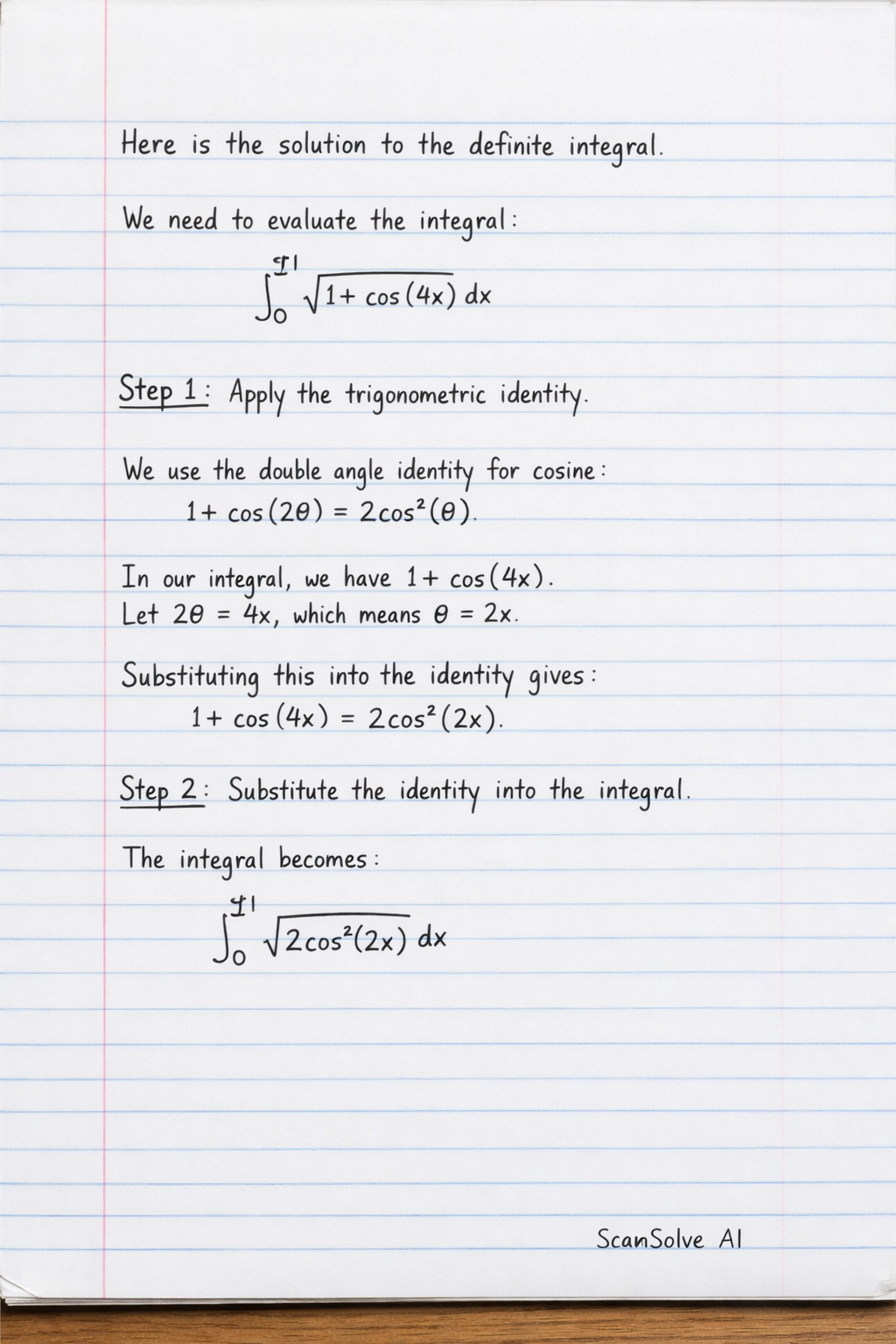
Here is the solution to the definite integral. We need to evaluate the integral: _0^/A sqrt(1 + (4x)) \, dx Step 1: Apply the trigonometric identity. We use the double angle identity for cosine: 1 + (2) = 2^2(). In our integral, we have 1 + (4x). Let 2 = 4x, which means = 2x. Substituting this into the identity gives: 1 + (4x) = 2^2(2x) Step 2: Substitute the identity into the integral. The integral becomes: _0^/A sqrt(2^2(2x)) \, dx Step 3: Simplify the square root. _0^/A sqrt(2) sqrt(^2(2x)) \, dx = _0^/A sqrt(2) |(2x)| \, dx For this integral to be straightforward, we assume that (2x) 0 over the entire interval of integration [0, ()/(A)]. This typically means that 2x lies in the interval [0, ()/(2)], which implies x lies in [0, ()/(4)]. Therefore, we assume ()/(A) ()/(4), or A 4. Under this assumption, |(2x)| = (2x). So the integral simplifies to: _0^/A sqrt(2) (2x) \, dx Step 4: Integrate the expression. We can pull the constant sqrt(2) out of the integral: sqrt(2) _0^/A (2x) \, dx The integral of (ax) is (1)/(a)(ax). So, the integral of (2x) is (1)/(2)(2x). = sqrt(2) [ (1)/(2)(2x) ]_0^/A Step 5: Evaluate the definite integral using the limits. = sqrt(2)2 [ (2 · ()/(A)) - (2 · 0) ] = sqrt(2)2 [ ((2)/(A)) - (0) ] Since (0) = 0: = sqrt(2)2 [ ((2)/(A)) - 0 ] = sqrt(2)2 ((2)/(A)) The value of the integral is sqrt(2)2 ((2)/(A)). That's 2 down. 3 left today — send the next one.