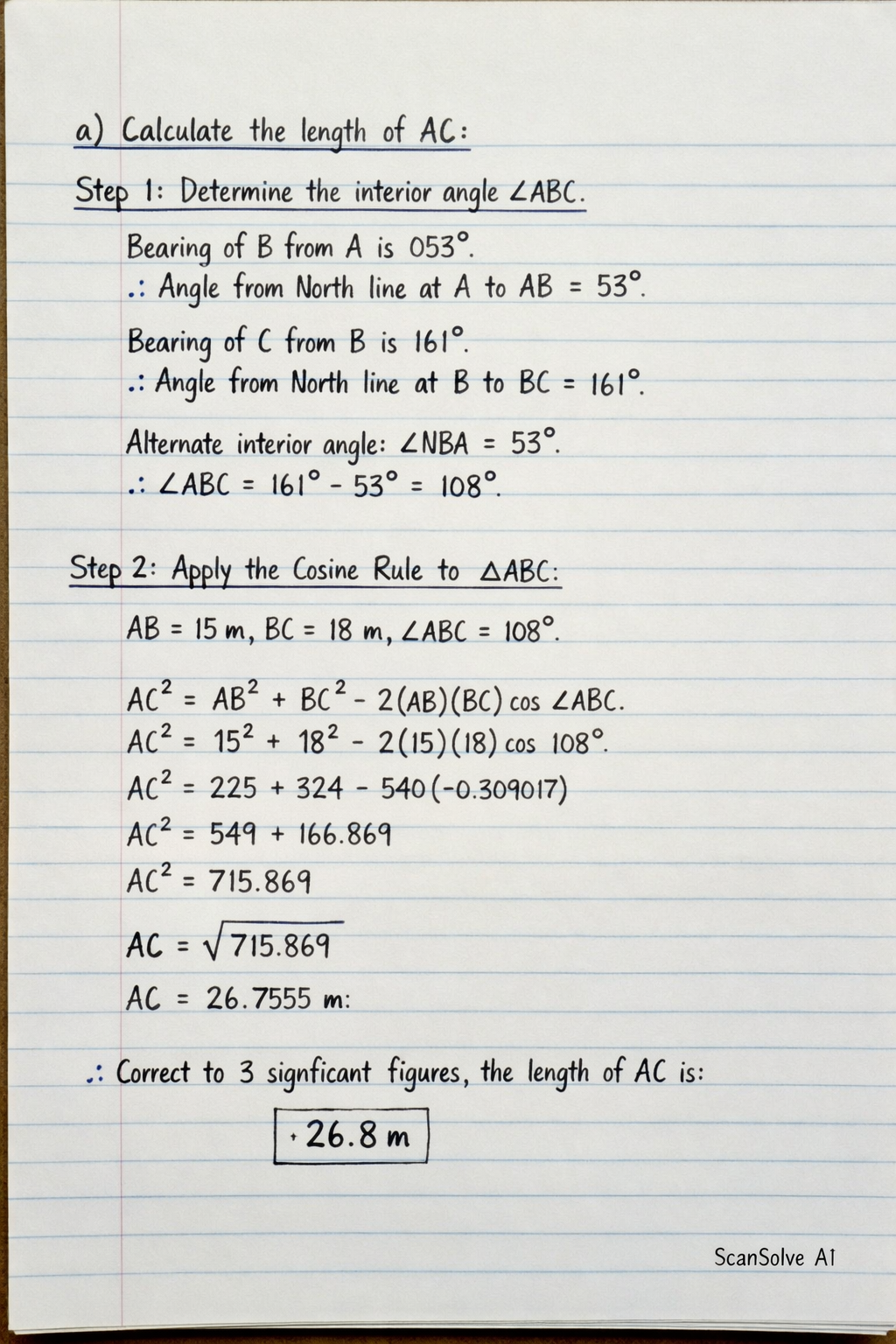
Determine the interior angle ABC.

Mathematics
Determine the interior angle ABC.

ScanSolve AI Answer

Answer

26.8, m

Here's how to solve the problem:

a) Calculate the length of AC: Step 1: Determine the interior angle ABC\angle ABC. The bearing of B from A is 053053^\circ. This means the angle from the North line at A to AB is 5353^\circ. The bearing of C from B is 161161^\circ. This means the angle from the North line at B to BC is 161161^\circ. Since the North lines at A and B are parallel, the alternate interior angle to 5353^\circ (angle NAB) is the angle between the line BA and the North line at B, which is 5353^\circ. Therefore, ABC=16153=108\angle ABC = 161^\circ - 53^\circ = 108^\circ.

Step 2: Apply the Cosine Rule to triangle ABC. Given AB=15mAB = 15\, \text{m}, BC=18mBC = 18\, \text{m}, and ABC=108\angle ABC = 108^\circ. AC2=AB2+BC22(AB)(BC)cos(ABC)AC^2 = AB^2 + BC^2 - 2(AB)(BC)\cos(\angle ABC) AC2=152+1822(15)(18)cos(108)AC^2 = 15^2 + 18^2 - 2(15)(18)\cos(108^\circ) AC2=225+324540(0.309017)AC^2 = 225 + 324 - 540(-0.309017) AC2=549+166.869AC^2 = 549 + 166.869 AC2=715.869AC^2 = 715.869 AC=715.869AC = \sqrt{715.869} AC=26.7555mAC = 26.7555\, m Correct to three significant figures, the length of AC is 26.8m\boxed{26.8\, m}.

b) Calculate the bearing of C from A: Step 1: Use the Sine Rule to find BAC\angle BAC. BCsin(BAC)=ACsin(ABC)\frac{BC}{\sin(\angle BAC)} = \frac{AC}{\sin(\angle ABC)} 18sin(BAC)=26.7555sin(108)\frac{18}{\sin(\angle BAC)} = \frac{26.7555}{\sin(108^\circ)} sin(BAC)=18×sin(108)26.7555\sin(\angle BAC) = \frac{18 \times \sin(108^\circ)}{26.7555} sin(BAC)=18×0.95105626.7555\sin(\angle BAC) = \frac{18 \times 0.951056}{26.7555} sin(BAC)=0.63908\sin(\angle BAC) = 0.63908 BAC=arcsin(0.63908)\angle BAC = \arcsin(0.63908) BAC=39.739\angle BAC = 39.739^\circ

Step 2: Calculate the bearing of C from A. The bearing of B from A is 053053^\circ. The bearing of C from A is the bearing of B from A plus BAC\angle BAC. BearingofCfromA=53+39.739=92.739Bearing of C from A = 53^\circ + 39.739^\circ = 92.739^\circ Correct to three significant figures, the bearing of C from A is 092.7\boxed{092.7^\circ}.

c) Calculate the height of the pole BT: Step 1: Identify the right-angled triangle ABT. The pole BT is vertical, so ABT=90\angle ABT = 90^\circ. Given AB=15mAB = 15\, \text{m} and ATB=58\angle ATB = 58^\circ.

Step 2: Use the tangent trigonometric ratio. tan(ATB)=OppositeAdjacent=ABBT\tan(\angle ATB) = \frac{Opposite}{Adjacent} = \frac{AB}{BT} tan(58)=15BT\tan(58^\circ) = \frac{15}{BT} BT=15tan(58)BT = \frac{15}{\tan(58^\circ)} BT=151.60033BT = \frac{15}{1.60033} BT=9.3730mBT = 9.3730\, m Correct to three significant figures, the height of the pole BT is 9.37m\boxed{9.37\, m}.

That's 2 down. 3 left today — send the next one.

Was this helpful?

Need help with your own homework?

Get instant step-by-step solutions to any question. Free to start.

Ask Your Question
Handwritten step-by-step solution preview

Handwritten Step-by-Step Solution

Get this as a handwritten image on WhatsApp — like a tutor wrote it for you.

Try on WhatsApp

Still have questions?

Quick Answer

Here's how to solve the problem: a) Calculate the length of AC: Step 1: Determine the interior angle ABC.

Determine the interior angle ABC.
Mathematics

This mathematics problem involves applying core mathematical principles and formulas. Below you will find a complete step-by-step solution with detailed explanations for each step, helping you understand not just the answer but the method behind it.

ScanSolve AI Answer
Here's how to solve the problem: a) Calculate the length of AC: Step 1: Determine the interior angle ABC. The bearing of B from A is 053^. This means the angle from the North line at A to AB is 53^. The bearing of C from B is 161^. This means the angle from the North line at B to BC is 161^. Since the North lines at A and B are parallel, the alternate interior angle to 53^ (angle NAB) is the angle between the line BA and the North line at B, which is 53^. Therefore, ABC = 161^ - 53^ = 108^. Step 2: Apply the Cosine Rule to triangle ABC. Given AB = 15\, m, BC = 18\, m, and ABC = 108^. AC^2 = AB^2 + BC^2 - 2(AB)(BC)( ABC) AC^2 = 15^2 + 18^2 - 2(15)(18)(108^) AC^2 = 225 + 324 - 540(-0.309017) AC^2 = 549 + 166.869 AC^2 = 715.869 AC = sqrt(715.869) AC = 26.7555\, m Correct to three significant figures, the length of AC is 26.8\, m. b) Calculate the bearing of C from A: Step 1: Use the Sine Rule to find BAC. (BC)/(( BAC)) = (AC)/(( ABC)) (18)/(( BAC)) = (26.7555)/((108^)) ( BAC) = (18 × (108^))/(26.7555) ( BAC) = (18 × 0.951056)/(26.7555) ( BAC) = 0.63908 BAC = (0.63908) BAC = 39.739^ Step 2: Calculate the bearing of C from A. The bearing of B from A is 053^. The bearing of C from A is the bearing of B from A plus BAC. Bearing of C from A = 53^ + 39.739^ = 92.739^ Correct to three significant figures, the bearing of C from A is 092.7^. c) Calculate the height of the pole BT: Step 1: Identify the right-angled triangle ABT. The pole BT is vertical, so ABT = 90^. Given AB = 15\, m and ATB = 58^. Step 2: Use the tangent trigonometric ratio. ( ATB) = OppositeAdjacent = (AB)/(BT) (58^) = (15)/(BT) BT = (15)/((58^)) BT = (15)/(1.60033) BT = 9.3730\, m Correct to three significant figures, the height of the pole BT is 9.37\, m. That's 2 down. 3 left today — send the next one.