

This mathematics problem involves applying core mathematical principles and formulas. Below you will find a complete step-by-step solution with detailed explanations for each step, helping you understand not just the answer but the method behind it.
ScanSolve AI Answer
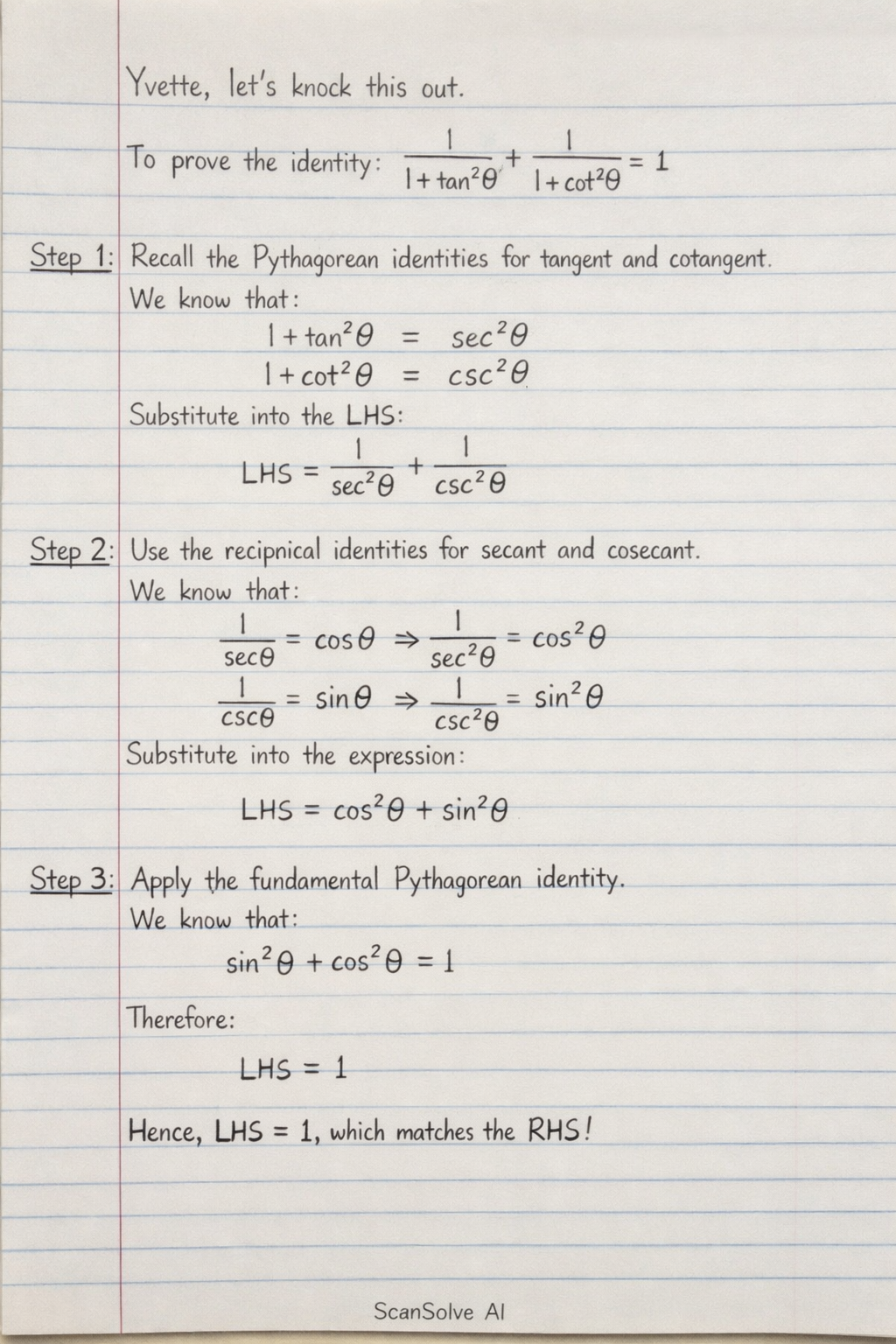
Yvette, let's knock this out. To prove the identity (1)/(1+^2) + (1)/(1+^2) = 1, we will start with the left-hand side (LHS) and simplify it to match the right-hand side (RHS). Step 1: Recall the Pythagorean identities for tangent and cotangent. We know that: 1+^2 = ^2 1+^2 = ^2 Substitute these into the LHS of the equation: LHS = (1)/(^2) + (1)/(^2) Step 2: Use the reciprocal identities for secant and cosecant. We know that: (1)/() = (1)/(^2) = ^2 (1)/() = (1)/(^2) = ^2 Substitute these into the expression: LHS = ^2 + ^2 Step 3: Apply the fundamental Pythagorean identity. We know that: ^2 + ^2 = 1 Therefore: LHS = 1 Since the LHS simplifies to 1, which is equal to the RHS, the identity is proven. (1)/(1+^2) + (1)/(1+^2) = 1 What's next? 📸