
This mathematics problem involves applying core mathematical principles and formulas. Below you will find a complete step-by-step solution with detailed explanations for each step, helping you understand not just the answer but the method behind it.
ScanSolve AI Answer
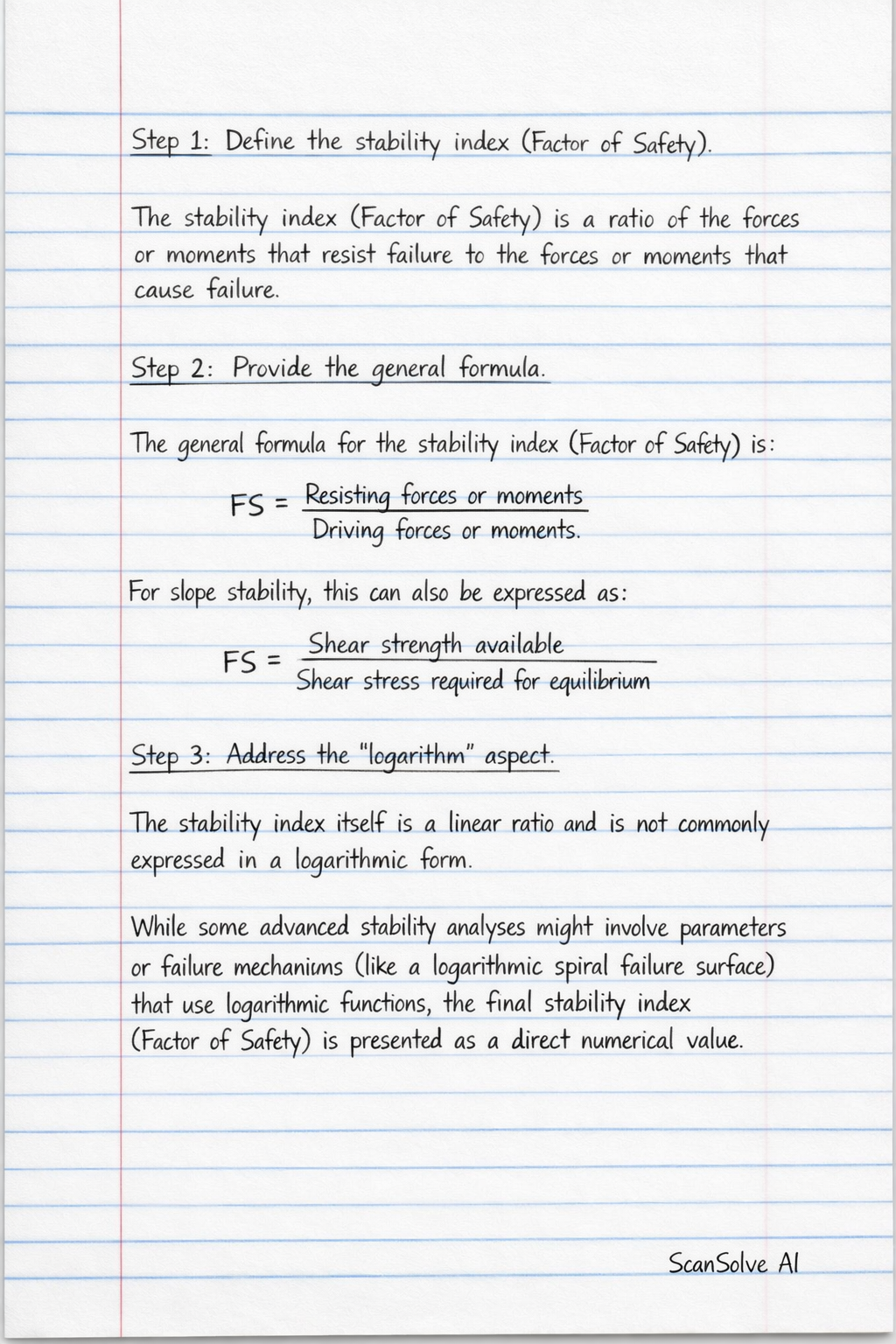
The stability index, often referred to as the Factor of Safety (FS) in geotechnical engineering, is a direct ratio and is not typically expressed in a logarithmic form. Step 1: Define the stability index (Factor of Safety). The stability index (Factor of Safety) is a ratio of the forces or moments that resist failure to the forces or moments that cause failure. Step 2: Provide the general formula. The general formula for the stability index (Factor of Safety) is: FS = Resisting forces or momentsDriving forces or moments For slope stability, this can also be expressed as: FS = Shear strength availableShear stress required for equilibrium Step 3: Address the "logarithm" aspect. The stability index itself is a linear ratio and is not commonly expressed in a logarithmic form. While some advanced stability analyses might involve parameters or failure mechanisms (like a logarithmic spiral failure surface) that use logarithmic functions, the final stability index (Factor of Safety) is presented as a direct numerical value. That's 2 down. 3 left today — send the next one.