
We read your photo as:
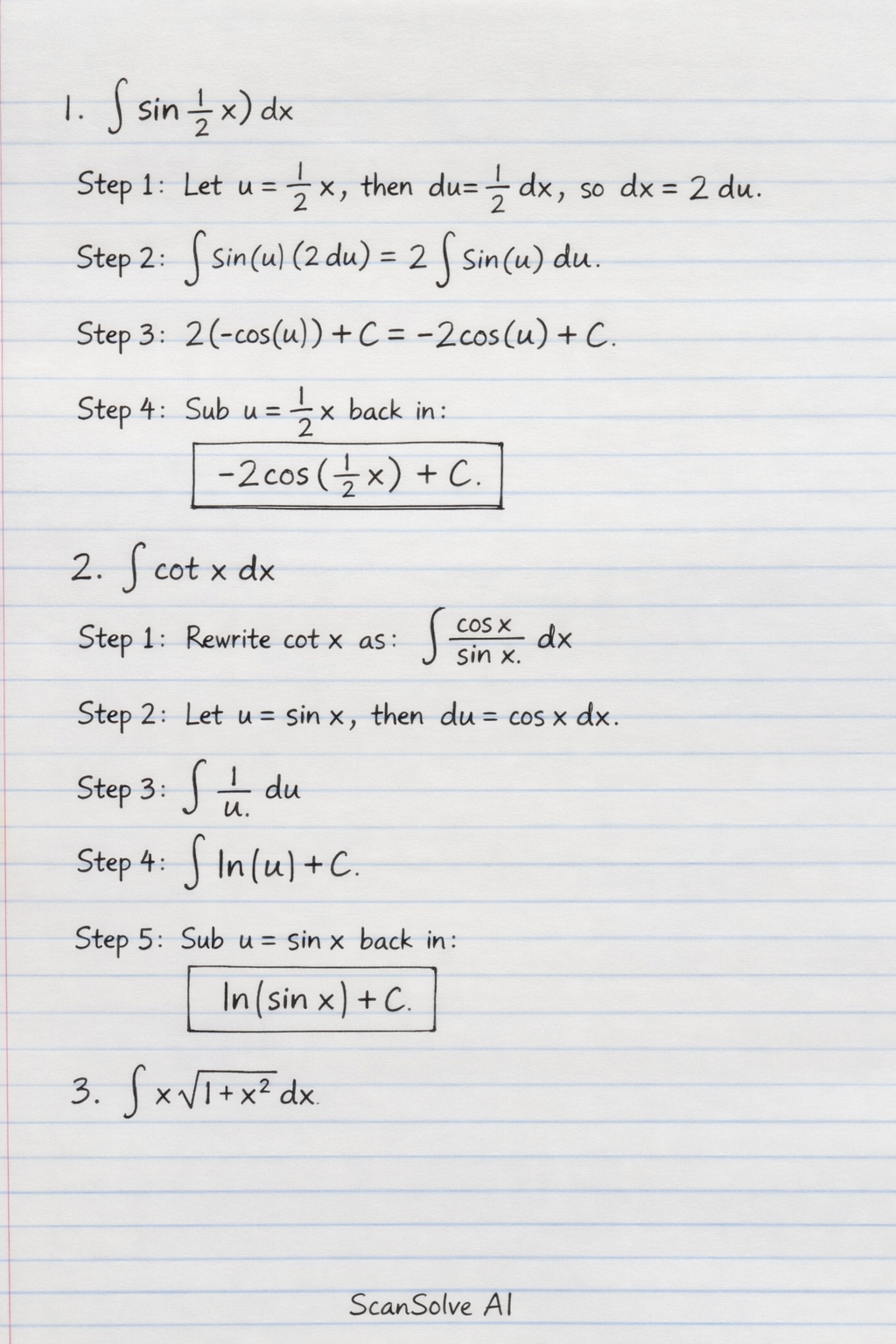
Use a substitution. Let u = (1)/(2)x.
ScanSolve AI Answer
Step-by-step solution
28 stepshere are the solutions to the integration problems:
- Integrate
Use a substitution.
Let .
Then, , which means .Substitute and into the integral.
$$ \int \sin(u) (2\,du) = 2 \int \sin(u)\,du $$Integrate with respect to .
$$ 2 (-\cos(u)) + C = -2\cos(u) + C $$Substitute back .
$$ \boxed{-2\cos\left(\frac{1}{2}x\right) + C} $$2. Integrate
Rewrite in terms of sine and cosine.
$$ \int \frac{\cos x}{\sin x}\,dx $$Use a substitution.
Let .
Then, .Substitute and into the integral.
$$ \int \frac{1}{u}\,du $$Integrate with respect to .
$$ \ln|u| + C $$Substitute back .
$$ \boxed{\ln|\sin x| + C} $$3. Integrate
Use a substitution.
Let .
Then, , which means .Substitute and into the integral.
$$ \int \sqrt{u} \left(\frac{1}{2}\,du\right) = \frac{1}{2} \int u^{1/2}\,du $$Integrate with respect to .
$$ \frac{1}{2} \left(\frac{u^{1/2 + 1}}{1/2 + 1}\right) + C = \frac{1}{2} \left(\frac{u^{3/2}}{3/2}\right) + C $$ $$ = \frac{1}{2} \cdot \frac{2}{3} u^{3/2} + C = \frac{1}{3} u^{3/2} + C $$Substitute back .
$$ \boxed{\frac{1}{3}(1 + x^2)^{3/2} + C} $$4. Integrate
Use a substitution.
Let .
Then, .Substitute and into the integral.
$$ \int u^4\,du $$Integrate with respect to .
$$ \frac{u^{4+1}}{4+1} + C = \frac{u^5}{5} + C $$Substitute back .
$$ \boxed{\frac{1}{5}(3 + e^x)^5 + C} $$5. Integrate
Recognize this as a standard integral.
The derivative of $\arctan x$ is $\frac{1}{1 + x^2}$.Apply the integration formula directly.
$$ \boxed{\arctan x + C} $$6. Integrate
Use the trigonometric identity .
$$ \int \frac{1 + \cos(2x)}{2}\,dx = \frac{1}{2} \int (1 + \cos(2x))\,dx $$Integrate term by term.
$$ \frac{1}{2} \left(\int 1\,dx + \int \cos(2x)\,dx\right) $$Integrate each term.
For , let , so , or . And .
Combine the results.
$$ \frac{1}{2} \left(x + \frac{1}{2}\sin(2x)\right) + C $$ $$ \boxed{\frac{1}{2}x + \frac{1}{4}\sin(2x) + C} $$7. Integrate
Rewrite using the identity .
$$ \int \cos^2 x \cdot \cos x\,dx = \int (1 - \sin^2 x) \cos x\,dx $$Use a substitution.
Let .
Then, .Substitute and into the integral.
$$ \int (1 - u^2)\,du $$Integrate with respect to .
$$ u - \frac{u^3}{3} + C $$Substitute back .
$$
\boxed{\sin x - \frac{1}{3}\sin^3 x + C}
$$
Still stuck on this one?
Ask a follow-up, and the answer starts from this question.
More Mathematics Questions
Handwritten Step-by-Step Solution
Get this as a handwritten image on WhatsApp — like a tutor wrote it for you.
Try on WhatsApp