Use the double angle formula for ^-1 x: 2 ^-1 x = ^-1 ((2x)/(1-x2)).
|Mathematics
Use the double angle formula for ^-1 x: 2 ^-1 x = ^-1 ((2x)/(1-x2)).
ScanSolve AI Answer
Answer
−177
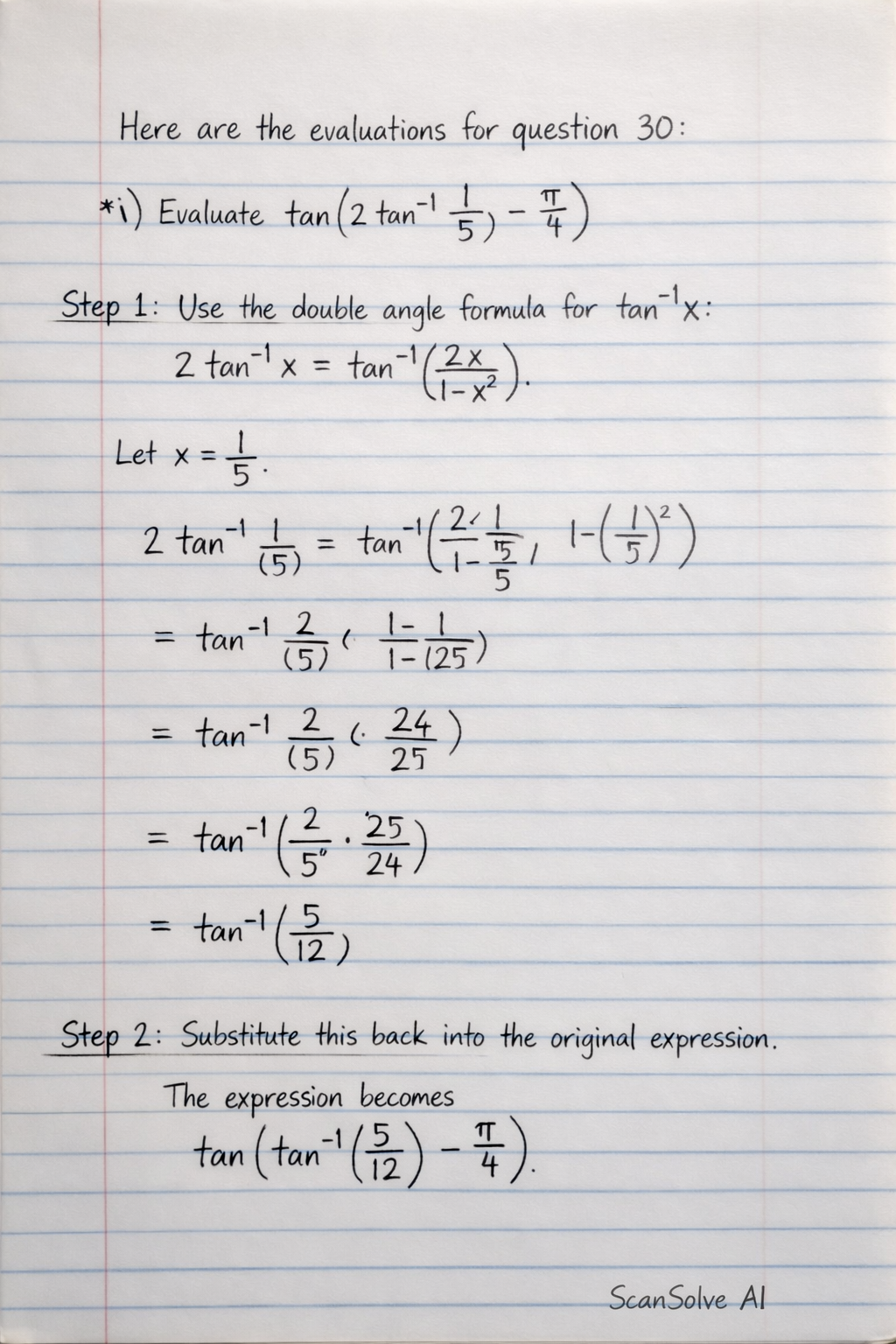
Here are the evaluations for question 30:
i) Evaluate tan(2tan−151−4π)
Step 1: Use the double angle formula for tan−1x: 2tan−1x=tan−1(1−x22x).
Let x=51.
2tan−151=tan−1(1−(51)22⋅51)=tan−1(1−25152)=tan−1(252452)=tan−1(52⋅2425)=tan−1(125)
Step 2: Substitute this back into the original expression.
The expression becomes tan(tan−1125−4π).
Step 3: Use the tangent subtraction formula: tan(A−B)=1+tanAtanBtanA−tanB.
Let A=tan−1125 and B=4π.
Then tanA=125 and tanB=tan4π=1.
tan(tan−1125−4π)=1+125⋅1125−1=1212+5125−12=1217−127=−177
The final answer is −177.
ii) Evaluate tan(21cos−135)
Step 1: Let θ=cos−135.
This implies cosθ=35. Since cos−1 returns a value in [0,π], θ is in the first quadrant, so 2θ is also in the first quadrant.
Step 2: Find sinθ using the identity sin2θ+cos2θ=1.
sin2θ=1−cos2θsin2θ=1−(35)2sin2θ=1−95sin2θ=99−5sin2θ=94
Since θ is in the first quadrant, sinθ is positive.
sinθ=94=32
Step 3: Use the half-angle formula for tangent: tan2θ=1+cosθsinθ.
tan(21cos−135)=tan2θ=1+3532=33+532=3+52
Step 4: Rationalize the denominator.
=3+52⋅3−53−5=32−(5)22(3−5)=9−52(3−5)=42(3−5)=23−5
The final answer is 23−5.
Send me the next one 📸
Was this helpful?
Need help with your own homework?
Get instant step-by-step solutions to any question. Free to start.
This mathematics problem involves applying core mathematical principles and formulas. Below you will find a complete step-by-step solution with detailed explanations for each step, helping you understand not just the answer but the method behind it.
ScanSolve AI Answer
Here are the evaluations for question 30: i) Evaluate (2 ^-1 (1)/(5) - ()/(4)) Step 1: Use the double angle formula for ^-1 x: 2 ^-1 x = ^-1 ((2x)/(1-x^2)). Let x = (1)/(5). 2 ^-1 (1)/(5) = ^-1 ((2 · 1)/(5)1 - ((1)/(5))^2) = ^-1 ((2)/(5)1 - (1)/(25)) = ^-1 ((2)/(5)(24)/(25)) = ^-1 ((2)/(5) · (25)/(24)) = ^-1 ((5)/(12)) Step 2: Substitute this back into the original expression. The expression becomes (^-1 (5)/(12) - ()/(4)). Step 3: Use the tangent subtraction formula: (A-B) = ( A - B)/(1 + A B). Let A = ^-1 (5)/(12) and B = ()/(4). Then A = (5)/(12) and B = ()/(4) = 1. (^-1 (5)/(12) - ()/(4)) = (5)/(12) - 11 + (5)/(12) · 1 = (5 - 12)/(12)(12 + 5)/(12) = (-7)/(12)(17)/(12) = -(7)/(17) The final answer is -(7)/(17). ii) Evaluate ((1)/(2) ^-1 sqrt(5)3) Step 1: Let = ^-1 sqrt(5)3. This implies = sqrt(5)3. Since ^-1 returns a value in [0, ], is in the first quadrant, so ()/(2) is also in the first quadrant. Step 2: Find using the identity ^2 + ^2 = 1. ^2 = 1 - ^2 ^2 = 1 - (sqrt(5)3)^2 ^2 = 1 - (5)/(9) ^2 = (9 - 5)/(9) ^2 = (4)/(9) Since is in the first quadrant, is positive. = sqrt((4)/(9)) = (2)/(3) Step 3: Use the half-angle formula for tangent: ()/(2) = ( )/(1 + ). ((1)/(2) ^-1 sqrt(5)3) = ()/(2) = (2)/(3)1 + sqrt(5)3 = (2)/(3)3 + sqrt(5)3 = (2)/(3 + sqrt(5)) Step 4: Rationalize the denominator. = (2)/(3 + sqrt(5)) · 3 - sqrt(5)3 - sqrt(5) = 2(3 - sqrt(5))3^2 - (sqrt(5))^2 = 2(3 - sqrt(5))9 - 5 = 2(3 - sqrt(5))4 = 3 - sqrt(5)2 The final answer is 3 - sqrt(5)2. Send me the next one 📸