c): Range d): velocity and direction of the motion at a height of 130 meters
|Physics
ScanSolve AI Answer
Answer
\text{3395 m
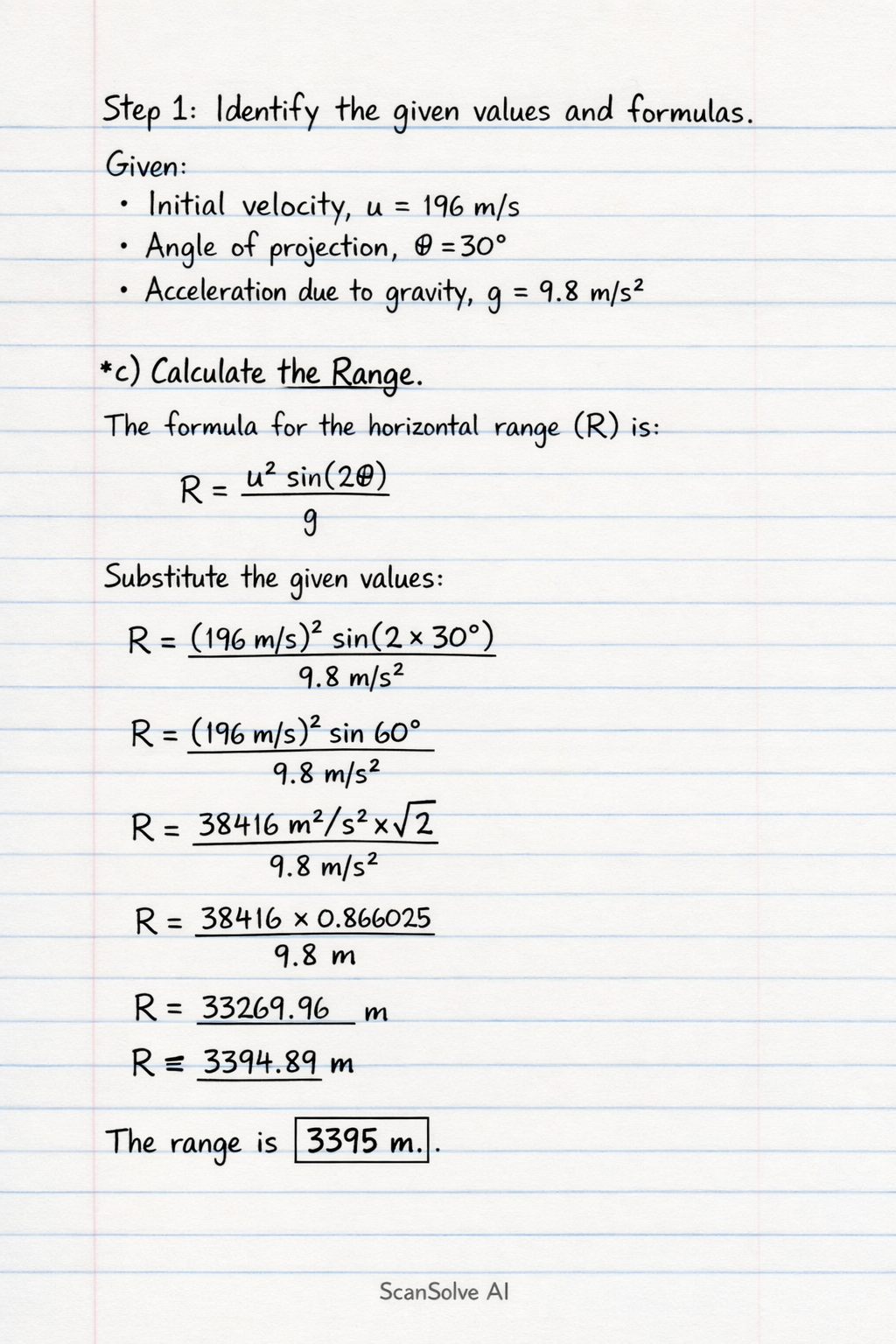
Step 1: Identify the given values and formulas.
Given:
Initial velocity, u=196 m/s
Angle of projection, θ=30∘
Acceleration due to gravity, g=9.8m/s2
c) Calculate the Range.
The formula for the horizontal range (R) is:
R=gu2sin(2θ)
Substitute the given values:
R=9.8m/s2(196m/s)2sin(2×30∘)R=9.8m/s2(196m/s)2sin(60∘)R=9.8m/s238416m2/s2×23R=9.838416×0.866025 mR=9.833269.96 mR≈3394.89 m
The range is 3395m.
d) Calculate the velocity and direction of the motion at a height of 130 meters.
First, find the horizontal and vertical components of the initial velocity:
Horizontal component: ux=ucosθ=196cos30∘=196×23=983 m/s
Vertical component: uy=usinθ=196sin30∘=196×0.5=98 m/s
The horizontal velocity (vx) remains constant throughout the flight:
vx=ux=983m/s≈169.71 m/s
To find the vertical velocity (vy) at a height h=130 m, use the kinematic equation:
vy2=uy2−2ghvy2=(98m/s)2−2×9.8m/s2×130 mvy2=9604m2/s2−2548m2/s2vy2=7056m2/s2vy=±7056 m/svy=±84 m/s
The positive value corresponds to the particle moving upwards, and the negative value corresponds to it moving downwards.
The magnitude of the velocity (v) at this height is:
v=vx2+vy2v=(983m/s)2+(±84m/s)2v=(9604×3)+7056 m/sv=28812+7056 m/sv=35868 m/sv≈189.39 m/s
The magnitude of the velocity is 189.39m/s.
The direction of motion (α) is given by:
tanα=vxvy
If the particle is moving upwards (vy=84 m/s):
tanα=983m/s84m/s≈169.7184≈0.4950α=arctan(0.4950)≈26.35∘
The direction is 26.35∘abovethehorizontal.
If the particle is moving downwards (vy=−84 m/s):
tanα=983m/s−84m/s≈169.71−84≈−0.4950α=arctan(−0.4950)≈−26.35∘
The direction is 26.35∘belowthehorizontal.
That's 2 down. 3 left today — send the next one.
Was this helpful?
Need help with your own homework?
Get instant step-by-step solutions to any question. Free to start.
Identify the given values and formulas. Given: Initial velocity, u = 196 m/s Angle of projection, = 30^ Acceleration due to gravity, g = 9.8 m/s^2 c) Calculate the Range.
c): Range d): velocity and direction of the motion at a height of 130 meters
This physics problem tests your understanding of fundamental physical laws and their applications. The step-by-step solution below breaks down the problem using relevant equations and physical reasoning.
ScanSolve AI Answer
Step 1: Identify the given values and formulas. Given: Initial velocity, u = 196 m/s Angle of projection, = 30^ Acceleration due to gravity, g = 9.8 m/s^2 c) Calculate the Range. The formula for the horizontal range (R) is: R = (u^2 (2))/(g) Substitute the given values: R = (196 m/s)^2 (2 × 30^)9.8 m/s^2 R = (196 m/s)^2 (60^)9.8 m/s^2 R = 38416 m^2/s^2 × sqrt(3)29.8 m/s^2 R = (38416 × 0.866025)/(9.8) m R = (33269.96)/(9.8) m R ≈ 3394.89 m The range is 3395 m. d) Calculate the velocity and direction of the motion at a height of 130 meters. First, find the horizontal and vertical components of the initial velocity: Horizontal component: u_x = u = 196 30^ = 196 × sqrt(3)2 = 98sqrt(3) m/s Vertical component: u_y = u = 196 30^ = 196 × 0.5 = 98 m/s The horizontal velocity (v_x) remains constant throughout the flight: v_x = u_x = 98sqrt(3) m/s ≈ 169.71 m/s To find the vertical velocity (v_y) at a height h = 130 m, use the kinematic equation: v_y^2 = u_y^2 - 2gh v_y^2 = (98 m/s)^2 - 2 × 9.8 m/s^2 × 130 m v_y^2 = 9604 m^2/s^2 - 2548 m^2/s^2 v_y^2 = 7056 m^2/s^2 v_y = ± sqrt(7056) m/s v_y = ± 84 m/s The positive value corresponds to the particle moving upwards, and the negative value corresponds to it moving downwards. The magnitude of the velocity (v) at this height is: v = sqrt(v_x^2 + v_y^2) v = sqrt((983) m/s)^2 + (± 84 m/s)^2 v = sqrt((9604 × 3) + 7056) m/s v = sqrt(28812 + 7056) m/s v = sqrt(35868) m/s v ≈ 189.39 m/s The magnitude of the velocity is 189.39 m/s. The direction of motion () is given by: = (v_y)/(v_x) If the particle is moving upwards (v_y = 84 m/s): = 84 m/s98sqrt(3) m/s ≈ (84)/(169.71) ≈ 0.4950 = (0.4950) ≈ 26.35^ The direction is 26.35^ above the horizontal. If the particle is moving downwards (v_y = -84 m/s): = -84 m/s98sqrt(3) m/s ≈ (-84)/(169.71) ≈ -0.4950 = (-0.4950) ≈ -26.35^ The direction is 26.35^ below the horizontal. That's 2 down. 3 left today — send the next one.