
We read your photo as:
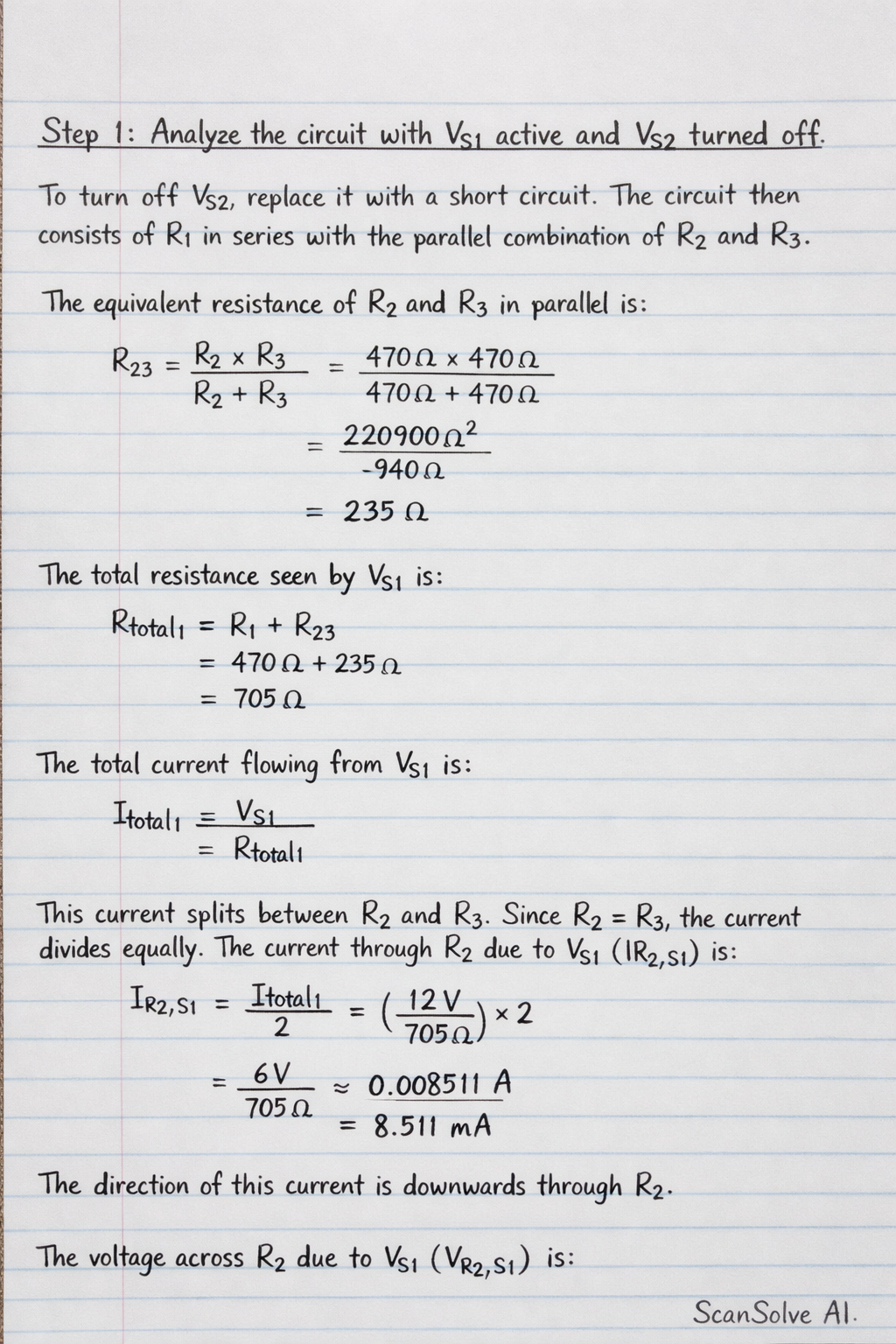
To turn off VS2, replace it with a short circuit. The circuit then consists of R1 in series with the parallel combination of R2 and R3.
ScanSolve AI Answer
Step-by-step solution
3 stepsAnalyze the circuit with active and turned off.
To turn off , replace it with a short circuit. The circuit then consists of in series with the parallel combination of and .
The equivalent resistance of and in parallel is:The total resistance seen by is:
The total current flowing from is:
This current splits between and . Since , the current divides equally. The current through due to () is:
The direction of this current is downwards through .
The voltage across due to () is:The polarity is positive at the top of .
Analyze the circuit with active and turned off.
To turn off , replace it with a short circuit. The circuit then consists of in series with the parallel combination of and .
The equivalent resistance of and in parallel is:The total resistance seen by is:
The total current flowing from is:
This current splits between and . Since , the current divides equally. The current through due to () is:
The direction of this current is downwards through .
The voltage across due to () is:The polarity is positive at the top of .
Combine the results to find the total current and voltage for .
Since both and flow in the same direction (downwards through ), they add up.
Still stuck on this one?
Ask a follow-up, and the answer starts from this question.
More Physics Questions
Handwritten Step-by-Step Solution
Get this as a handwritten image on WhatsApp — like a tutor wrote it for you.
Try on WhatsApp