

This mathematics problem involves applying core mathematical principles and formulas. Below you will find a complete step-by-step solution with detailed explanations for each step, helping you understand not just the answer but the method behind it.
ScanSolve AI Answer
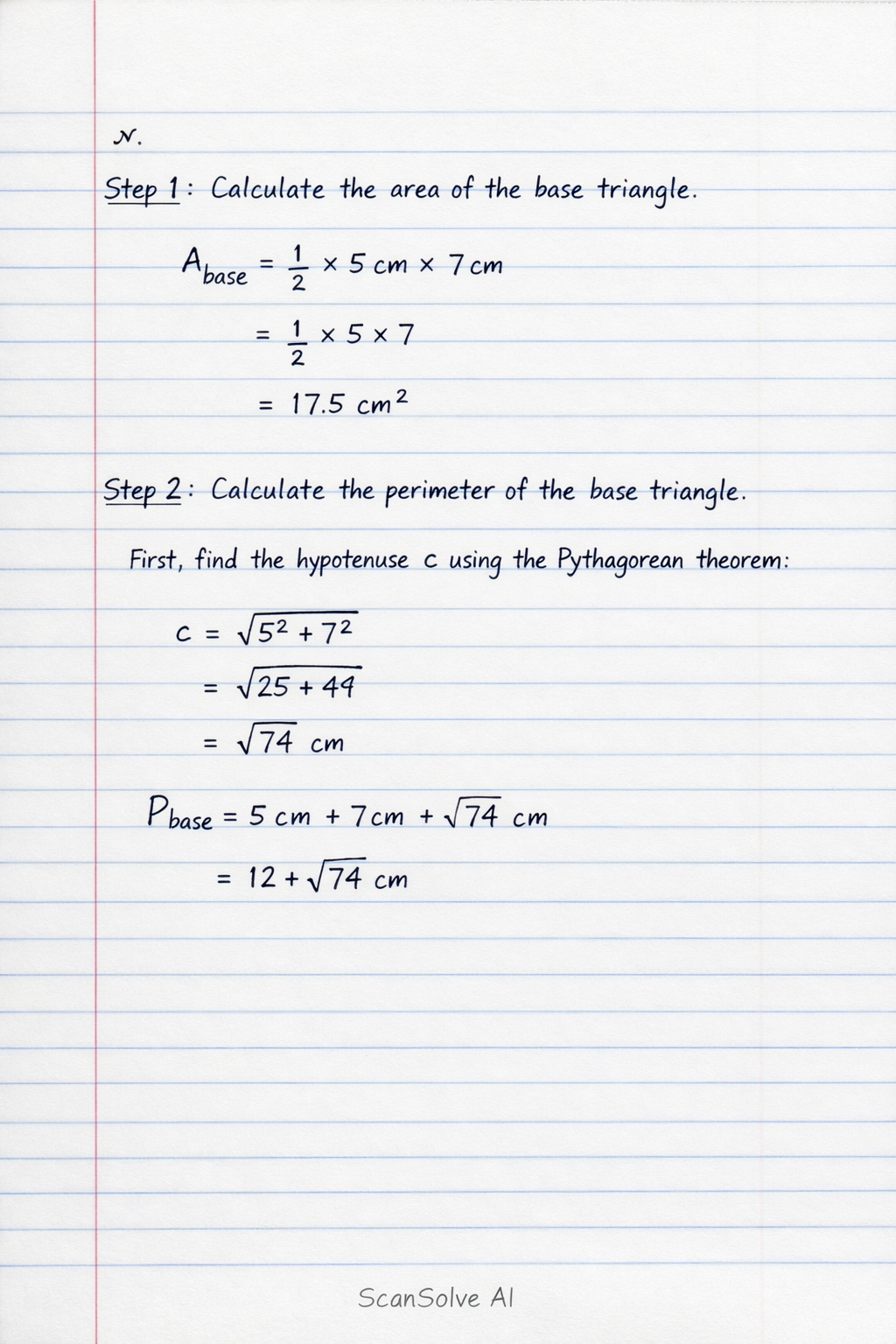
א. Step 1: Calculate the area of the base triangle. The diagram for part a shows a right-angled triangle with legs 5 cm and 7 cm. We will proceed with this interpretation, assuming the general description "isosceles triangles that are not right-angled" does not apply to this specific diagram. The height of the prism is AB = 6 cm. A_base = (1)/(2) × leg_1 × leg_2 = (1)/(2) × 5 cm × 7 cm = 17.5 cm^2 Step 2: Calculate the perimeter of the base triangle. First, find the hypotenuse c using the Pythagorean theorem. c = sqrt(5^2 + 7^2) = sqrt(25 + 49) = sqrt(74) cm P_base = 5 cm + 7 cm + sqrt(74) cm = (12 + sqrt(74)) cm Step 3: Calculate the total surface area of the prism. The height of the prism is h_prism = AB = 6 cm. The total surface area is A_total = 2 × A_base + P_base × h_prism. A_total = 2 × 17.5 cm^2 + (12 + sqrt(74)) cm × 6 cm A_total = 35 cm^2 + (72 + 6sqrt(74)) cm^2 A_total = (107 + 6sqrt(74)) cm^2 Using sqrt(74) ≈ 8.6023: A_total ≈ 107 + 6 × 8.6023 cm^2 ≈ 107 + 51.6138 cm^2 ≈ 158.61 cm^2 The total surface area for prism a is (107 + 6sqrt(74)) cm^2 ≈ 158.61 cm^2 . ב. Step 1: Calculate the area of the base triangle. The base is an isosceles triangle with sides 13 cm, 13 cm, and 10 cm. The height of the prism is AB = 12 cm. To find the height of the triangle (h_base), we bisect the base of 10 cm into two 5 cm segments. h_base^2 + 5^2 = 13^2 h_base^2 + 25 = 169 h_base^2 = 144 h_base = 12 cm A_base = (1)/(2) × base × h_base = (1)/(2) × 10 cm × 12 cm = 60 cm^2 Step 2: Calculate the perimeter of the base triangle. P_base = 13 cm + 13 cm + 10 cm = 36 cm Step 3: Calculate the total surface area of the prism. The height of the prism is h_prism = AB = 12 cm. A_total = 2 × A_base + P_base × h_prism A_total = 2 × 60 cm^2 + 36 cm × 12 cm A_total = 120 cm^2 + 432 cm^2 A_total = 552 cm^2 The total surface area for prism b is 552 cm^2 . ג. Step 1: Calculate the area of the base triangle. The base is an isosceles triangle with sides 26 cm, 26 cm, and 20 cm. The height of the prism is AB = 24 cm. To find the height of the triangle (h_base), we bisect the base of 20 cm into two 10 cm segments. h_base^2 + 10^2 = 26^2 h_base^2 + 100 = 676 h_base^2 = 576 h_base = 24 cm A_base = (1)/(2) × base × h_base = (1)/(2) × 20 cm × 24 cm = 240 cm^2 Step 2: Calculate the perimeter of the base triangle. P_base = 26 cm + 26 cm + 20 cm = 72 cm Step 3: Calculate the total surface area of the prism. The height of the prism is h_prism = AB = 24 cm. A_total = 2 × A_base + P_base × h_prism A_total = 2 × 240 cm^2 + 72 cm × 24 cm A_total = 480 cm^2 + 1728 cm^2 A_total = 2208 cm^2 The total surface area for prism c is 2208 cm^2 . That's 2 down. 3 left today — send the next one.