

This computer science problem involves algorithmic thinking and programming concepts. The solution below explains the approach, logic, and implementation step by step.
ScanSolve AI Answer
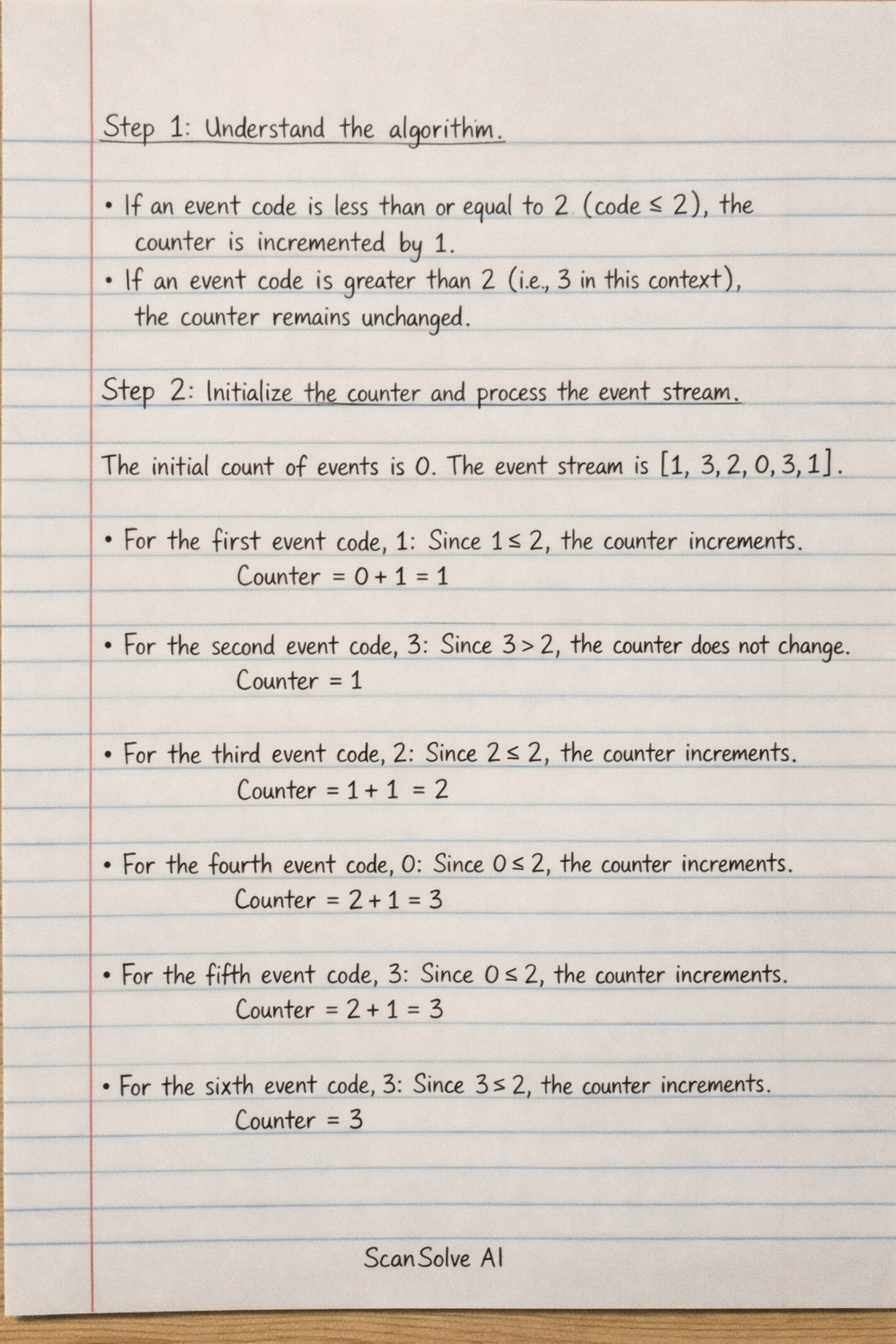
Step 1: Understand the algorithm. The problem describes an event counter that processes a stream of event codes. • If an event code is less than or equal to 2 ( code 2 ), the counter is incremented by 1. • If an event code is greater than 2 (i.e., 3 in this context), the counter remains unchanged. Step 2: Initialize the counter and process the event stream. The initial count of events is 0. The event stream is [1, 3, 2, 0, 3, 1] . • For the first event code, 1: Since 1 2, the counter increments. Counter = 0 + 1 = 1. • For the second event code, 3: Since 3 2, the counter does not change. Counter = 1. • For the third event code, 2: Since 2 2, the counter increments. Counter = 1 + 1 = 2. • For the fourth event code, 0: Since 0 2, the counter increments. Counter = 2 + 1 = 3. • For the fifth event code, 3: Since 3 2, the counter does not change. Counter = 3. • For the sixth event code, 1: Since 1 2, the counter increments. Counter = 3 + 1 = 4. Step 3: State the final count. After processing all events in the stream, the final value of the counter is 4. The correct option is 4. 4 Send me the next one 📸