
We read your photo as:
Write down the amount received for the school fund in words. 2.2. Calculate the missing value A. 2.3. Calculate the difference between the income and expenses of Daniëlskuil High School. 2.4. Mention any incidental expenses that the school may face.
ScanSolve AI Answer
Step-by-step solution
6 stepsPart 2.1· 2 steps
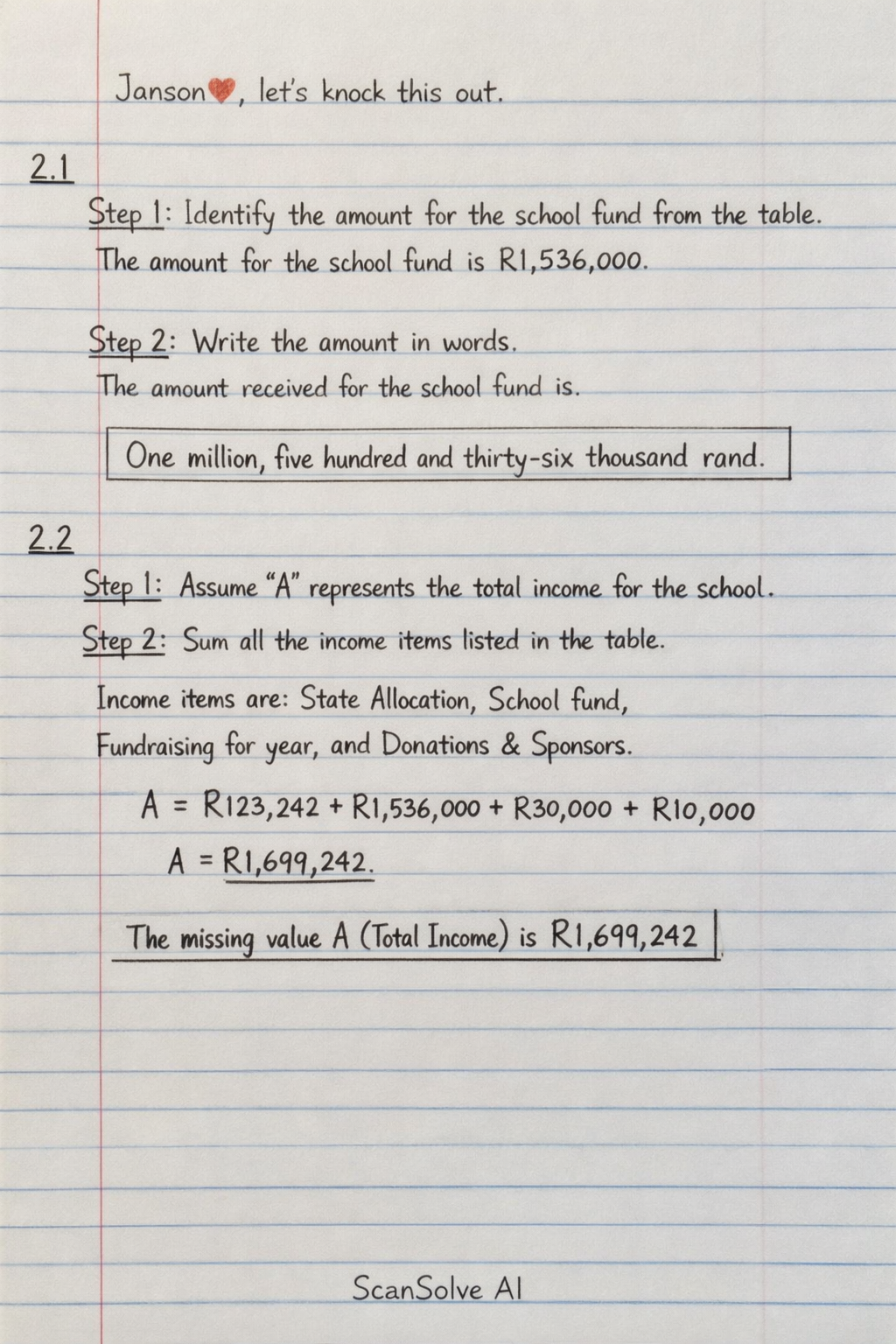
Identify the amount for the school fund from the table.
The amount for the school fund is .
Write the amount in words.
The amount received for the school fund is One million, five hundred and thirty-six thousand rand.
Part 2.2· 2 steps
Assume "A" represents the total income for the school, as it is a common missing value in budget tables.
Sum all the income items listed in the table.
Income items are: State Allocation, School fund, Fundraising for year, and Donations & Sponsors.
The missing value A (Total Income) is .
Part 2.3· 2 steps
Calculate the total expenditure by summing all expense items from the table.
Expenditure items are: Water and Sanitation, Professional services, SBL Salaries, Fuel and travel allowance, Stationery, Transportation costs, Textbooks, Sports equipment, Telephone/photocopying, and Sundry expenses.
Calculate the difference between the total income (from 2.2) and the total expenditure.
The difference between the income and expenses is .
Part 2.4
Incidental expenses are minor, often unexpected costs that are not part of the main budget categories.
Some incidental expenses a school may face include:
- Minor repairs (e.g., fixing a broken window or a leaky tap)
- Emergency supplies (e.g., unexpected first aid refills or cleaning materials)
- Small administrative costs (e.g., postage for urgent mail, bank charges)
- Unplanned event costs (e.g., refreshments for an impromptu meeting)
Still stuck on this one?
Ask a follow-up, and the answer starts from this question.
More Accounting Questions
Handwritten Step-by-Step Solution
Get this as a handwritten image on WhatsApp — like a tutor wrote it for you.
Try on WhatsApp