
We read your photo as:
A. A business has the following balances at year-end: Sales: le 120,000; Purchases: le 70,000; Inventory (Opening): le 10,000; Inventory (Closing): le 15,000; Wages: le 20,000; Rent: le 5,000.
ScanSolve AI Answer
Step-by-step solution
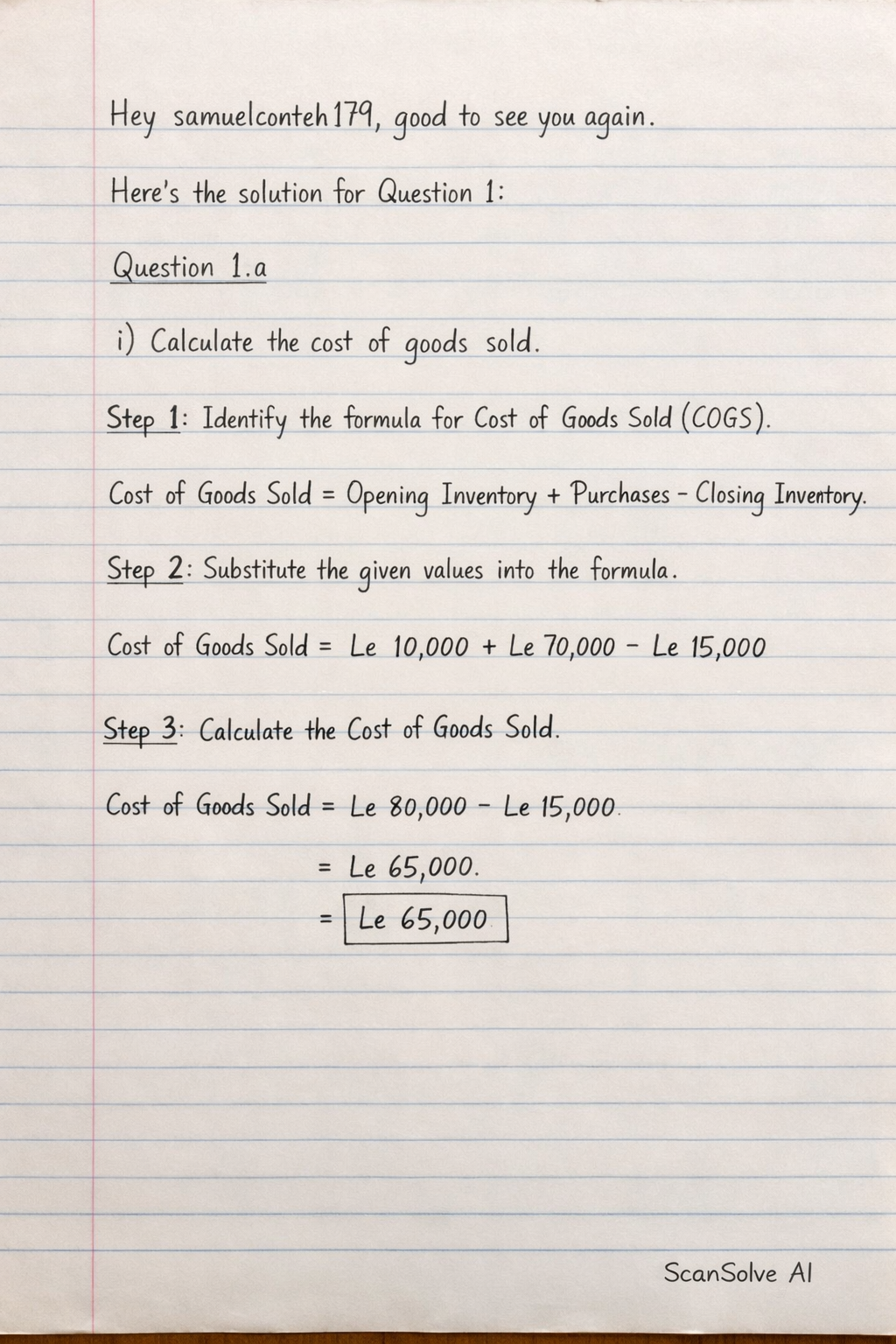
14 stepsHere's the solution for Question 1:
Question 1.a
i) Calculate the cost of goods sold.
Identify the formula for Cost of Goods Sold (COGS).
Substitute the given values into the formula.
Calculate the Cost of Goods Sold.
ii) Prepare a simple income statement.
Start with Sales Revenue.
Subtract Cost of Goods Sold to find Gross Profit.
Subtract operating expenses (Wages and Rent) from Gross Profit to find Net Profit.
iii) Explain the effect of closing inventory on profit.
A higher closing inventory reduces the Cost of Goods Sold, which in turn increases the gross profit and ultimately the net profit for the period. Conversely, a lower closing inventory increases the Cost of Goods Sold, leading to a decrease in both gross and net profit.iv) Identify and explain two users of the financial statements.
- Investors: They use financial statements to assess the company's profitability and financial health to make decisions about buying, holding, or selling shares.
- Creditors: Banks and other lenders use financial statements to evaluate a company's ability to repay loans before granting credit.
Question 1.b
i) Calculate contribution per unit.
Identify the formula for contribution per unit.
Substitute the given values.
Calculate the contribution per unit.
ii) Compute the break-even point in units.
Identify the formula for break-even point in units.
Substitute the given values.
Calculate the break-even point.
iii) What is the profit if 1,000 units are sold?
Calculate total contribution.
Calculate profit by subtracting fixed costs from total contribution.
iv) Explain one advantage and one limitation of marginal costing.
- Advantage: Marginal costing is useful for short-term decision-making such as pricing, accepting special orders, or make-or-buy decisions, because it clearly separates fixed and variable costs, highlighting the contribution each unit makes to covering fixed costs.
- Limitation: It does not comply with Generally Accepted Accounting Principles (GAAP) for external reporting, as inventory is valued only at variable production costs, which can understate asset values on the balance sheet.
Still stuck on this one?
Ask a follow-up, and the answer starts from this question.
More Accounting Questions
Handwritten Step-by-Step Solution
Get this as a handwritten image on WhatsApp — like a tutor wrote it for you.
Try on WhatsApp