
We read your photo as:
What is a cash receipt journal and how is it closed off at the end of the month? Explain the purpose of the analysis of receipts column.
ScanSolve AI Answer
Step-by-step solution
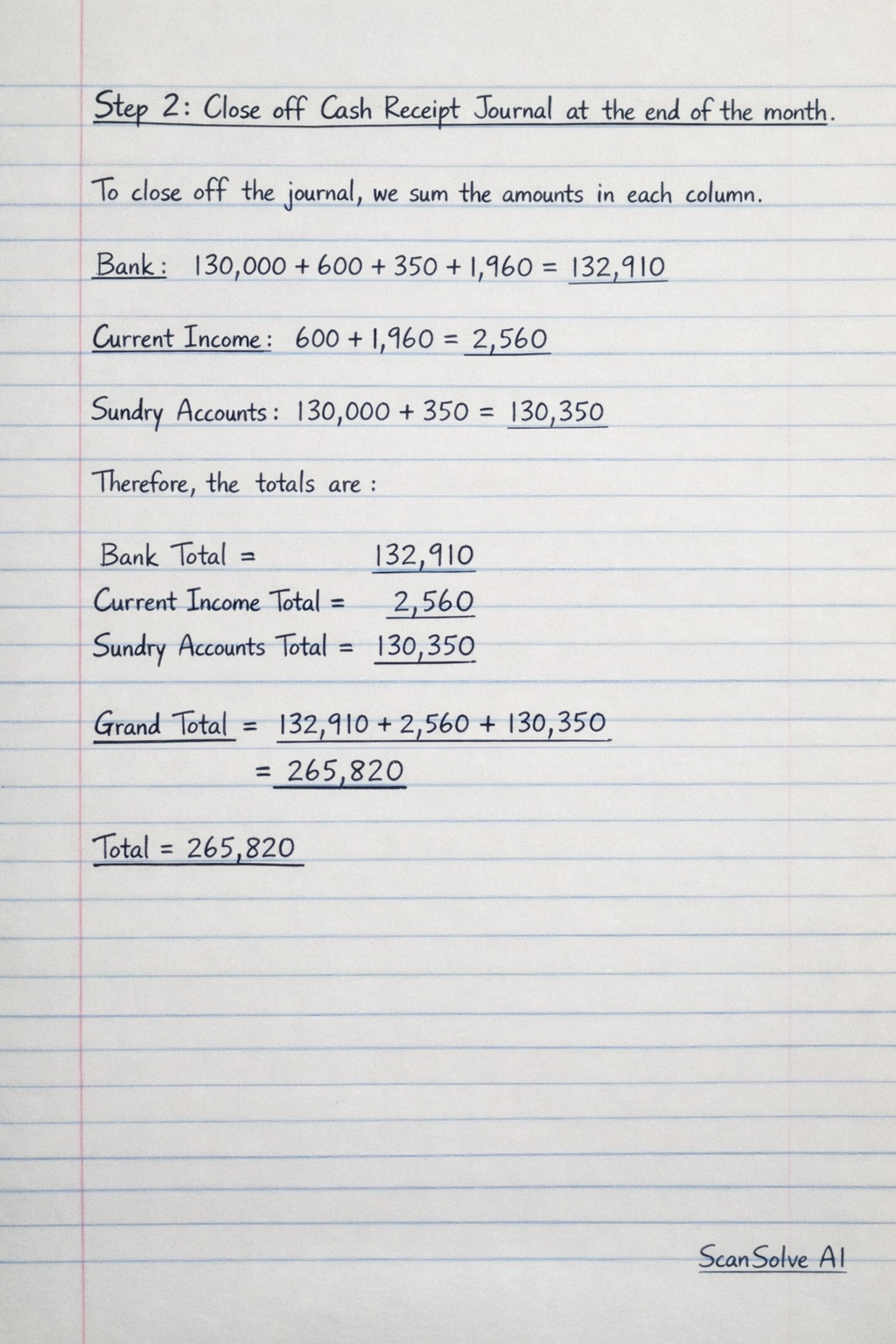
4 stepsClose off Cash Receipt Journal at the end of the month.
To close off the journal, we sum the amounts in each column.
\begin{tabular}{|c|c|l|c|c|c|c|c|c|l|} \hline \textbf{Doc} & \textbf{Day} & \textbf{Details} & \textbf{Fol.} & \textbf{Analysis of receipts} & \textbf{Bank} & \textbf{Current income} & \multicolumn{3}{c|}{\textbf{Sundry accounts}} \\ \cline{8-10} & & & & & & & \textbf{Amount} & \textbf{Fol.} & \textbf{Details} \\ \hline 46 & 1 & Capital (G. Gantry) & & R130 000 & R130 000 & & R130 000 & & Capital \\ \hline & 14 & Hair styling services & & R600 & R600 & R600 & & & \\ \hline 47 & 14 & Rental Income (A. Kango) & & R350 & R350 & & R350 & & Rental Income \\ \hline & 28 & Hair cutting services & & R1960 & R1960 & R1960 & & & \\ \hline \textbf{} & \textbf{} & \textbf{Totals} & \textbf{} & \textbf{R132 910} & \textbf{R132 910} & \textbf{R2560} & \textbf{R130 350} & \textbf{} & \textbf{} \\ \hline \end{tabular}Answer Question 3.
The analysis of receipts column is necessary to provide a summary of all cash inflows before they are categorized into specific income or sundry accounts. It ensures that the total cash received matches the total amount deposited into the bank.
Answer Question 4.
For the transaction on 28 February 2023 (hair cutting services), the following columns were used:
- Analysis of receipts: To record the total cash received.
- Bank: To record the amount deposited into the business bank account.
- Current income: Hair cutting services are the primary source of income for a hair salon, so this receipt is classified as current income.
Answer Question 5.
It is important to have details in the Sundry accounts section because this section is used for infrequent or unusual receipts that do not have a dedicated column. The "Details" column specifies the exact nature of the receipt (e.g., Capital, Rental Income, Sale of Asset), which is crucial for correctly posting the amount to the appropriate general ledger account.
Still stuck on this one?
Ask a follow-up, and the answer starts from this question.
More Accounting Questions
Handwritten Step-by-Step Solution
Get this as a handwritten image on WhatsApp — like a tutor wrote it for you.
Try on WhatsApp