
We read your photo as:
Explain the accounting concepts of materiality, capital expenditures, asset exchanges, and depreciation.
ScanSolve AI Answer
Here are the answers to your questions, formatted as requested:
-
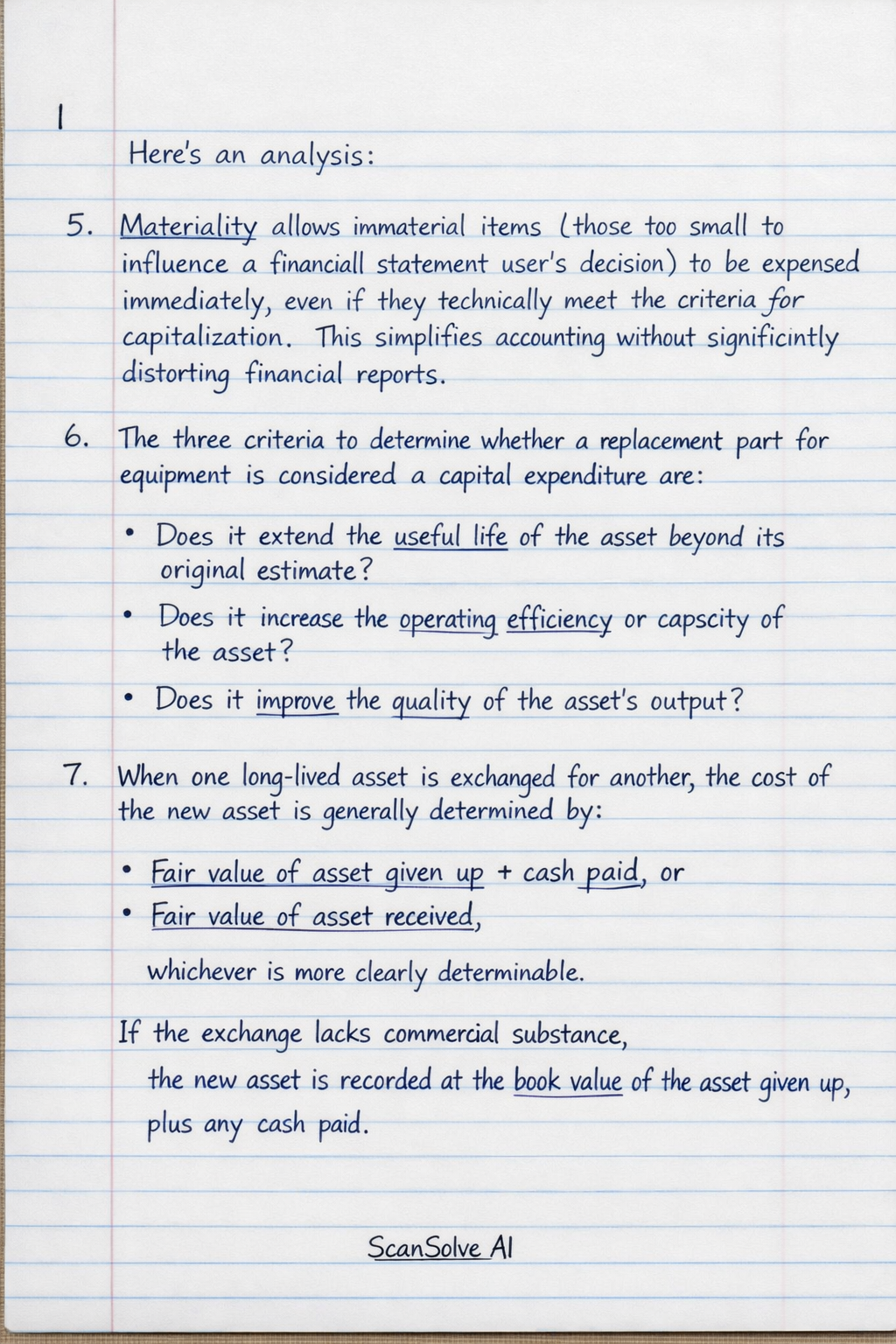
Materiality allows immaterial items (those too small to influence a financial statement user's decision) to be expensed immediately, even if they technically meet the criteria for capitalization. This simplifies accounting without significantly distorting financial reports.
-
The three criteria to determine whether a replacement part for equipment is considered a capital expenditure are:
- Does it extend the useful life of the asset beyond its original estimate?
- Does it increase the operating efficiency or capacity of the asset?
- Does it improve the quality of the asset's output?
-
When one long-lived asset is exchanged for another, the cost of the newly-acquired asset is generally determined by the fair value of the asset given up plus any cash paid, or the fair value of the asset received, whichever is more clearly determinable. If the exchange lacks commercial substance, the new asset is recorded at the book value of the asset given up, plus any cash paid.
-
Depreciation is the systematic allocation of the cost of a tangible long-lived asset over its estimated useful life. It is an accounting method used to expense the cost of an asset over the period it is expected to generate revenue.
-
I agree. The value of benefits from a long-lived asset, such as a car, may not be the same in the first years as in later years. A new car typically provides higher reliability, efficiency, and prestige in its early years, leading to greater economic benefits. As it ages, maintenance costs may increase, and its performance or appeal might decrease, reducing the benefits derived.
-
For a new sports car, a usage-based method (e.g., units-of-production based on mileage) is generally preferable for recording depreciation. This is because the wear and tear, and thus the decline in value, of a sports car is often more directly related to how much it is driven (its usage) rather than simply the passage of time.
-
Using the declining balance method, the carrying amount of an asset decreases more rapidly in the early years of its useful life and more slowly in later years. With the straight-line method, the carrying amount decreases by a constant amount each period, resulting in a steady, linear decline over its useful life.
-
The double-declining balance rate of depreciation for an asset with a ten-year useful life is calculated as:
-
Partial-year depreciation expense is calculated by determining the full year's depreciation amount and then multiplying it by the fraction of the year the asset was in service. For example, if an asset was used for 7 months in a year, the partial-year depreciation would be of the full year's depreciation.
Still stuck on this one?
Ask a follow-up, and the answer starts from this question.
More Accounting Questions
Handwritten Step-by-Step Solution
Get this as a handwritten image on WhatsApp — like a tutor wrote it for you.
Try on WhatsApp