
We read your photo as:
Analyze the provided bank statement and answer the following questions: 2.1.1 Define a credit transaction and give an example. 2.1.2 State the opening balance. 2.1.3 Calculate C and D. 2.1.4 Count the
ScanSolve AI Answer
Step-by-step solution
11 stepsHere are the answers to your questions:
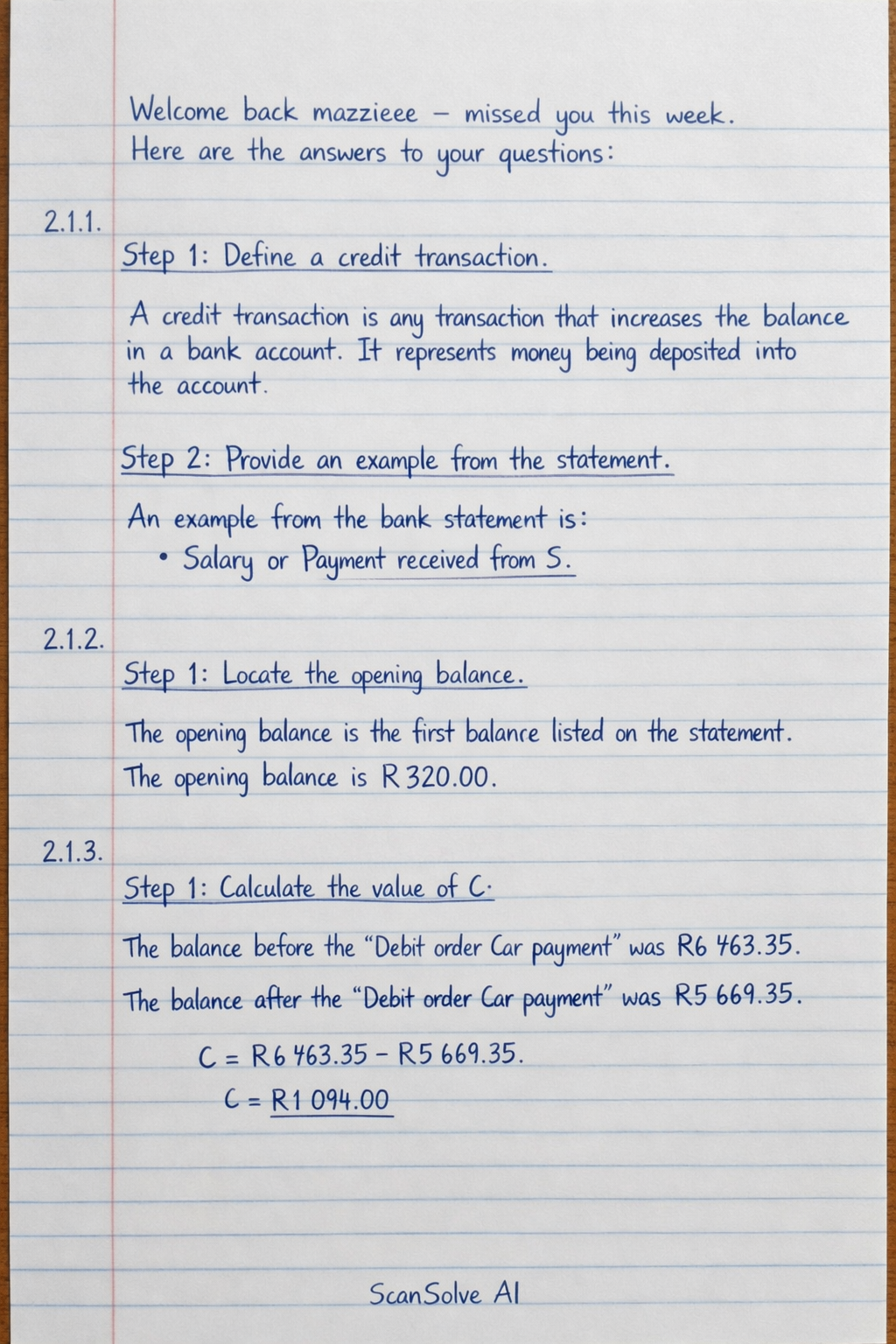
2.1.1
Define a credit transaction.
A credit transaction is any transaction that increases the balance in a bank account. It represents money being deposited into the account.
Provide an example from the statement.
An example from the bank statement is Salary or Payment received from S.
2.1.2
Locate the opening balance.
The opening balance is the first balance listed on the statement.
The opening balance is .2.1.3
Calculate the value of C.
The balance before the "Debit order Car payment" was .
The balance after the "Debit order Car payment" was .Calculate the value of D.
The balance before "Payment received from S" was .
The "Payment received from S" was a credit of .The values are .
2.1.4
Count the debit orders.
The debit orders listed are:
- Debit order home loan
- Debit order fee
- Debit order Car payment
- Debit order fee
- Debit order insurance
- Debit order fee
- Debit order medical aid
- Debit order fee There are 8 debit orders. The number of debit orders is .
2.1.5
Banks omit the last four digits of the account number for security reasons. This helps protect the client's account information from unauthorized access or fraud.2.1.6
Identify all withdrawal fees.
The withdrawal fees are:
- (01/04)
- (03/04)
- (10/05)
Calculate the total withdrawal fees.
The total withdrawal fees are .
2.1.7
Identify the old and new medical aid amounts.
Old medical aid amount (from statement):
New medical aid amount:Calculate the percentage increase.
Round to a whole number.
Rounding $13.84
Still stuck on this one?
Ask a follow-up, and the answer starts from this question.
More Accounting Questions
Handwritten Step-by-Step Solution
Get this as a handwritten image on WhatsApp — like a tutor wrote it for you.
Try on WhatsApp