
We read your photo as:
As the Auditor of Good Food Ltd describe the evidence you would expect to find in your Audit. For each of the matters raised under (i) and (ii), discuss four factors that would influence the Auditor's approach to the Audit and opinion, including assessment of materiality.
Accounting
ScanSolve AI Answer
Here are the answers to your questions:
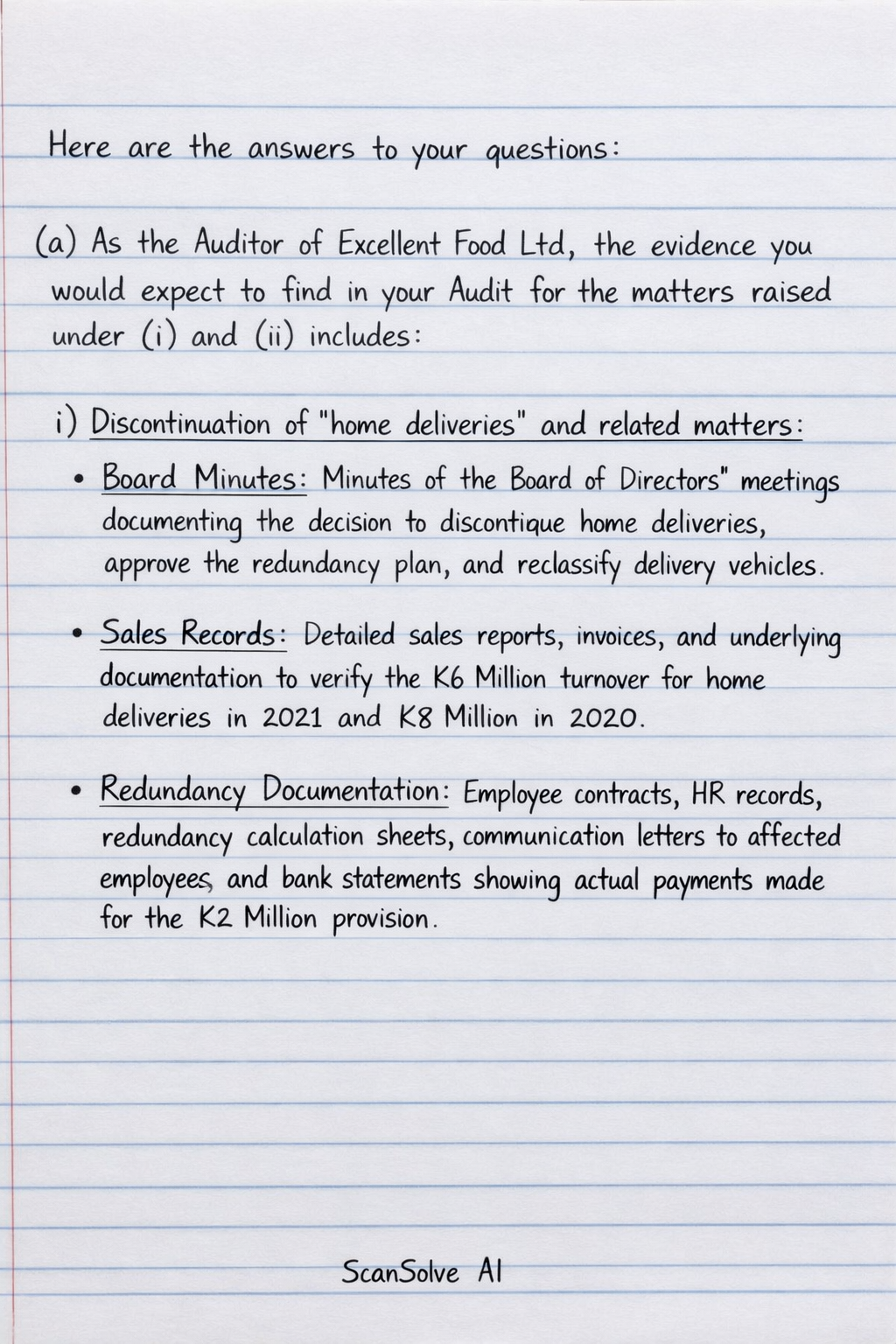
a) As the Auditor of Excellent Food Ltd, the evidence you would expect to find in your Audit for the matters raised under (i) and (ii) includes:
-
i) Discontinuation of "home deliveries" and related matters:
- Board Minutes: Minutes of the Board of Directors' meetings documenting the decision to discontinue home deliveries, approve the redundancy plan, and reclassify delivery vehicles.
- Sales Records: Detailed sales reports, invoices, and underlying documentation to verify the K6 Million turnover for home deliveries in 2021 and K8 Million in 2020.
- Redundancy Documentation: Employee contracts, HR records, redundancy calculation sheets, communication letters to affected employees, and bank statements showing actual payments made for the K2 Million provision.
- Vehicle Reclassification: Management's formal plan for selling the delivery vehicles, independent valuation reports supporting the K8 Million fair value less cost to sell, asset register entries showing the reclassification from Property, Plant and Equipment (PPE) to "assets held for sale," and depreciation schedules confirming the K5 Million Net Book Value (NBV).
-
ii) Revaluation of properties:
- Board Minutes: Minutes of the Board of Directors' meetings approving the revaluation policy and the specific revaluations of properties.
- Valuation Reports: Independent professional valuation reports for all revalued properties, detailing the valuation methodology, significant assumptions, and the effective date of valuation (30 September 2021).
- Property Records: Property deeds and titles to confirm ownership, updated asset registers reflecting the revalued amounts, and revised depreciation schedules.
- Accounting Entries: Journal entries recording the revaluation surplus of K71 Million and its credit to equity, along with supporting calculations.
- Financial Statement Disclosures: Review of the notes to the financial statements to ensure adequate disclosure of the revaluation policy, effective dates, methods, significant assumptions, and the carrying amount under the cost model.
b) For each of the matters raised under (i) and (ii), four factors that would influence the Auditor's approach to the Audit and opinion, including assessment of materiality:
-
i) Discontinuation of "home deliveries" and related matters:
- Materiality: The K6 Million reduction in sales, K2 Million redundancy provision, and K3 Million gain on reclassification (K8M fair value less cost to sell - K5M NBV) are quantitatively significant relative to the company's total revenue (K422M), Profit Before Taxation (K18M), and total assets (K307M). Qualitatively, discontinuing a service line is a major operational change. The auditor will set a lower materiality threshold for these items and perform extensive substantive testing.
- Compliance with Accounting Standards: The auditor must assess compliance with IAS 37 Provisions, Contingent Liabilities and Contingent Assets for the redundancy provision (e.g., existence of a present obligation, probable outflow, reliable measurement) and IFRS 5 Non-current Assets Held for Sale and Discontinued Operations for the reclassification and measurement of delivery vehicles. Non-compliance could lead to adjustments or a modified audit opinion.
- Management Judgement and Estimates: The K2 Million redundancy provision and the K8 Million fair value less cost to sell for vehicles involve significant management judgment and estimation. The auditor will critically evaluate the reasonableness of these estimates, potentially involving independent verification or expert consultation, to ensure they are free from bias.
- Risk of Material Misstatement (RMM): The inherent risk is high due to the complexity of accounting for provisions and assets held for sale, and the significant operational change. The auditor will assess the effectiveness of internal controls over these processes. A higher RMM will necessitate a more extensive audit approach, including increased substantive testing and scrutiny of management's assertions.
-
ii) Revaluation of properties:
- Materiality: The total revaluation surplus of K71 Million is highly material in relation to the company's total assets (K307M) and equity. This significant impact on the balance sheet means the auditor will apply a stringent materiality assessment and conduct thorough procedures.
- Compliance with Accounting Standards: The auditor must ensure compliance with IAS 16 Property, Plant and Equipment, specifically regarding the revaluation model. This includes verifying that revaluations are performed with sufficient regularity, the fair value is determined reliably, and the revaluation surplus is correctly recognized in Other Comprehensive Income and accumulated in equity.
- Use of an Expert (Valuer): The auditor will assess the competence, capabilities, and objectivity of the independent valuers. This involves reviewing their qualifications, experience, and the appropriateness of their valuation methods and assumptions. If the valuer's work is deemed unreliable, the auditor may need to perform additional procedures or engage their own expert.
- Risk of Material Misstatement (RMM): The inherent risk is high due to the subjective nature of property valuations, the large number of properties involved, and the potential for management bias. The auditor will evaluate the internal controls over the revaluation process, including the selection of valuers and review of valuation reports, to determine the extent of substantive testing required.
Was this helpful?
Still stuck on this one?
Ask a follow-up, and the answer starts from this question.
Got a different question?Ask your own question
More Accounting Questions
QMabaso Ltd, a JSE-listed manufacturing company, has recently expanded operations into renewable…QQUESTION 3: AUDITING AND THE AUDIT REPORTQPlease provide answers to the following Forensic Accounting questions: 11-16.QGot it – Ethics & Professionalism full 40/40 essay for Section C. Learn this structure and just swap…QFor each activity below, indicate whether it forms part of an assurance engagement or an advisory…
Handwritten Step-by-Step Solution
Get this as a handwritten image on WhatsApp — like a tutor wrote it for you.
Try on WhatsApp