
We read your photo as:
Calculate the financial indicators for 28 February 2026, specifically: 2.4.1 % Operating expenses on sales, 2.4.2 Earnings per share (EPS), and 2.4.3 % Return on average shareholders' equity.
ScanSolve AI Answer
The provided image contains financial data for 30 April 2024 and 30 April 2025. To calculate the financial indicators for 28 February 2026 as requested in question 2.4, the specific financial figures for the year ending 28 February 2026 are needed. These figures (e.g., sales, operating expenses, net profit, shareholders' equity, number of shares) are not available in the provided image.
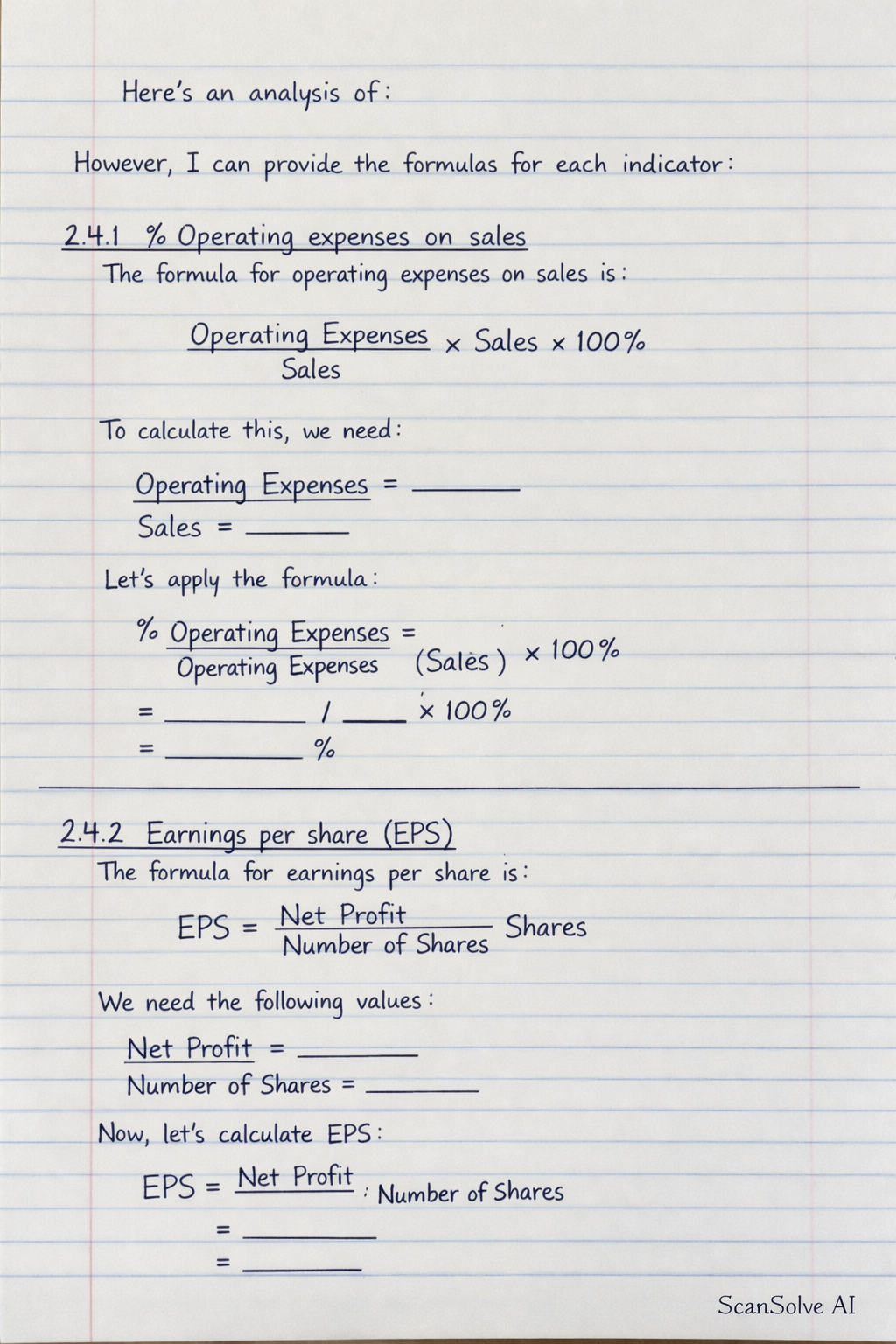
However, I can provide the formulas for each indicator:
2.4.1 % Operating expenses on sales
The formula for operating expenses on sales is:
To calculate this, you would need the Operating Expenses and Sales figures for the financial year ended 28 February 2026.
2.4.2 Earnings per share (EPS)
The formula for Earnings per share (EPS) is:
To calculate this, you would need the Net Profit after Tax for the year ended 28 February 2026, any Preference Dividends paid during that period, and the Number of Ordinary Shares in Issue as at 28 February 2026.
2.4.3 % Return on average shareholders' equity
The formula for Return on average shareholders' equity is:
Where Average Shareholders' Equity is calculated as:
To calculate this, you would need the Net Profit after Tax for the year ended 28 February 2026, and the Shareholders' Equity at the beginning (1 March 2025) and end (28 February 2026) of that financial year.
Still stuck on this one?
Ask a follow-up, and the answer starts from this question.
More Accounting Questions
Handwritten Step-by-Step Solution
Get this as a handwritten image on WhatsApp — like a tutor wrote it for you.
Try on WhatsApp