
We read your photo as:
Calculate Mr. Dire's monthly tax contribution and monthly UIF contribution given his annual taxable income of R236 000.
ScanSolve AI Answer
Answers
4 partsStep-by-step solution
11 stepshere are the solutions to the questions from the image.
Part 2
Mr. Dire's Contributions
Mr. Dire's taxable annual income is R236 000 for 2018/2019.
UIF contribution: 1% of gross income.
Pension Fund contribution: 7.5% of gross income.
Part 2.1
Calculate his monthly tax contribution.
Identify the correct tax bracket for Mr.
Dire's annual taxable income.
Mr. Dire's annual taxable income is R236 000.
From the provided table, the income bracket R165 601 – R258 750 has a tax rate of "29 808 + 25% of the amount above 165 600".Calculate the tax payable before rebates.
The amount above R165 600 is R236 000 - R165 600 = R70 400.
Tax payable = R29 808 + (25% of R70 400)
Tax payable = R29 808 + (0.25 \times 70 400)
Tax payable = R29 808 + R17 600
Tax payable = R47 408Apply the primary rebate.
From the table, the Primary Rebate (for Individuals) is R14 220.
Net annual tax payable = Tax payable - Primary Rebate
Net annual tax payable = R47 408 - R14 220
Net annual tax payable = R33 188Calculate the monthly tax contribution.
Monthly tax contribution = Net annual tax payable / 12
Monthly tax contribution = R33 188 / 12
Monthly tax contribution = R2 765.666...Rounding to two decimal places:
Monthly tax contribution = R2 765.67
Part 2.2
Calculate his monthly contribution towards UIF.
Calculate the annual UIF contribution.
UIF contribution is 1% of gross income.
Annual gross income = R236 000
Annual UIF contribution = 1% of R236 000
Annual UIF contribution = 0.01 \times R236 000
Annual UIF contribution = R2 360Calculate the monthly UIF contribution.
Monthly UIF contribution = Annual UIF contribution / 12
Monthly UIF contribution = R2 360 / 12
Monthly UIF contribution = R196.666...Rounding to two decimal places:
Monthly UIF contribution = R196.67
Part 2.3
Calculate his monthly contribution towards Pension Fund.
Calculate the annual Pension Fund contribution.
Pension Fund contribution is 7.5% of gross income.
Annual gross income = R236 000
Annual Pension Fund contribution = 7.5% of R236 000
Annual Pension Fund contribution = 0.075 \times R236 000
Annual Pension Fund contribution = R17 700Calculate the monthly Pension Fund contribution.
Monthly Pension Fund contribution = Annual Pension Fund contribution / 12
Monthly Pension Fund contribution = R17 700 / 12
Monthly Pension Fund contribution = R1 475
Part 2.4
Calculate his net monthly income.
Calculate total monthly deductions.
Total monthly deductions = Monthly tax contribution + Monthly UIF contribution + Monthly Pension Fund contribution
Total monthly deductions = R2 765.67 + R196.67 + R1 475.00
Total monthly deductions = R4 437.34Calculate his gross monthly income.
Gross monthly income = Annual gross income / 12
Gross monthly income = R236 000 / 12
Gross monthly income = R19 666.666...
Gross monthly income = R19 666.67 (rounded to two decimal places)Calculate his net monthly income.
Net monthly income = Gross monthly income - Total monthly deductions
Net monthly income = R19 666.67 - R4 437.34
Net monthly income = R15 229.33
Part 1
Pie Chart Analysis
Part 1.1
What number of students included in the 2025 survey travelled to college by bus/taxi?
The image provided only shows a table for tax rates and rebates, and a partial question 1.1. It does not include the pie charts or any data for the 2025 survey regarding student travel modes. Therefore, it is not possible to answer this question.
Part 1.2
What was the probability (in percentage) of a student travelling to college by car in 2019?
Similar to 1.1, the necessary pie charts or data for student travel modes in 2019 are not provided in the image. Therefore, it is not possible to answer this question.
1.3 The 60 students represented by Pie Chart B were selected at random from a population of 810 students. What number of students from the total population of 810 could on an assumption have travelled to college by bicycle?
The image does not contain Pie Chart B or any information about the percentage of students who travelled by bicycle. Therefore, it is not possible to answer this question.
Part 1.4
Determine the major downward trend and the major upward trend from 2019 to 2025 across the modes of transport as displayed in the graphs and indicate in which modes these trends occur.
The image does not contain the graphs or pie charts displaying trends in modes of transport from 2019 to 2025. Therefore, it is not possible to answer this question.
Part 1.5
Give a reason why the two pie charts can lead to misinterpretation of information.
The image does not contain the two pie charts in question. Without seeing the charts, it is not possible to give a specific reason for potential misinterpretation. However, common reasons for misinterpretation of pie charts include:
- Too many slices, making it hard to distinguish proportions.
- Similar slice sizes, making comparisons difficult without labels.
- Using 3D effects, which can distort the perceived size of slices.
- Not including percentages or raw numbers for each slice.
- Comparing charts with different total populations without clear indication.
Try one yourself
A new problem that tests the same skill.
Still stuck on this one?
Ask a follow-up, and the answer starts from this question.
More Accounting Questions
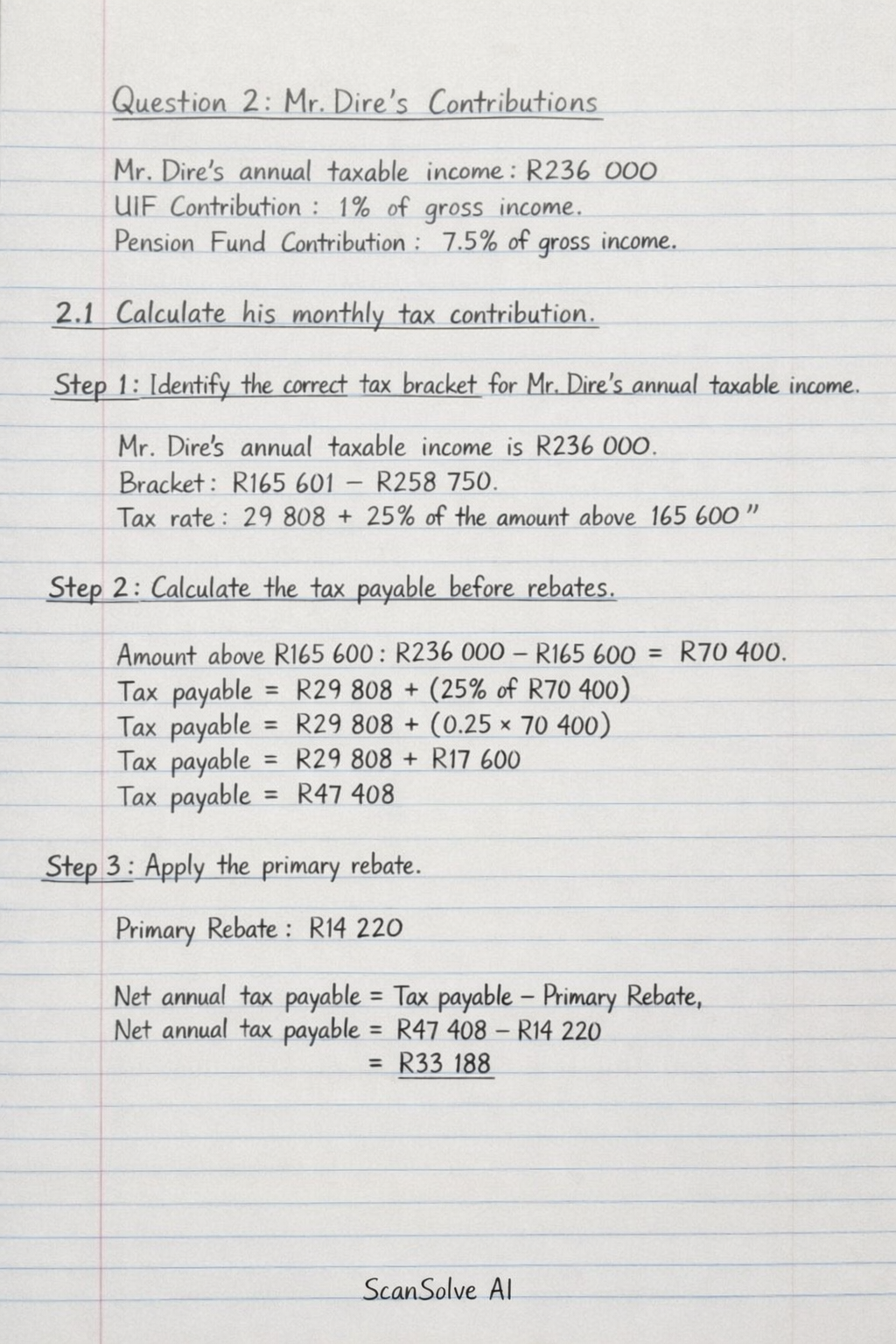
Handwritten Step-by-Step Solution
Get this as a handwritten image on WhatsApp — like a tutor wrote it for you.
Try on WhatsApp