
We read your photo as:
Which of the following costs is excluded from the acquisition cost under IFRS 3?
ScanSolve AI Answer
Answer
1. Which of the following costs is excluded from the acquisition cost under IFRS 3?
Under IFRS 3, acquisition-related costs such as legal, accounting, and valuation fees are expensed as incurred and are not included in the measurement of the consideration transferred.
- The correct option is B.
2. If the acquirer issues shares as consideration, they are measured at:
IFRS 3 requires that the consideration transferred in a business combination, including equity instruments issued, be measured at its fair value at the acquisition date.
- The correct option is C.
4. Which situation results in a bargain purchase?
A bargain purchase occurs when the fair value of the identifiable net assets acquired exceeds the fair value of the consideration transferred (plus any non-controlling interest and previously held equity interest).
- The correct option is C.
5. Goodwill represents:
Goodwill is recognized as the excess of the aggregate of the consideration transferred, the amount of any non-controlling interest in the acquiree, and the fair value of the acquirer's previously held equity interest in the acquiree over the net of the acquisition-date amounts of the identifiable assets acquired and liabilities assumed.
- The correct option is B.
6. In a step acquisition, previously held interest is:
In a step acquisition, the acquirer remeasures its previously held equity interest in the acquiree at its fair value at the acquisition date and recognizes any resulting gain or loss in profit or loss.
- The correct option is B.
7. Non-controlling interest (NCI) can be measured at:
IFRS 3 allows an acquirer to measure any non-controlling interest in the acquiree either at fair value or at the non-controlling interest's proportionate share of the acquiree's identifiable net assets.
- The correct option is C.
8. Which asset must be recognized at fair value even if not previously recognized by the acquire?
IFRS 3 requires the acquirer to recognize identifiable assets acquired and liabilities assumed at their fair values at the acquisition date. This includes contingent liabilities if they meet the recognition criteria, even if the acquiree had not previously recognized them.
- The correct option is B.
9. Which is not a business combination?
A business combination is a transaction or other event in which an acquirer obtains control of one or more businesses. An acquisition of assets that do not constitute a 'business' is an asset acquisition, not a business combination.
- The correct option is A.
10. Measurement period adjustments are allowed for:
IFRS 3 permits a measurement period, which shall not exceed one year from the acquisition date, during which the acquirer may adjust the provisional amounts recognized for a business combination.
- The correct option is A.
11. Which statement about goodwill is correct?
Under IFRS, goodwill is not amortized. Instead, it is tested for impairment at least annually.
- The correct option is B.
12. Which standard governs business combinations under IFRS?
IFRS 3 is the International Financial Reporting Standard that deals with accounting for business combinations.
- The correct option is C.
13. In a reverse acquisition, the acquirer is identified based on:
In a reverse acquisition, the entity that issues equity instruments (the legal acquirer) is identified as the acquiree for accounting purposes, and the legal acquiree is identified as the acquirer. The accounting acquirer is the entity that obtains control.
- The correct option is C.
14. On consolidation, investment in subsidiary is eliminated against:
During the consolidation process, the parent company's investment in the subsidiary is eliminated against the subsidiary's equity (e.g., share capital, retained earnings, and other reserves) to prevent double-counting of assets and equity.
- The correct option is C.
15. Post-acquisition profits are:
Post-acquisition profits of a subsidiary are included in the consolidated financial statements as part of the group revenue and group profit, reflecting the economic performance of the combined entity from the acquisition date.
- The correct option is C.
Try one yourself
A new problem that tests the same skill.
Still stuck on this one?
Ask a follow-up, and the answer starts from this question.
More Accounting Questions
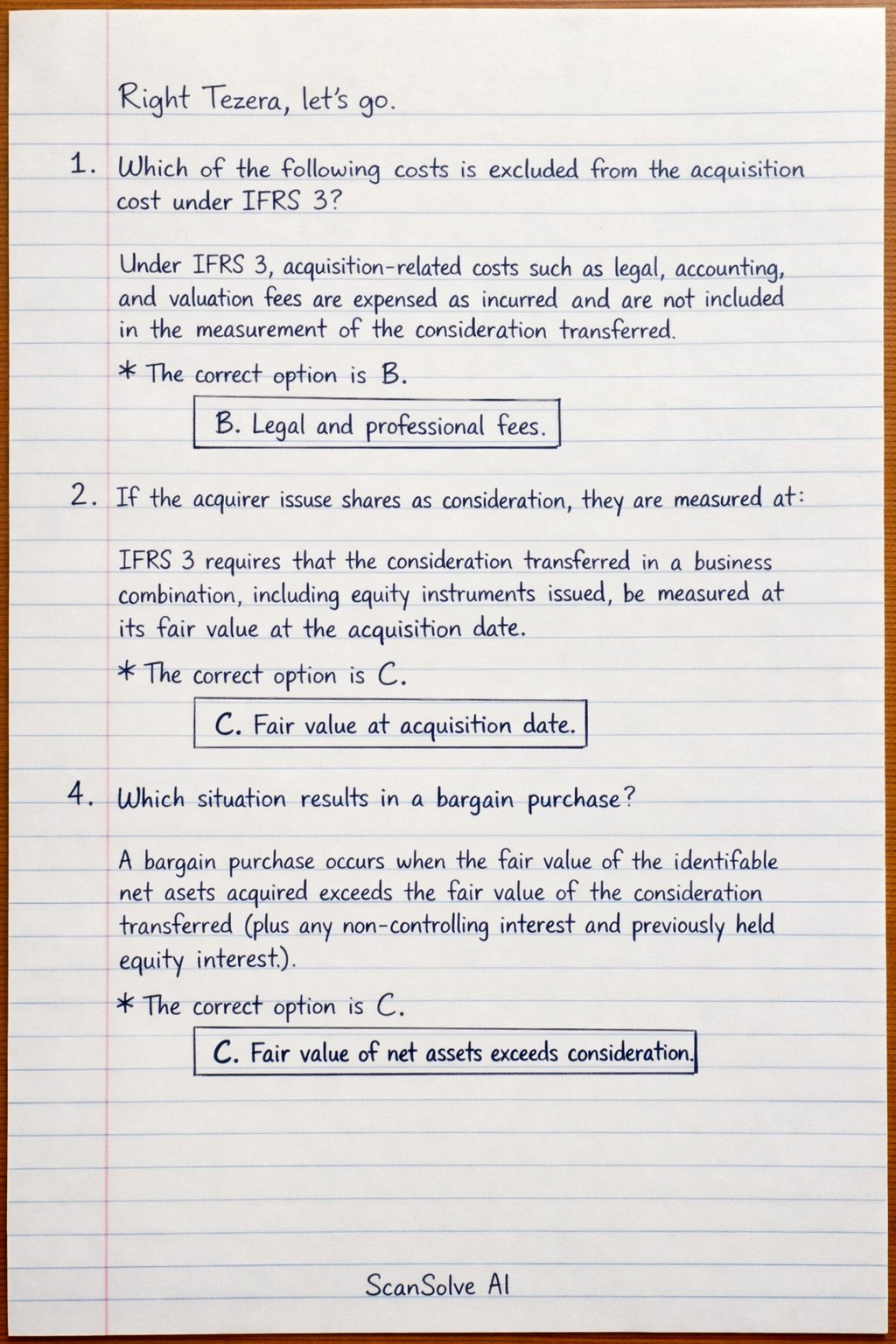
Handwritten Step-by-Step Solution
Get this as a handwritten image on WhatsApp — like a tutor wrote it for you.
Try on WhatsApp