

This accounting problem is solved step by step below, with detailed explanations to help you understand the method and arrive at the correct answer.
ScanSolve AI Answer
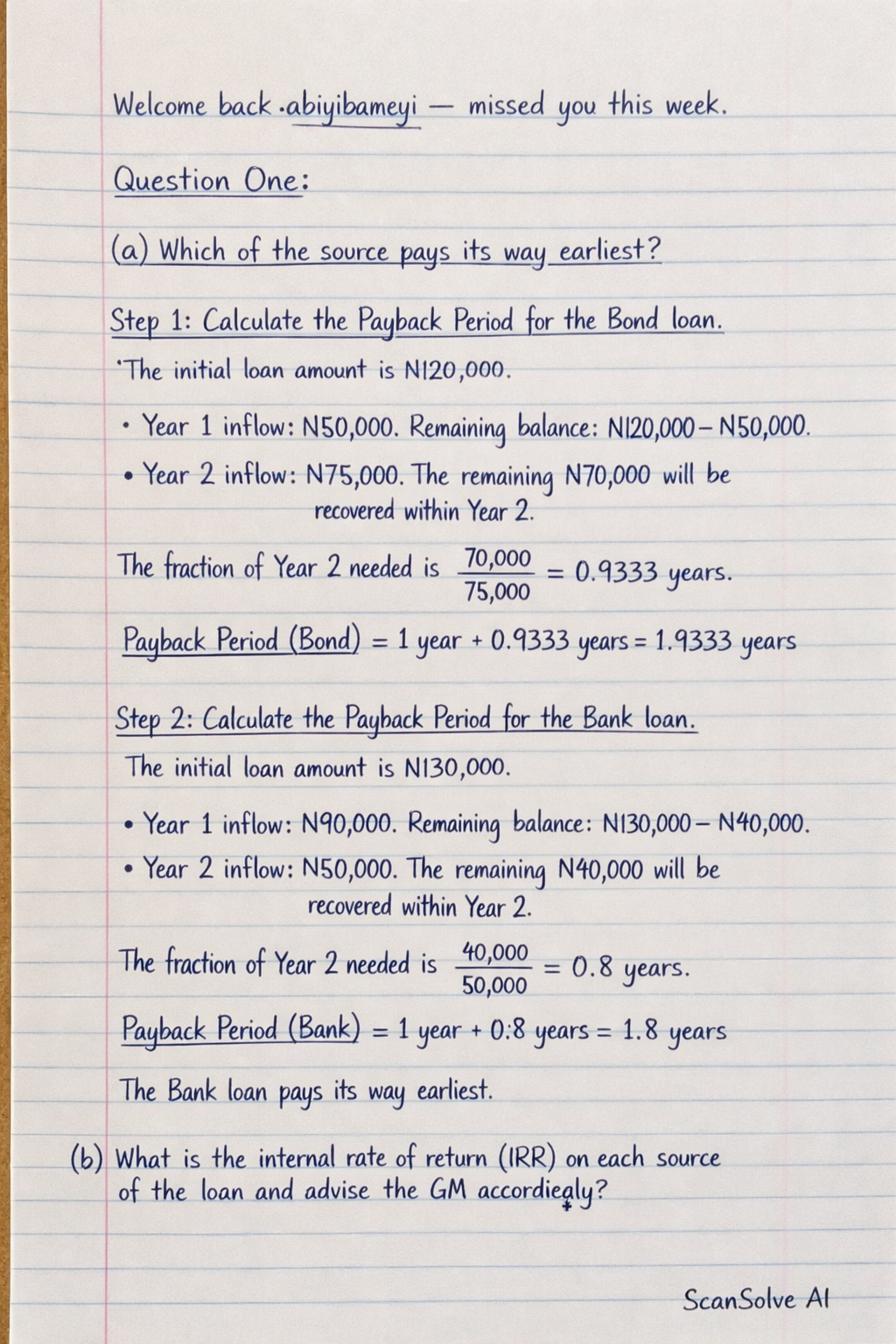
Question One: a) Which of the source pays its way earliest? Step 1: Calculate the Payback Period for the Bond loan. The initial loan amount is N120,000. • Year 1 inflow: N50,000. Remaining balance: N120,000 - N50,000 = N70,000. • Year 2 inflow: N75,000. The remaining N70,000 will be recovered within Year 2. The fraction of Year 2 needed is (70,000)/(75,000) ≈ 0.9333 years. Payback Period (Bond) = 1 year + 0.9333 years = 1.9333 years Step 2: Calculate the Payback Period for the Bank loan. The initial loan amount is N130,000. • Year 1 inflow: N90,000. Remaining balance: N130,000 - N90,000 = N40,000. • Year 2 inflow: N50,000. The remaining N40,000 will be recovered within Year 2. The fraction of Year 2 needed is (40,000)/(50,000) = 0.8 years. Payback Period (Bank) = 1 year + 0.8 years = 1.8 years The Bank loan pays its way earliest. b) What is the internal rate of return (IRR) on each source of the loan and advise the GM accordingly? Step 3: Calculate the Internal Rate of Return (IRR) for the Bond loan. The IRR is the discount rate at which the Net Present Value (NPV) of cash flows is zero. Initial Outflow (CF_0): -N120,000 Cash Inflows: CF_1 = N50,000, CF_2 = N75,000, CF_3 = N80,000. Using trial and error with 25% and 30%: At r = 25\%: NPV_25\% = -120,000 + (50,000)/((1+0.25)^1) + (75,000)/((1+0.25)^2) + (80,000)/((1+0.25)^3) NPV_25\% = -120,000 + 40,000 + 48,000 + 40,960 = N8,960 At r = 30\%: NPV_30\% = -120,000 + (50,000)/((1+0.30)^1) + (75,000)/((1+0.30)^2) + (80,000)/((1+0.30)^3) NPV_30\% = -120,000 + 38,461.54 + 44,378.70 + 36,413.29 = -N746.47 Using interpolation: IRR_Bond = 0.25 + (8,960)/(8,960 - (-746.47)) (0.30 - 0.25) IRR_Bond = 0.25 + (8,960)/(9,706.47) (0.05) ≈ 0.25 + 0.046155 ≈ 0.296155 IRR_Bond = 29.62\% Step 4: Calculate the Internal Rate of Return (IRR) for the Bank loan. Initial Outflow (CF_0): -N130,000 Cash Inflows: CF_1 = N90,000, CF_2 = N50,000, CF_3 = N60,000. Using trial and error with 25% and 30%: At r = 25\%: NPV_25\% = -130,000 + (90,000)/((1+0.25)^1) + (50,000)/((1+0.25)^2) + (60,000)/((1+0.25)^3) NPV_25\% = -130,000 + 72,000 + 32,000 + 30,720 = N4,720 At r = 30\%: NPV_30\% = -130,000 + (90,000)/((1+0.30)^1) + (50,000)/((1+0.30)^2) + (60,000)/((1+0.30)^3) NPV_30\% = -130,000 + 69,230.77 + 29,585.79 + 27,309.97 = -N3,873.47 Using interpolation: IRR_Bank = 0.25 + (4,720)/(4,720 - (-3,873.47)) (0.30 - 0.25) IRR_Bank = 0.25 + (4,720)/(8,593.47) (0.05) ≈ 0.25 + 0.0274625 ≈ 0.2774625 IRR_Bank = 27.75\% Step 5: Advise the GM. The Internal Rate of Return (IRR) for the Bond loan is 29.62%, and for the Bank loan is 27.75%. The cost of borrowing in the capital market is stated as 25% and 30%. • If the cost of borrowing is 25%: Both the Bond (IRR 29.62%) and the Bank loan (IRR 27.75%) are acceptable, as their IRRs are greater than 25%. However, the Bond loan is preferred because it offers a higher return. • If the cost of borrowing is 30%: Neither the Bond loan (IRR 29.62%) nor the Bank loan (IRR 27.75%) is acceptable, as their IRRs are less than 30%. Based on the higher IRR, the Bond loan is financially more attractive if the project is viable. Question Two: a) Explain the meaning of stores in relation to Public Sector Accounting? In Public Sector Accounting, stores refer to tangible assets held by government entities or public organizations. These assets are intended for use in the provision of public goods and services, for administrative purposes, or for distribution. They encompass a wide range of items, from raw materials and supplies to finished goods and equipment. b) Note with relevant examples on the following: • (i) Non-expendable stores: These are items that are not consumed in a single use and have a relatively long useful life. They retain their identity over time and can be reused. Examples:* Office furniture (e.g., desks, chairs), computers, vehicles. • (ii) Expendable stores: These are items that are consumed or used up in a single use or have a short useful life. Once used, they lose their original form or identity. Examples:* Stationery (e.g., pens, paper), cleaning supplies (e.g., detergents, mops), fuel. • (iii) Consumable stores: These are items that are consumed in the process of providing services or producing goods and need regular replenishment. This category often overlaps with expendable stores, focusing on items directly used up in operations. Examples:* Medicines in a public clinic, food items in a government-run cafeteria, raw materials for a public workshop. c) State the duties of a storekeeper during receipt and keeping of stores. During Receipt of Stores: • Verify the quantity and quality of goods received against the purchase order and delivery note. • Inspect goods for any damage, defects, or discrepancies before acceptance. • Prepare and issue a Goods Received Note (GRN) to acknowledge receipt and document the condition of the items. • Arrange for the prompt and appropriate storage of the received items. During Keeping of Stores: • Ensure proper organization and systematic arrangement of stores for easy identification, retrieval, and efficient space utilization. • Maintain accurate and up-to-date stock records, such as bin cards and stock ledgers, reflecting all movements of goods. • Implement security measures to protect stores from theft, damage, deterioration, or obsolescence. • Issue stores only upon receipt of duly authorized requisition forms and ensure proper documentation of all issues.