
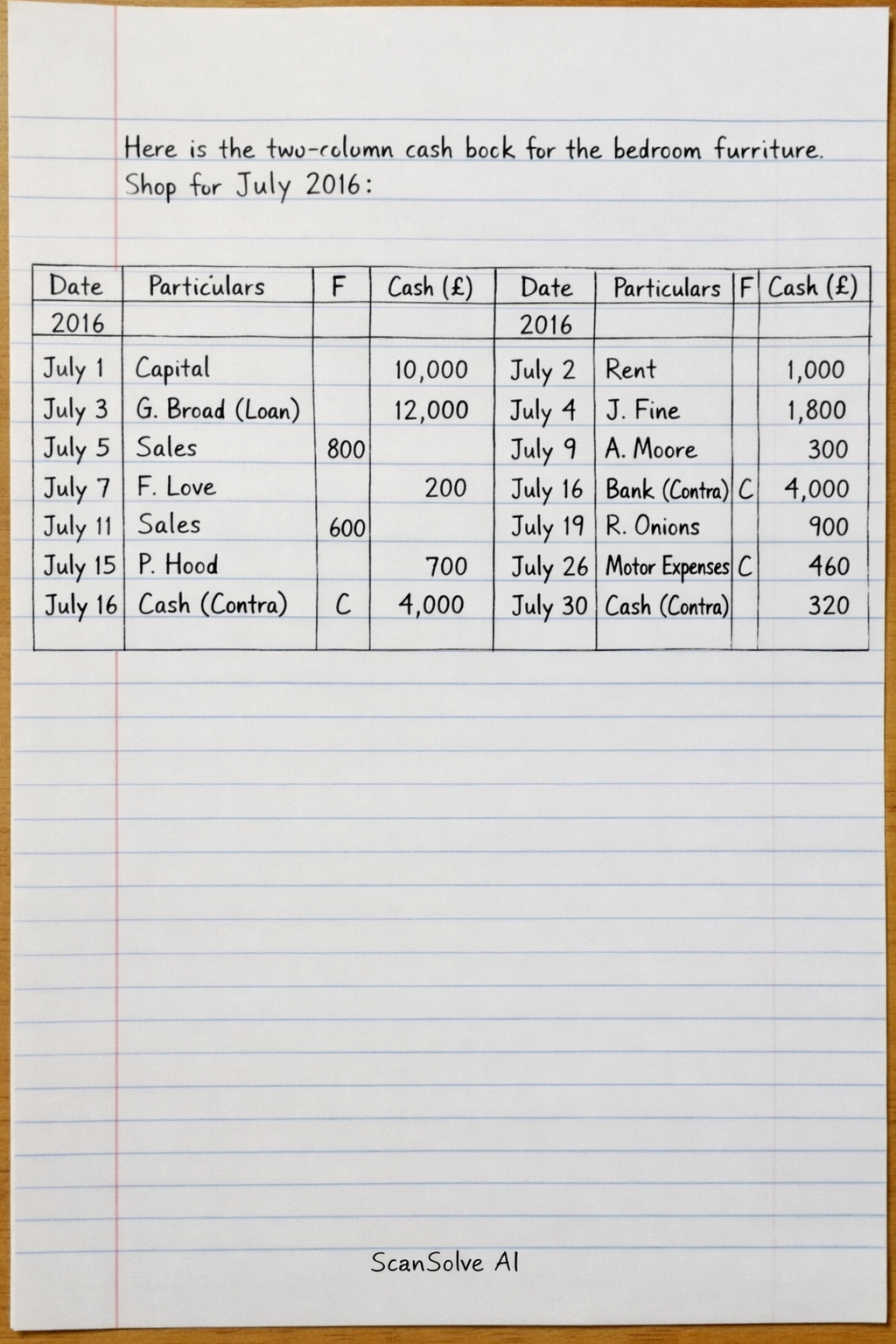
We read your photo as:
Prepare a two-column cash book for the bedroom furniture shop for July 2016.
Accounting
ScanSolve AI Answer
Here is the two-column cash book for the bedroom furniture shop for July 2016:
-
Explanation of entries:
- Debit side (Receipts): All money received, whether in cash or directly into the bank, is recorded here. Contra entries (C) indicate transfers between the cash and bank accounts within the business.
- Credit side (Payments): All money paid out, whether in cash or by cheque from the bank, is recorded here. Contra entries (C) also appear here for transfers.
- Balance c/d (carried down): This is the closing balance for the month, calculated as total debits minus total credits for each column. It is placed on the side with the smaller total to make both sides equal.
- Balance b/d (brought down): This is the opening balance for the next month, which is the same as the closing balance from the previous month, but recorded on the opposite side (debit side for positive balances).
-
Calculations for balances:
- Cash Column:
- Total Debits:
- Total Credits:
- Balance c/d:
- Bank Column:
- Total Debits:
- Total Credits:
- Balance c/d:
- Cash Column:
Was this helpful?
Still stuck on this one?
Ask a follow-up, and the answer starts from this question.
Got a different question?Ask your own question
More Accounting Questions
QPrepare a Two-Column Cash Book for September 2025.QPrepare a Two-Column Cash Book for the month of September 2025.QPrepare a double column cash book for SUMSASUM Ltd. for May 20X5.QPrepare a duly balanced three column cash book to record the above transactions.QPrepare a Two-Column Cash Book for September 2025, showing all entries and balancing it.
Handwritten Step-by-Step Solution
Get this as a handwritten image on WhatsApp — like a tutor wrote it for you.
Try on WhatsApp