
We read your photo as:
Prepare (i) a production budget for each of the four months, October to January year 5, (ii) a purchases budget for raw materials for each of the three months, October to December year 5. Explain how a flexible budgeting control system works.
ScanSolve AI Answer
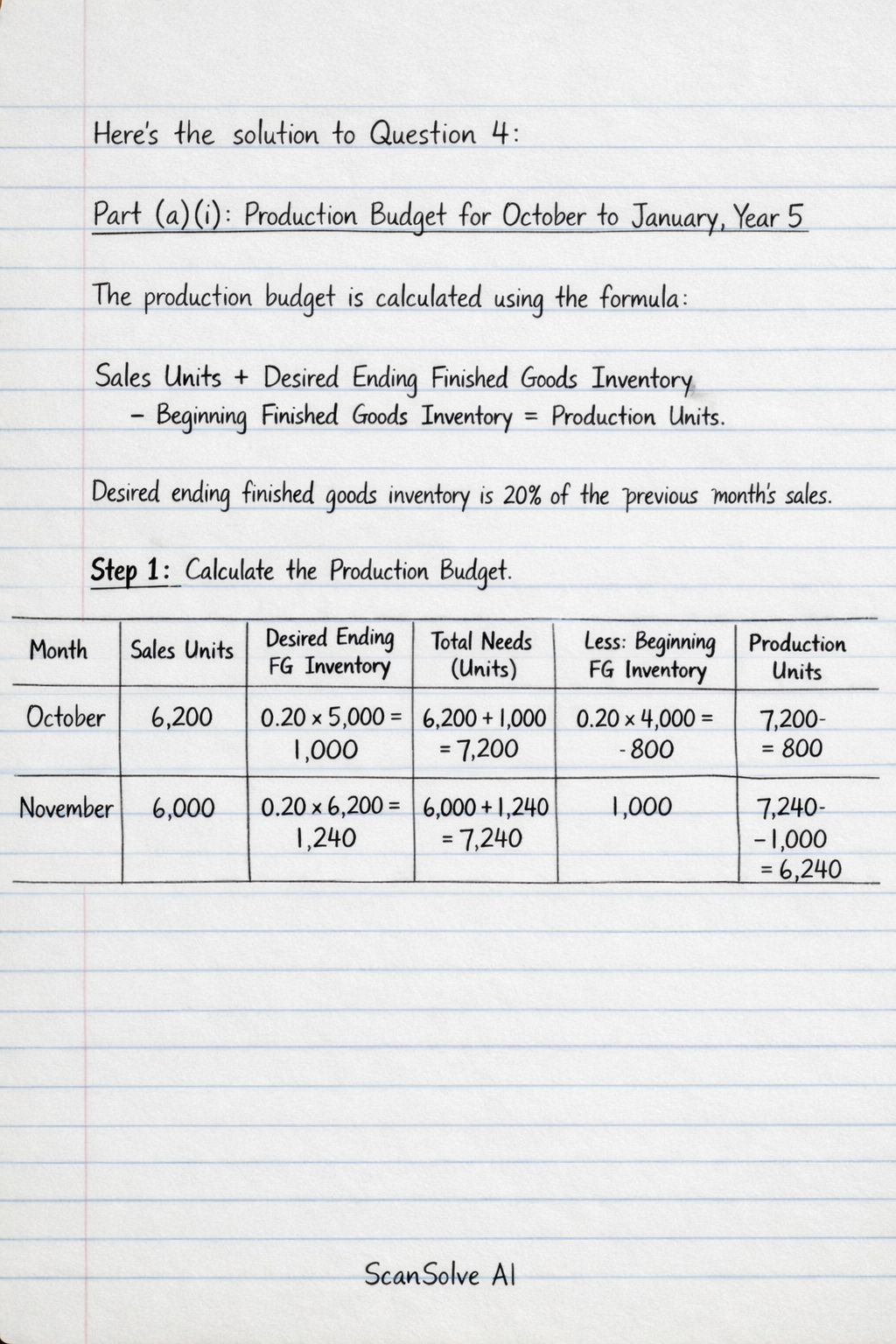
Here's the solution to Question 4:
Part (a)(i): Production Budget for October to January, Year 5
The production budget is calculated using the formula:
Sales Units + Desired Ending Finished Goods Inventory - Beginning Finished Goods Inventory = Production Units.
Desired ending finished goods inventory is 20% of the previous month's sales.
- Step 1: Calculate the Production Budget.
| Month | Sales Units | Desired Ending FG Inventory (Units) | Total Needs (Units) | Less: Beginning FG Inventory (Units) | Production Units |
|---|---|---|---|---|---|
| October | 6,200 | ||||
| November | 6,000 | 1,000 | |||
| December | 6,500 | 1,240 | |||
| January | 6,800 | 1,200 |
Part (a)(ii): Purchases Budget for Raw Materials for October to December, Year 5
Each unit requires 1.5 kg of raw materials. Raw materials are purchased one month before they are needed for production. Ending raw materials inventory is 10% of the next month's production requirements.
-
Step 2: Calculate Raw Materials Needed for Production (in kg).
- October:
- November:
- December:
- January:
-
Step 3: Calculate Raw Materials Inventory (in kg).
- Beginning October (End September):
- Ending October (Beginning November):
- Ending November (Beginning December):
- Ending December (Beginning January):
-
Step 4: Prepare the Raw Materials Purchases Budget. Since raw materials are purchased one month before they are needed, the purchases in a given month are primarily for the next month's production. The cost of raw materials is $2.00 per kg.
| Month of Purchase | Raw Materials Needed for Next Month's Production (kg) | Desired Ending RM Inventory (kg) | Total Needs (kg) | Less: Beginning RM Inventory (kg) | Raw Materials to be Purchased (kg) | Cost of Purchases ($) |
|---|---|---|---|---|---|---|
| October | 9,360 (for Nov) | 936 (End Oct) | 960 (Beg Oct) | 9,336 \times \2.00 = $18,672$ | ||
| November | 9,690 (for Dec) | 969 (End Nov) | 936 (Beg Nov) | 9,723 \times \2.00 = $19,446$ | ||
| December | 10,350 (for Jan) | 1,035 (End Dec) | 969 (Beg Dec) | 10,416 \times \2.00 = $20,832$ |
Part (b): Explain how a flexible budgeting control system works.
- Step 5: Explain Flexible Budgeting. A flexible budgeting control system adjusts the budget to the actual level of activity achieved, rather than comparing actual results to a static budget based on a single planned activity level. This allows managers to evaluate performance more accurately by separating variances caused by changes in activity volume from those caused by cost control or efficiency. It helps in identifying whether cost deviations are due to higher or lower activity than planned, or due to effective or ineffective management of costs.
Still stuck on this one?
Ask a follow-up, and the answer starts from this question.
More Accounting Questions
Handwritten Step-by-Step Solution
Get this as a handwritten image on WhatsApp — like a tutor wrote it for you.
Try on WhatsApp