

This accounting problem is solved step by step below, with detailed explanations to help you understand the method and arrive at the correct answer.
ScanSolve AI Answer
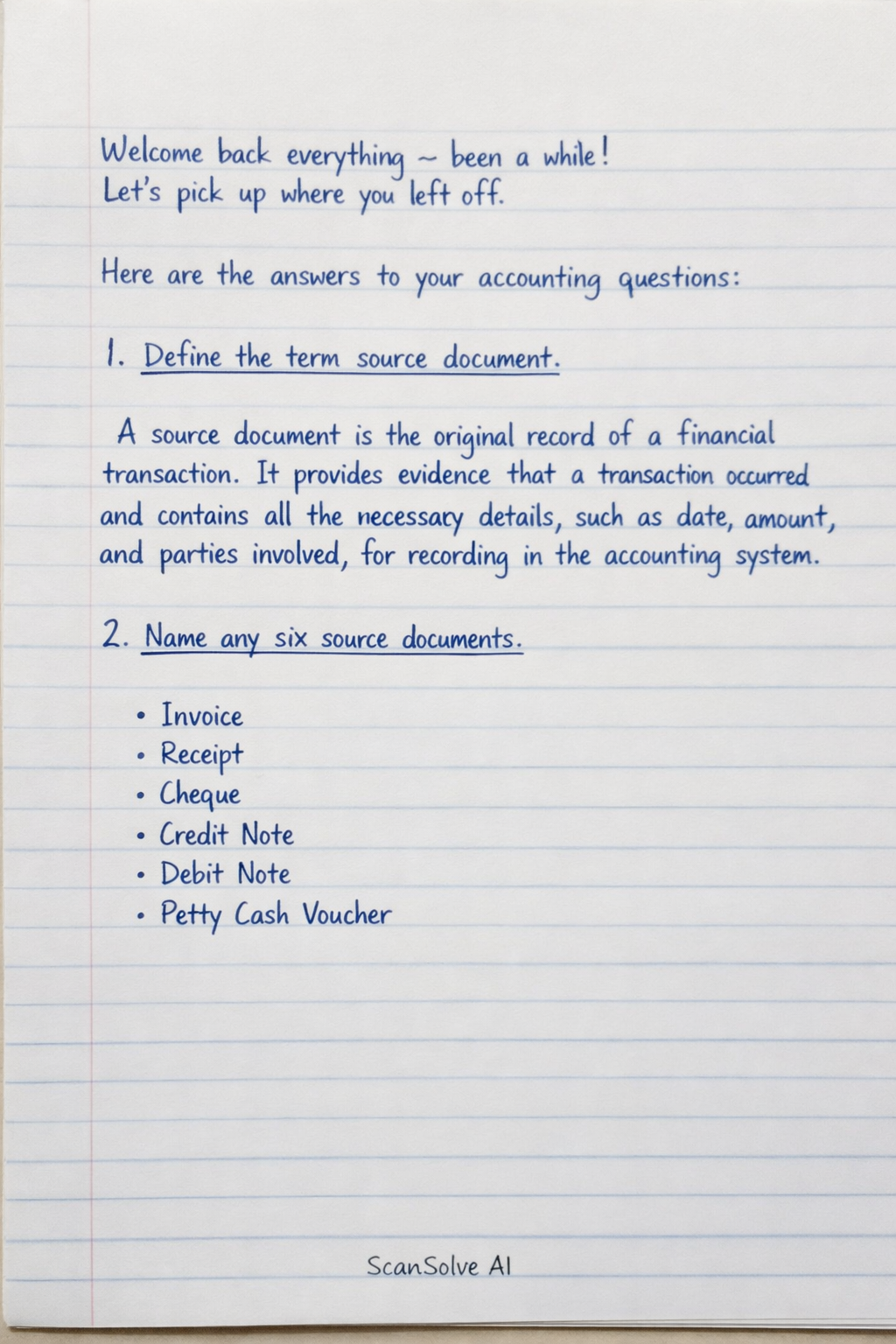
Here are the answers to your accounting questions: 1. Define the term source document. A source document is the original record of a financial transaction. It provides evidence that a transaction occurred and contains all the necessary details, such as date, amount, and parties involved, for recording in the accounting system. 2. Name any six source documents. Invoice Receipt Cheque Credit Note Debit Note Petty Cash Voucher 3. For each source document named in (b) above, describe when it is used. Invoice: Used when goods or services are bought or sold on credit. A sales invoice is issued by the seller, and a purchase invoice* is received by the buyer. Receipt*: Issued by the seller to the buyer as proof of cash payment received for goods or services. Cheque: Used by a payer to instruct a bank to pay a specific amount of money from their account to a payee. The cheque counterfoil or stub* serves as the source document for the payer. Credit Note*: Issued by a seller to a buyer to acknowledge a reduction in the amount owed, typically due to returned goods, damaged goods, or overcharges. Debit Note*: Issued by a buyer to a seller to request a credit note for goods returned or overcharged. It can also be issued by a seller to increase the amount owed by a customer (less common). Petty Cash Voucher*: Used to record small cash payments made from the petty cash fund within a business. 4. Name the source document used for each of the cases below: Bought goods for reselling on credit from DZ Wholesalers: Purchase Invoice* Paid A. Rashid, a supplier by cheque 120: Cheque Counterfoil (or Cheque Stub*) Bought stationery for use in the business on credit from Jayman Stationers: Purchase Invoice* Sold goods on credit to a customer, F. Lungu: Sales Invoice* M. Mpofu returned some goods to us: Credit Note* Cash sales for 120: Cash Register Slip (or Receipt*) Paid for rent using petty cash: Petty Cash Voucher* 5. Name the source documents used in each of the transactions below: February 1: Sold goods on credit 1,000 to A. Lachman: Sales Invoice* February 2: Sold goods for 400 cash: Cash Register Slip (or Receipt*) February 7: Paid for electricity by cash 210: Receipt (from electricity company) or Cash Voucher* February 11: Paid for travelling costs from petty cash 90: Petty Cash Voucher* February 13: Received faulty goods previously sold to A. Sibanda: Credit Note* February 17: Returned wrongly supplied goods to H. Dhana Stores: Debit Note* February 24: Bought a motor van on credit $700 from W. Dube: Purchase Invoice* Drop the next question! 📸