
We read your photo as:
What are the cost drivers and cost driver rates for material procurement, general accounting, and quality control?
ScanSolve AI Answer
Step-by-step solution
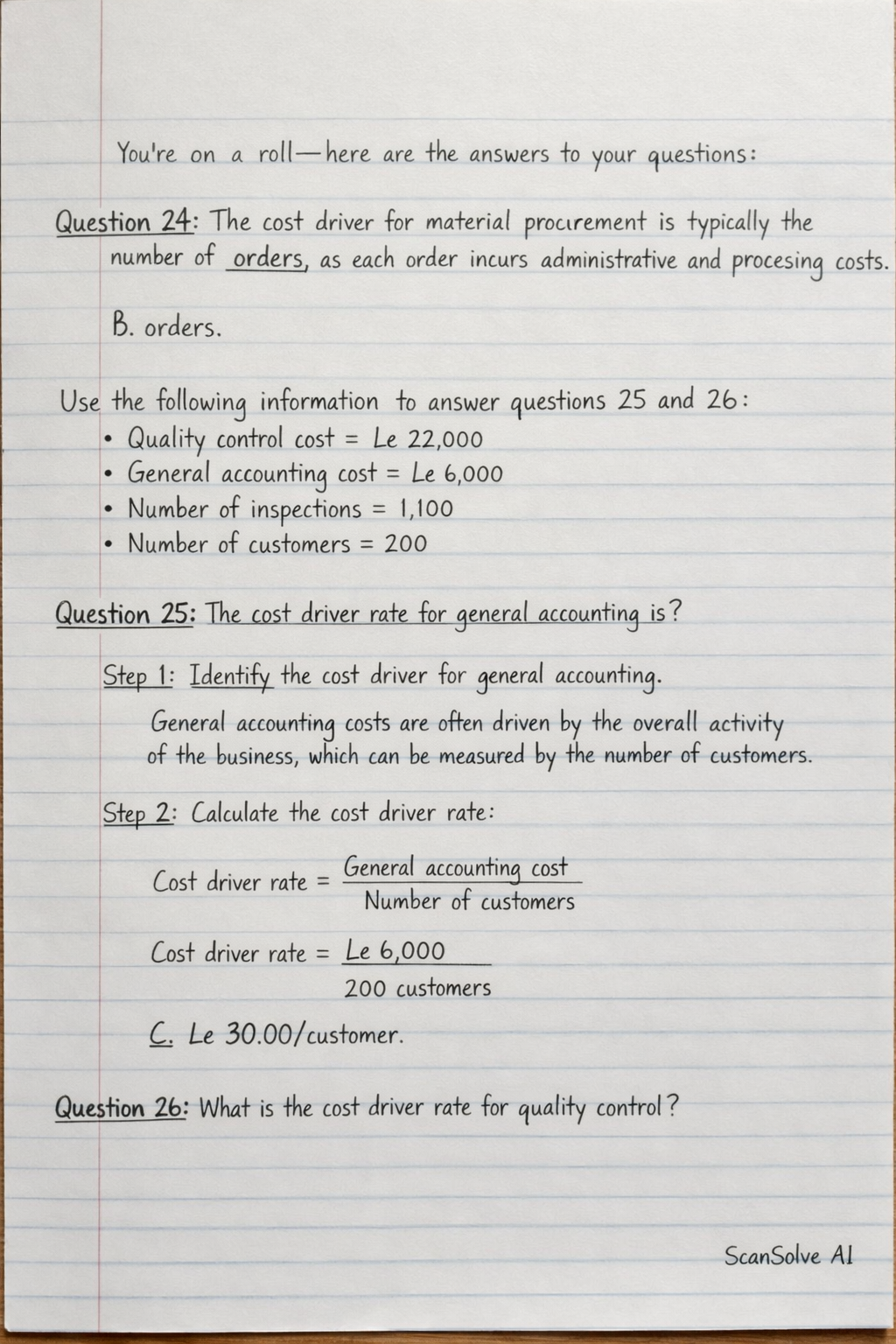
7 stepshere are the answers to your questions:
Part 24
The cost driver for material procurement is typically the number of orders, as each order incurs administrative and processing costs.
- B. orders.
Use the following information to answer questions 25 and 26:
- Quality control cost = Le 22,000
- General accounting cost = Le 6,000
- Number of inspections = 1,100
- Number of customers = 200
Part 25· 2 steps
The cost driver rate for general accounting is?
Identify the cost driver for general accounting.
General accounting costs are often driven by the overall activity of the business, which can be measured by the number of customers.
Calculate the cost driver rate.
- C. Le 30.00/customer.
Part 26· 2 steps
What is the cost driver rate for quality control?
Identify the cost driver for quality control.
Quality control costs are directly related to the effort spent on ensuring quality, which is measured by the number of inspections.
Calculate the cost driver rate.
- B. Le 20.00/inspection.
Part 27
Companies that exist to provide meals to their clients use service costing, as they are providing an intangible service rather than manufacturing a physical product.
- D. service costing.
Use the data below to answer questions 28 to 30:
- Units introduced into process = 5,000 units for GH¢ 30,000
- Actual production = 4,800 units for GH¢ 52,800
- Normal loss = 5%
Part 28· 1 step
Calculate the normal loss for the process.
Calculate the normal loss units.
Normal loss is a percentage of the units introduced into the process.
- C. 250 units
Part 29· 2 steps
Production in the process resulted in
Calculate the expected output.
Expected output is the units introduced minus the normal loss units.
Determine if there is an abnormal loss or gain.
Compare the actual production with the expected output.
Since actual production
Still stuck on this one?
Ask a follow-up, and the answer starts from this question.
More Accounting Questions
Handwritten Step-by-Step Solution
Get this as a handwritten image on WhatsApp — like a tutor wrote it for you.
Try on WhatsApp