
We read your photo as:
What are the ethical considerations for handling cash, security features of banknotes, types of register reads, and risks of leaving cash unsecured?
ScanSolve AI Answer
Answer
Step-by-step solution
3 stepsHere are the answers to the scenarios:
11. Scenario:
Putting the K50 note directly into your personal pocket violates workplace ethics because all money received, even if intended as a tip or "keep the change," must be processed through the company's point-of-sale (POS) system and recorded as revenue. This ensures accurate accounting, prevents fraud, and maintains transparency and trust within the business.
12. Scenario:
Two distinct physical security features on a high-value banknote that you can check to verify its authenticity are:
- A watermark, which is an image or pattern embedded in the paper that is visible when held up to the light.
- A security thread, a thin strip embedded in the paper, often with microprinting, that is also visible when held to the light and may glow under UV light.
13. Scenario:
An X-Read provides a snapshot of the current sales and cash totals in the register without clearing the data, allowing for mid-shift checks. A Z-Read, performed at the end of a trading day, finalizes the sales data, resets the register totals to zero, and provides a comprehensive report for daily reconciliation.
14. Scenario:
It is dangerous to leave K4,000 in cash in the desk drawer overnight due to the high risk of theft or burglary, which could result in significant financial loss for the resort. This cash should be securely deposited in a locked safe or a secure night deposit box at a bank, following the resort's established cash handling procedures.
15. Scenario:
Identify the amount to be converted and the exchange rate.
The cost is K150, and the exchange rate is 1 USD = K3.80.
Convert Kina to USD.
To find out how many USD K150 is worth, divide the Kina amount by the exchange rate.
Round up to the nearest whole dollar.
Since the tourist needs to cover the bill, and the calculated amount is 40.
The tourist needs to give:
Try one yourself
A new problem that tests the same skill.
Still stuck on this one?
Ask a follow-up, and the answer starts from this question.
More Accounting Questions
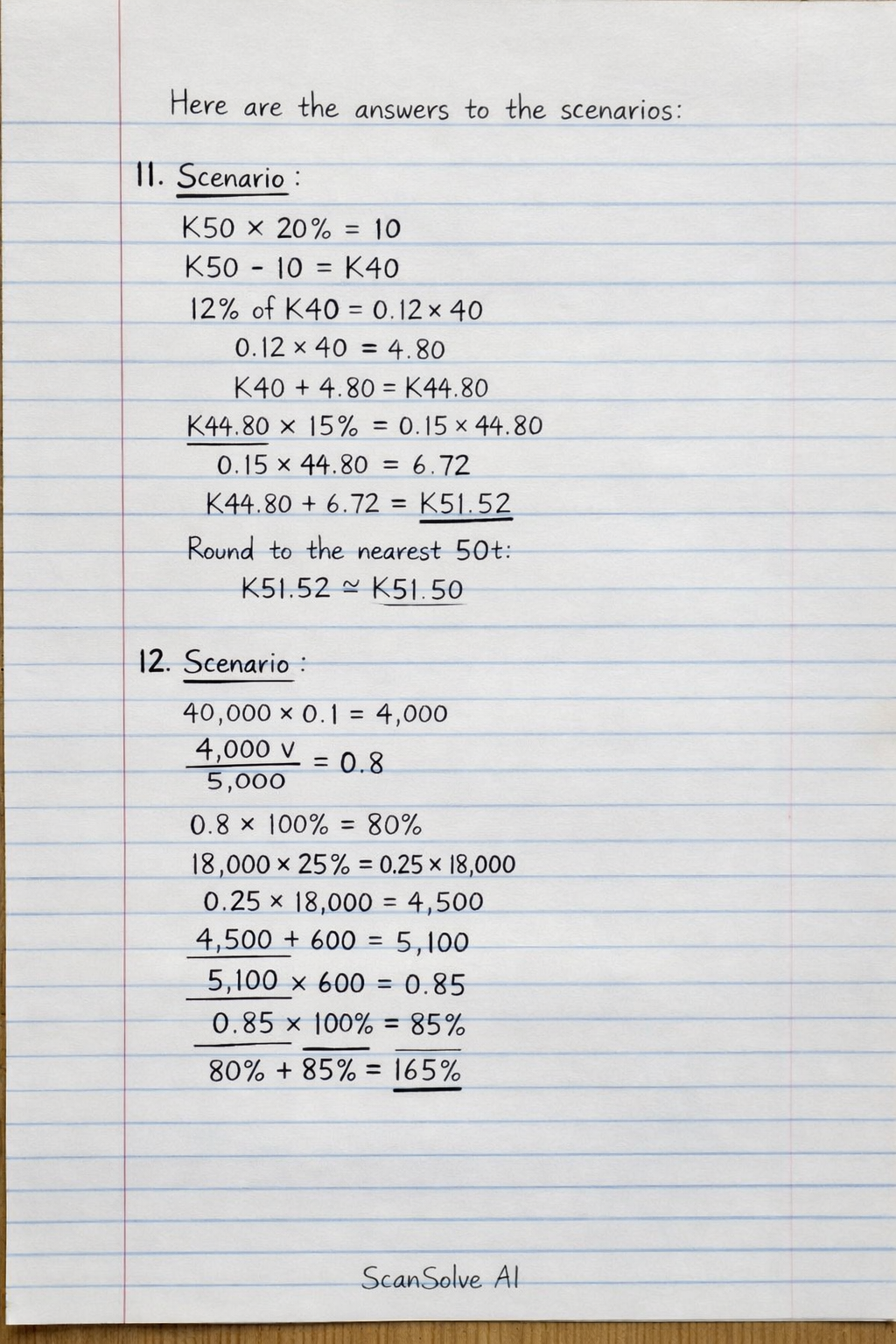
Handwritten Step-by-Step Solution
Get this as a handwritten image on WhatsApp — like a tutor wrote it for you.
Try on WhatsApp