
We read your photo as:
Use the tables of cubes to find the cube root of the following 654.8.
ScanSolve AI Answer
Step-by-step solution
11 stepsHere are the solutions to the problems:
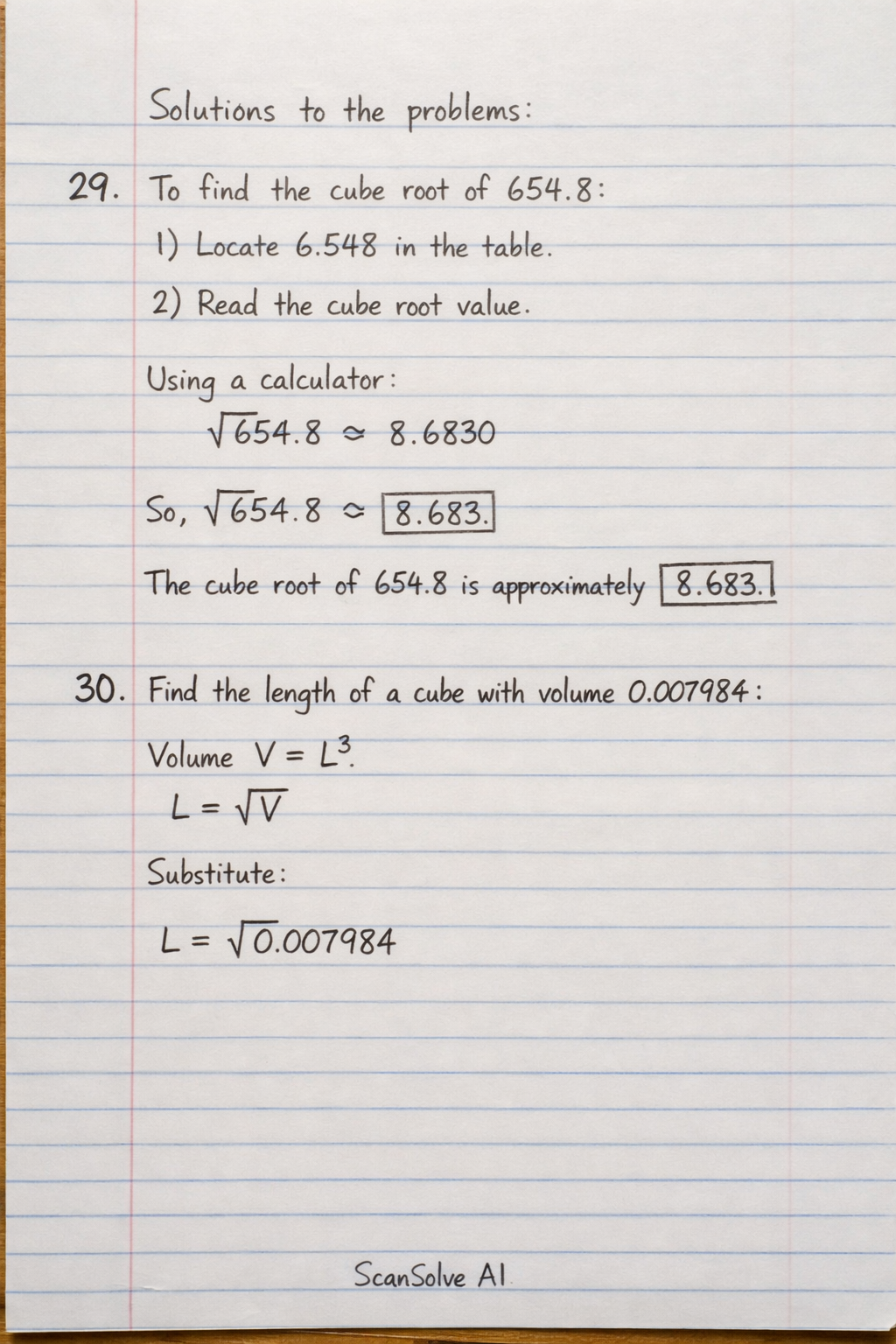
29. Use the tables of cubes to find the cube root of the following 654.8.
To find the cube root of 654.8 using mathematical tables:
Locate the number 654.8 in the "number" column of the cube root table.
If the table is for numbers and their cube roots , you would look for 6.548 and adjust the decimal.
Read the corresponding value in the "cube root" column.
Since I do not have access to a physical mathematical table, I will provide the value obtained using a calculator, which approximates the result you would get from a sufficiently detailed table.
Using a calculator:
The cube root of 654.8 is approximately .
30. The volume of a cube was 0.007984 using mathematical table, find its length.
The volume of a cube with side length is given by the formula .
To find the length , we need to calculate the cube root of the volume: .Substitute the given volume into the formula.
To use a mathematical table for cube roots, you would typically adjust the number to be between 1 and 1000, find its cube root, and then adjust the decimal place.
For example, . Then . You would look up in the table and then multiply by 0.1.
Since I do not have access to a physical mathematical table, I will provide the value obtained using a calculator.
The length of the cube is approximately .
31. a) Construct a parallelogram WXYZ such that WX = 7cm, WZ = 5cm, .
To construct the parallelogram WXYZ:
Draw a line segment WX of length 7 cm.
At point X, use a protractor to construct an angle of with WX.
Along the arm of the angle from X, mark point Y such that XY = 5 cm (since opposite sides of a parallelogram are equal, XY = WZ).
From point W, draw an arc with a radius of 5 cm (length of WZ).
From point Y, draw an arc with a radius of 7 cm (length of YZ, which is equal to WX).
The intersection of the arcs from Step 4 and Step 5 is point Z.
Join WZ and YZ to complete the parallelogram WXYZ.
Still stuck on this one?
Ask a follow-up, and the answer starts from this question.
More Biology Questions
Handwritten Step-by-Step Solution
Get this as a handwritten image on WhatsApp — like a tutor wrote it for you.
Try on WhatsApp