

This biology question covers important biological concepts and processes. The step-by-step explanation below helps you understand the underlying mechanisms and reasoning.
ScanSolve AI Answer
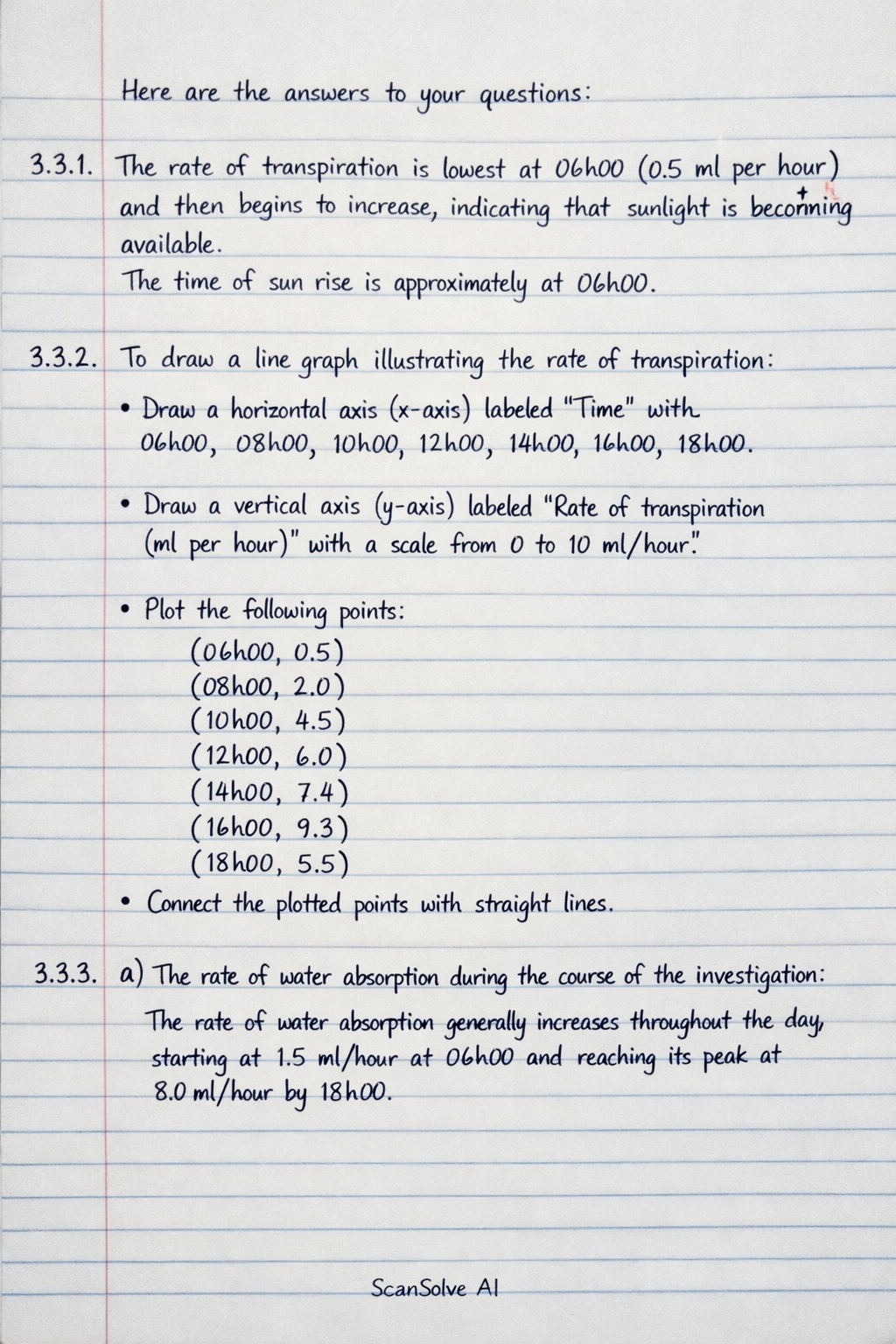
Here are the answers to your questions: 3.3.1. The rate of transpiration is lowest at 06h00 (0.5 ml per hour) and then begins to increase, indicating that sunlight is becoming available. The time of sun rise is approximately at 06h00. 3.3.2. To draw a line graph illustrating the rate of transpiration: • Draw a horizontal axis (x-axis) labeled "Time" with intervals for 06h00, 08h00, 10h00, 12h00, 14h00, 16h00, and 18h00. • Draw a vertical axis (y-axis) labeled "Rate of transpiration (ml per hour)" with an appropriate scale (e.g., from 0 to 10 ml/hour). • Plot the following points: (06h00, 0.5) (08h00, 2.0) (10h00, 4.5) (12h00, 6.0) (14h00, 7.4) (16h00, 9.3) (18h00, 5.5) • Connect the plotted points with straight lines. 3.3.3. a) The rate of water absorption during the course of the investigation: The rate of water absorption generally increases throughout the day, starting at 1.5 ml/hour at 06h00 and reaching its peak at 8.0 ml/hour by 18h00. b) The rate of transpiration during the course of the investigation: The rate of transpiration increases from 06h00, reaching a maximum of 9.3 ml/hour at 16h00, and then decreases to 5.5 ml/hour by 18h00. 3.3.4. Five steps required before the investigation can commence: 1. Select a healthy leafy shoot. 2. Cut the shoot underwater to prevent air bubbles from entering the xylem. 3. Assemble the potometer apparatus. 4. Fill the potometer with water, ensuring no air bubbles are present. 5. Insert the cut shoot into the potometer, ensuring a watertight seal. 3.3.5. Two precautions when measuring the rate of transpiration using a potometer: • Cut the shoot underwater: This prevents air from entering the xylem vessels. If air enters, it can form an airlock, blocking the continuous column of water and stopping water transport. • Ensure all connections are airtight: Leaks in the apparatus would allow water to escape or air to enter, leading to inaccurate measurements of water uptake by the plant. 3.3.6. The leafy shoot should be cut underwater to prevent air bubbles from entering the xylem vessels. If air enters the xylem, it can form an airlock (embolism) that breaks the continuous column of water, thereby blocking water transport to the leaves and affecting the rate of transpiration. Send me the next one 📸