
We read your photo as:
State FOUR differences between plant and animal cells. (4 marks)
ScanSolve AI Answer
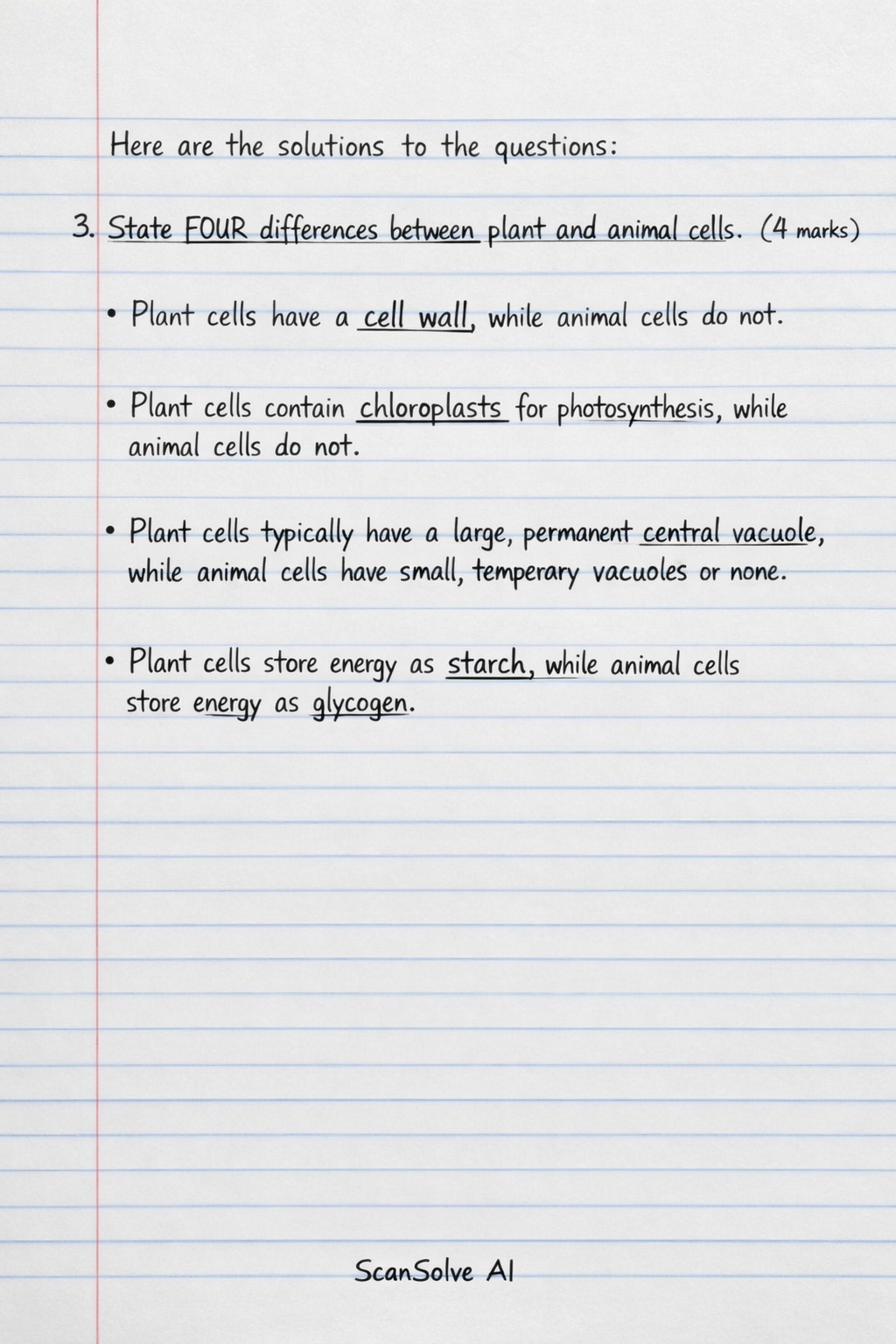
Here are the solutions to the questions:
3. State FOUR differences between plant and animal cells. (4 marks)
- Plant cells have a cell wall, while animal cells do not.
- Plant cells contain chloroplasts for photosynthesis, while animal cells do not.
- Plant cells typically have a large, permanent central vacuole, while animal cells have small, temporary vacuoles or none.
- Plant cells store energy as starch, while animal cells store energy as glycogen.
4. A community near Lake Victoria is experiencing an increasing water-borne disease, crop failure due to pests and poor waste management.
- a) Define Biology. (2 marks) Biology is the scientific study of life and living organisms, including their structure, function, growth, origin, evolution, and distribution.
- b) Outline four characteristics of living things. (4 marks)
- Nutrition (feeding)
- Respiration (gas exchange and energy release)
- Growth (increase in size and complexity)
- Reproduction (producing offspring)
- c) Using the situation above, explain three ways Biology can be applied to solve problems faced by the community. (3 marks)
- Water-borne disease: Biology helps identify the pathogens causing diseases, understand their transmission, and develop methods for water purification and disease prevention.
- Crop failure due to pests: Biological knowledge aids in developing pest-resistant crop varieties, implementing biological control methods, and designing effective pest management strategies.
- Poor waste management: Biology provides insights into decomposition processes, enabling the development of composting, bioremediation, and other sustainable waste treatment solutions.
- d) State 3 reasons why learning Biology is important to learners in everyday life. (3 marks)
- It helps in understanding human health, diseases, and promoting healthy lifestyles.
- It enables informed decision-making regarding environmental conservation and sustainable resource management.
- It provides knowledge about food production, nutrition, and the diversity of life around us.
5.
- a) Explain two ways in which study of Biology prepares learners for future career opportunities. (2 marks)
- It develops critical thinking, problem-solving, and analytical skills essential for scientific research and various professional fields.
- It provides foundational knowledge for careers in medicine, agriculture, environmental science, biotechnology, pharmacy, and education.
- b) State two Biology-related careers suitable for learners regardless of gender or disability. (2 marks)
- Doctor
- Environmental Scientist
6. Name two preservatives used in animal specimen preservation. (2 marks)
- Formalin (formaldehyde solution)
- Ethanol (alcohol)
7. Define Magnification. (2 marks)
Magnification is the process of enlarging the apparent size of an object, or the ratio of the apparent size of an object seen through a microscope (or other optical instrument) to its actual size.
8. Name 2 types of Microscope. (2 marks)
- Light microscope (or Compound microscope)
- Electron microscope
9. Identify 5 apparatus and in each case give its function. (10 marks)
- Test tube: Used to hold small amounts of liquids for reactions or heating.
- Beaker: Used for holding, mixing, and heating larger volumes of liquids.
- Measuring cylinder: Used for accurately measuring volumes of liquids.
- Petri dish: Used for culturing microorganisms or observing small specimens.
- Forceps: Used for grasping or holding small objects or specimens during dissection or manipulation.
10. What is a herbarium? (2 marks)
A herbarium is a collection of preserved plant specimens, typically dried and mounted on sheets, along with associated data such as collection date, location, and collector's name, used for scientific study and reference.
11. State 3 importance of collecting, processing and preserving biological specimens. (6 marks)
- Research and study: Provides material for scientific investigation, identification, and classification of organisms.
- Education: Serves as teaching aids to illustrate biological concepts, biodiversity, and anatomical structures.
- Conservation and documentation: Creates a permanent record of flora and fauna, aiding in biodiversity monitoring, tracking species distribution, and identifying endangered species.
12. Discuss why the following should be considered during collection of specimens:
- i) collect only the required specimens. (2 marks) This practice minimizes disturbance to the ecosystem and prevents unnecessary harm or depletion of species, promoting ethical collection and environmental sustainability.
- ii) Do not destroy the habitat of the specimen. (2 marks) Preserving the habitat ensures the continued survival of the species and the ecological balance of the area, preventing loss of biodiversity and ecosystem degradation.
13. Outline the functions of the following parts of a microscope:
- i) Eyepiece (2 marks) The eyepiece (or ocular lens) is the part through which the observer looks, containing lenses that further magnify the image formed by the objective lens.
- ii) Coarse adjustment knob (2 marks) This knob is used for large adjustments to focus the microscope, primarily for bringing the specimen into approximate focus under low power.
- iii) Condenser (2 marks) The condenser gathers and focuses light from the illuminator onto the specimen, improving the illumination and contrast of the image.
- iv) Mirror (2 marks) The mirror reflects light from an external source up through the diaphragm, specimen, and lenses, illuminating the specimen for viewing.
- v) Revolving nose-piece (2 marks) The revolving nose-piece holds the objective lenses and allows for easy rotation to switch between different magnifications.
Still stuck on this one?
Ask a follow-up, and the answer starts from this question.
More Biology Questions
Handwritten Step-by-Step Solution
Get this as a handwritten image on WhatsApp — like a tutor wrote it for you.
Try on WhatsApp